

Five days, and a result that points both ways
Berkshire Hathaway has published what it looks for in a business and has done since around 1983. Five things. Run that list against the two department stores this week has been taking apart and Dillard’s meets all five, while Macy’s meets one, fails three, and leaves one unproven. The company that satisfies every criterion is the one Berkshire has not bought and could not buy in any size that would register. The company it did buy does not satisfy them. And the prices run in the opposite direction to the scores, which is what makes this worth five days rather than five minutes.
First, a test set in June, settled
A piece published here in June left a specific test behind. The claim being checked was that the roughly 350 stores Macy’s is keeping are doing meaningfully better than the ones it is closing. The test: go-forward comparable sales at or above 2 percent for a second quarter, with the gap to the whole fleet still positive.
The quarter arrived on 10 September 2026. Go-forward comparable sales rose 2.8 percent and total company comparable sales rose 2.7 percent. The quarter before that, released 3 June 2026, was 3.1 and 3.0.
The test passed, twice. Above 2 percent, gap positive, both quarters.
Now the part that matters more than the pass.
The gap is one tenth of a percentage point. In both quarters. The claim was that the kept stores are doing meaningfully better. A tenth of a point is not meaningfully better. The test was looser than the claim it was meant to check, and a looser test is not a test.
There is a mechanical reason the gap is narrow, too. As the closure program finishes, closed stores drop out of the comparable base, so the two figures have to converge whatever the business does.
And the 2.8 percent is not coming from where the claim says it is. Macy’s own nameplate rose 1.1 percent in the quarter. The Reimagine 200 stores rose 1.9 percent. Bloomingdale’s rose 11.3 percent. The number is being carried by the luxury chain, not by the reimagined Macy’s stores the assumption was about.
Passed on the letter, failed on the substance, and the fault is in how the test was written.
The five criteria, and what they are
The buyer whose filing started this week has published what it looks for and has done since around 1983. Five things.
Demonstrated consistent earning power. Good returns on equity while employing little debt. Management in place. A simple business. And no turnarounds.
One caution carried all week. Those criteria were written for buying whole companies, not small stakes in listed shares. A $173.0 million position in a $299 billion book is not an acquisition. The list runs anyway, because it is the only published standard available, and it runs on both companies, because a checklist tested on one teaches nothing.
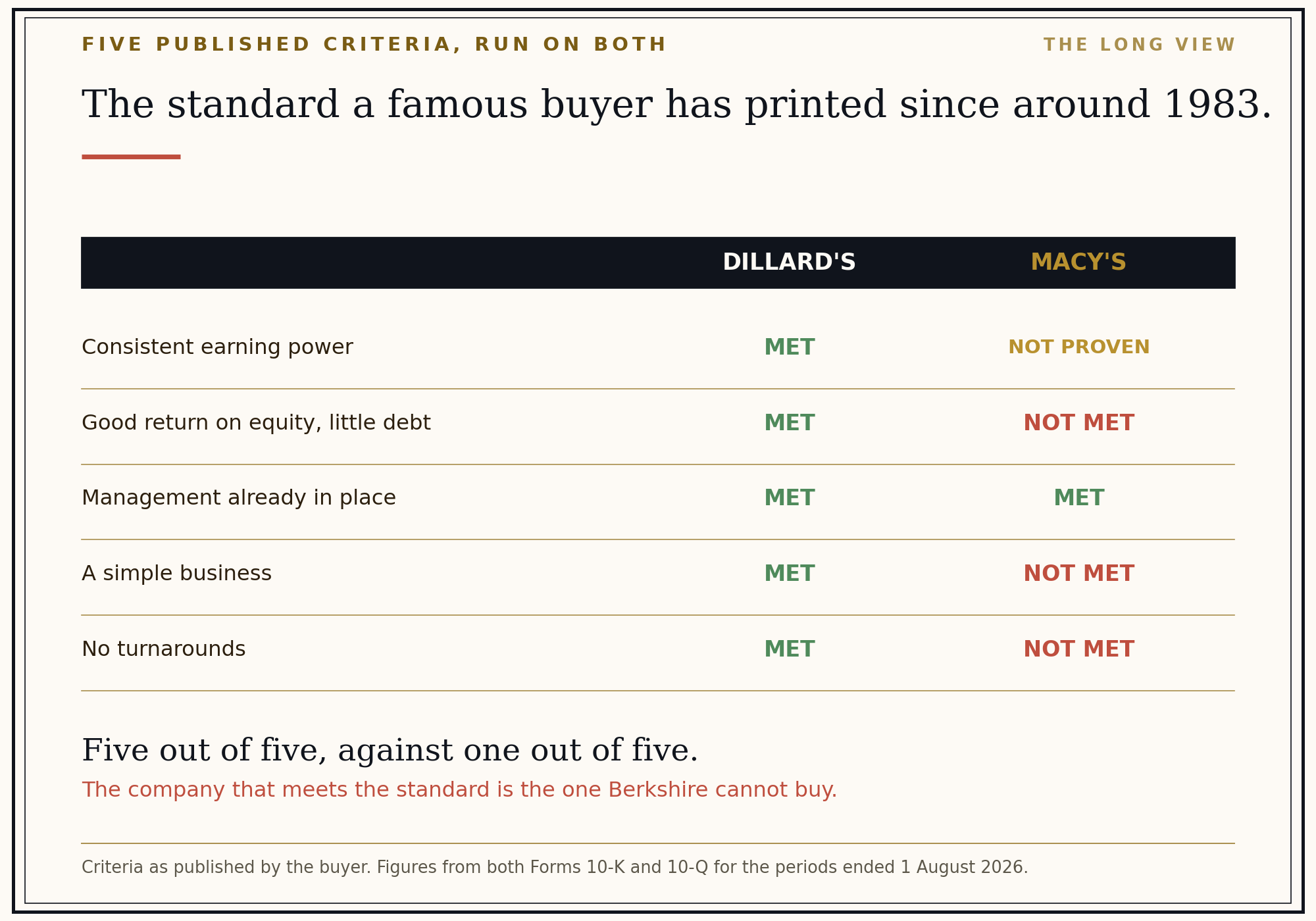
Consistent earning power. Dillard’s earned $681.7 million over the last twelve months and has declared a special dividend in each of five consecutive fiscal years, rising from $15.00 to $30.00 a share. MET. Macy’s earned $749 million over the same span, and has guided to an adjusted loss of between 19 and 23 cents a share in its current quarter. Earning power is there. Consistency is the word doing the work, and one guided loss quarter is not enough to settle it either way. NOT PROVEN.
Good returns on equity with little debt. Dillard’s made 33.7 percent on shareholders’ equity of $2.03 billion and holds $1.26 billion of cash and short-term investments against $425.7 million of debt. It is net cash. MET. Macy’s made 15.2 percent on equity of $4.93 billion while carrying $2.43 billion of long-term debt and $2.66 billion of long-term lease liabilities. Fifteen percent is a respectable return. Little debt it is not. NOT MET.
Management in place. Both. Dillard’s is run by the family that founded it in 1938. Macy’s chief executive has been in the chair since February 2024 and the turnaround is his. MET for both.
A simple business. Dillard’s sells clothes in 272 stores and owns a construction company that builds them. Macy’s operates seven divisions under three nameplates, runs a credit card programme that produced $156 million in the quarter, and sells advertising through a media network that produced $37 million. MET for Dillard’s. NOT MET for Macy’s.
No turnarounds. Dillard’s is not in one. Macy’s announced a strategy called A Bold New Chapter in a release dated 27 February 2024 and is in the third year of it. MET for Dillard’s. NOT MET for Macy’s.
Five out of five, against one out of five
Dillard’s meets all five. Macy’s meets one, fails three, and one is NOT PROVEN, which is a verdict rather than a gap, because the filing that would settle it is named below.
Sit with that for a second, because it is strange. The company that satisfies every published criterion is the one Berkshire has not bought and could not buy in any size that would register, because there are 15.6 million shares and a family holds the class that elects most of the board. The company Berkshire did buy fails the list.
So what did Berkshire see in Macy’s? No public document says. No public document says and nobody who does know has written it down. What this week can tell you is what it was not. It was not these five criteria, because Macy’s does not meet them.
Which leaves the other thing an investor might be looking at, and it is the thing the criteria do not measure at all.
Price against the value of the assets
Every price below comes from a filing rather than a quote page, because those are the only two either company has put in writing.
Dillard’s Class A closed at $592.64 on 2 June 2026, a figure stated in the company’s own registration filing. Shareholders’ equity was $2.03 billion at 2 May 2026 across 15.6 million shares, which is $129.84 a share. That is 4.56 times the accounting value of the assets.
Macy’s paid an average of $20.48 a share for its own stock during the first half of 2026. Shareholders’ equity was $4.93 billion at 1 August 2026 across 261.2 million shares, which is $18.87. That is 1.09 times book. Strip out $828 million of goodwill and $417 million of other intangible assets and tangible book is $14.10 a share, so 1.45 times.
Book value is not worth, and the caution runs in both directions. Both companies carry property at cost less depreciation, so buildings bought decades ago sit on the balance sheet at a fraction of what they would fetch, which understates both. And goodwill is the price of expectations recorded as an asset, which flatters Macy’s, which is why it is shown here with and without.
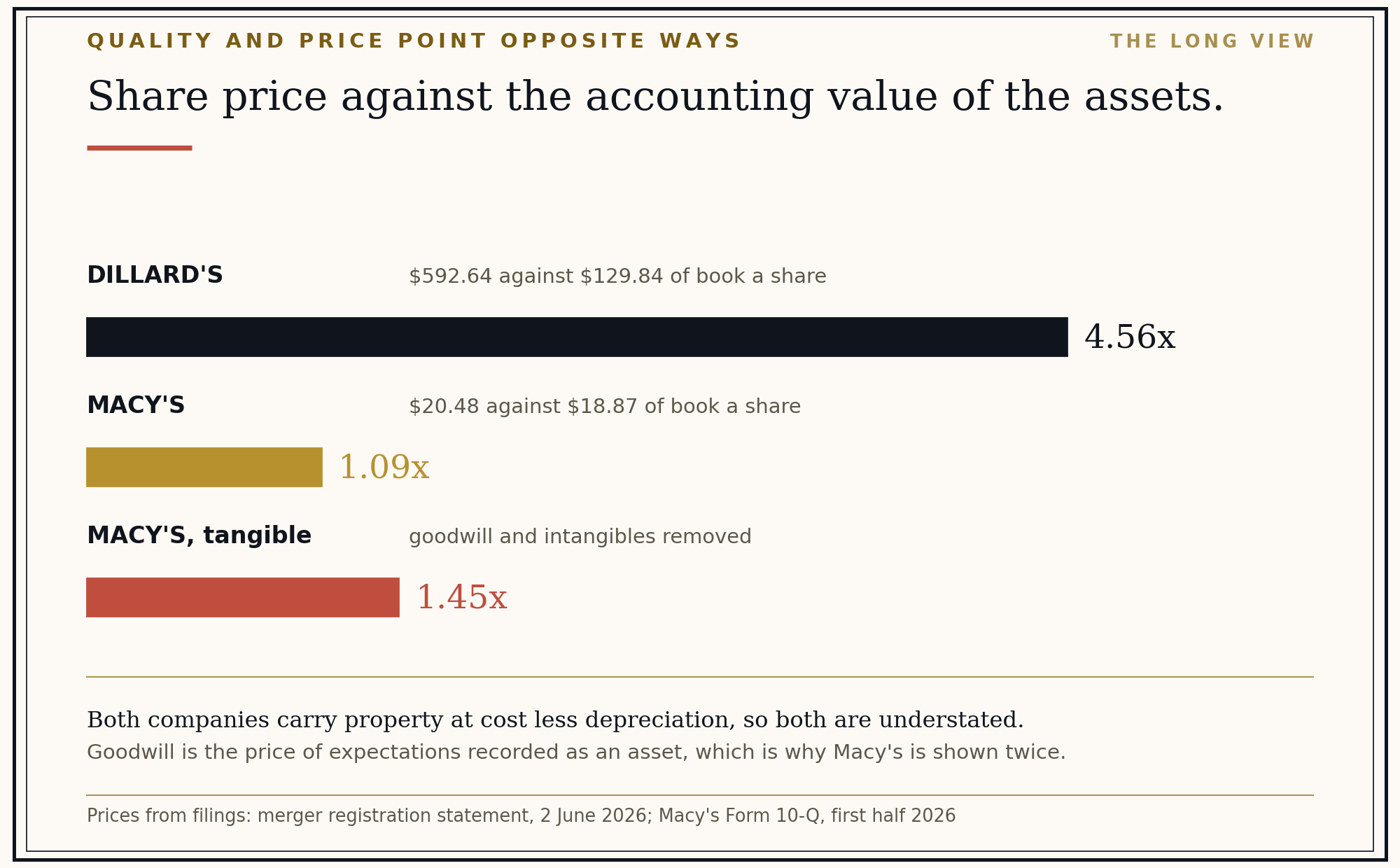
The two tests point in opposite directions. On quality, Dillard’s wins five to one. On price, Macy’s is at book value and Dillard’s is at four and a half times it.
That is not a contradiction. It is the whole job.
What might have been on the page
No public document says why Berkshire bought Macy’s, and nothing below changes that.
What follows is what sits in the filings that a buyer of this type would have been reading. It is reasoning from the documents, not from any knowledge of what crossed anyone’s desk, and it is offered for weighing rather than believing.
Macy’s is priced at the value of its own assets. At the $20.48 it paid for its own stock, the whole company is worth about $5.35 billion against shareholders’ equity of $4.93 billion. Inside that equity sits 243 owned locations and 79 buildings on leased land, carried at cost less depreciation and stated in the 10-K to be free and clear of mortgages.
It throws off more cash than the price suggests. Free cash flow was $690 million in the year ended 31 January 2026 before disposal proceeds, or $797 million on the company’s own definition. Against $5.35 billion of market value that is between 12.9 and 14.9 percent.
And there are two businesses inside it that are not a department store. Macy’s reported $857 million of other revenue for the year: $669 million from its credit card program and $188 million from its media network. That is 3.9 percent of net sales carrying almost no cost of goods. A retailer priced at book value with a card business and an advertising business attached to it is a recognizable shape, and the shape has a name. It is the sum of the parts being worth more than the whole.
Two things cut hard the other way. Macy’s fails three of the five criteria that same buyer publishes. And the position is $173.0 million inside a $299 billion book, which is 0.058 percent. A stake that small may be a probe rather than a conclusion, and may have been made by somebody other than the person whose criteria I just applied.
The reading, offered as reading and not as fact: if anything on that list was the attraction, it was price against assets and cash rather than business quality. On business quality Macy’s does not clear the bar its buyer set, and nothing this week suggests otherwise.
What Macy’s would have to do to repeat what Dillard’s did
Here is the comparison the whole week was built to make, and it needs one piece of disclosure to work.
I own Dillard’s at an average cost of $33.43. The bulk of the position went on at that price and I have not reinvested consistently since, which is why the average has not drifted. Macy’s paid $20.48 for its own stock this year.
Those two numbers look close, and Monday was about why that means nothing. But put the same money into each and the question becomes answerable.
$5,000 at $33.43 bought 149.6 shares of Dillard’s. At $592.64 those shares are worth $88,639.
$5,000 at $20.48 buys 244.1 shares of Macy’s. For that to reach $88,639, Macy’s has to trade at $363.07 a share, which values the whole company at $94.8 billion.
Now work backwards from there, because this is where it stops being arithmetic and starts being a judgement.
At eighteen times earnings, $94.8 billion requires Macy’s to earn $5.27 billion, which is a net margin of 24.2 percent on today’s sales. At fifteen times, $6.32 billion and 29.1 percent. At twelve times, $7.90 billion and 36.3 percent.
Macy’s runs about 3.4 percent. Dillard’s, the best margin in this comparison by a distance, runs about 10.5.
So the answer to the question this week opened with is no. Not a cautious no, not a wait-and-see no. There is no combination of margin and multiple that gets Macy’s from here to what Dillard’s did from $33.43, because it would require a department store to earn roughly two and a half times what the best department store in this comparison earns.
That is worth knowing and it is worth saying plainly, because the share prices look similar and the similarity is an illusion. Dillard’s at $33.43 was a far smaller company divided into far fewer shares. Macy’s today is a company worth $5.35 billion divided into 261.2 million pieces. The same entry price buys a completely different position in a completely different situation.
What is on the table instead is smaller and not at all absurd.
Double your money. Macy’s reaches $40.96 and is worth $10.7 billion, needing about $713 million of earnings at fifteen times. It earned $749 million over the last twelve months. Doubling asks Macy’s to keep doing what it is already doing and to be priced differently for it.
Triple. $61.44, worth $16.0 billion, needing a 4.9 percent net margin against the 3.4 it runs now.
Five times. $102.40, worth $26.7 billion, needing 8.2 percent, which is close to what Dillard’s earns.
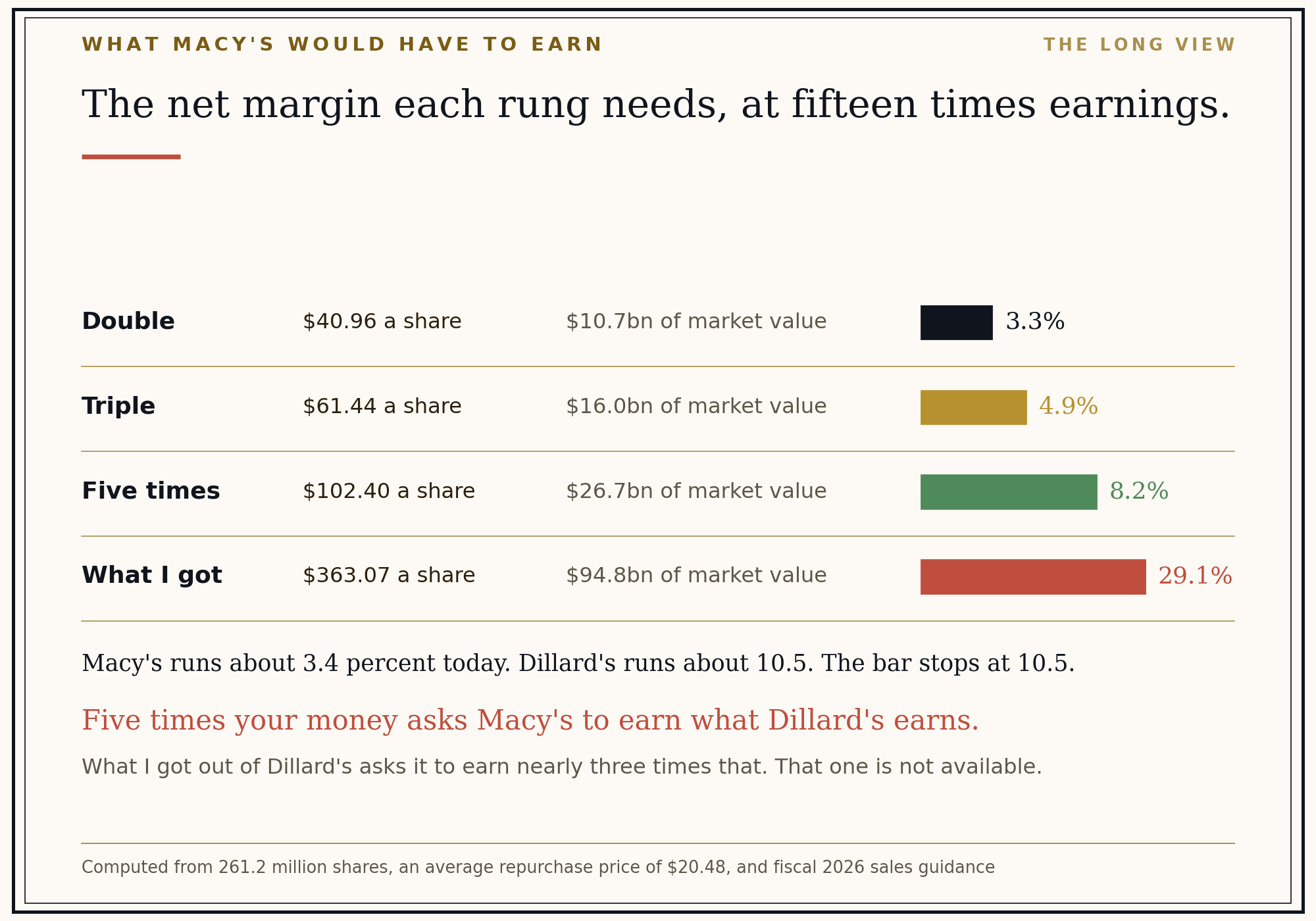
There is the week in one line. Five times your money on Macy’s requires Macy’s to earn something close to what Dillard’s earns. Not to be more famous. Not to own its buildings. To keep the same share of a sales dollar. And Wednesday showed exactly where that gap lives, which is six and a half points of operating cost.
Which one gave a shareholder more to work with
This week kept a tally of every point where one of these companies stopped an answer from being found.
Macy’s does not publish square footage by ownership type, and its off-price economics are not visible because Note 1 of its Form 10-Q aggregates all seven divisions into a single reporting segment on the stated basis that they have similar economic characteristics.
Dillard’s does not break out the components of cost of sales, or occupancy inside operating expenses, or what its clearance centers earn. A post-merger count of its Class B holders of record was not found where it would normally sit.
Honors roughly even, which was not the expected answer. What was not even is the clarity of what each does disclose. Dillard’s tells you its retail gross margin separately from its construction business. Macy’s tells you its comparable sales three different ways. Both are trying. Neither is hiding.
The conviction problem is not that either company withholds. It is that neither publishes the one figure that would settle the question this week has been circling, which is what it costs each of them to run a store.
What Dillard’s price requires
Whether Dillard’s is a good business and whether it is a good investment at $592.64 are two different questions. The first is settled. It plainly is.
At 4.56 times book value, the price requires the business to keep doing several things at once. Hold a retail gross margin near 38 percent with the tariff refund stripped out. Keep operating costs near 29 percent of sales. Keep generating around $700 million of cash a year from a sales base that has been flat. And keep handing most of it back, because 83 percent of operating cash flow returned to owners is what the shares are being priced on.
Every one of those is checkable in a quarterly release, and none of them requires anybody to have an opinion.
Three things would break that case. The retail gross margin falling below the prior year twice running with no one-off to explain it. The operating expense ratio moving above 30 percent. Or a year in which the special dividend does not come.
What five days could not settle
Why Berkshire bought Macy’s. No document says.
What either company’s off-price business earns.
What the real estate is worth, at either company.
And the Class B holder count since the merger on 4 June 2026, which has almost certainly changed.
The last word
Two department stores. The same designer labels on the same racks, the same customer, quarters ending on the same day. From the parking lot they are the same business.
One of them keeps 4.6 cents of every sales dollar, owns nearly all its buildings, passes every criterion a famous buyer has published, and trades at four and a half times the value of its assets.
The other keeps two cents, rents more than half its stores, fails most of the criteria, and trades at book.
Neither of those is a recommendation. They are two completely different propositions wearing the same clothes, and anyone who tells you the department store business is one thing has not opened the filings.
Not investment advice. The subscriber decides.