

What each of them did with it
Yesterday I showed you that Dillard’s keeps 4.6 cents from every sales dollar and Macy’s keeps about two. That is only half a question. The other half is what happens to the money after it is earned, and here the two companies are not just different, they are running on opposite principles. In its last completed year Dillard’s generated $717.0 million of cash from operations and handed $592.6 million of it back to shareholders. That is 83 percent. Macy’s generated $1.43 billion and handed back $448 million. That is 31 percent. One of these companies is being run as a machine for distributing cash. The other is being run as a business that intends to reinvest.
Neither of those is wrong. They are answers to different questions, and which one you prefer depends entirely on what you think the next ten years look like for department stores.
Five years of special dividends
A special dividend is a one-off payment a company declares outside its normal schedule, usually because it has more cash than it has uses for.
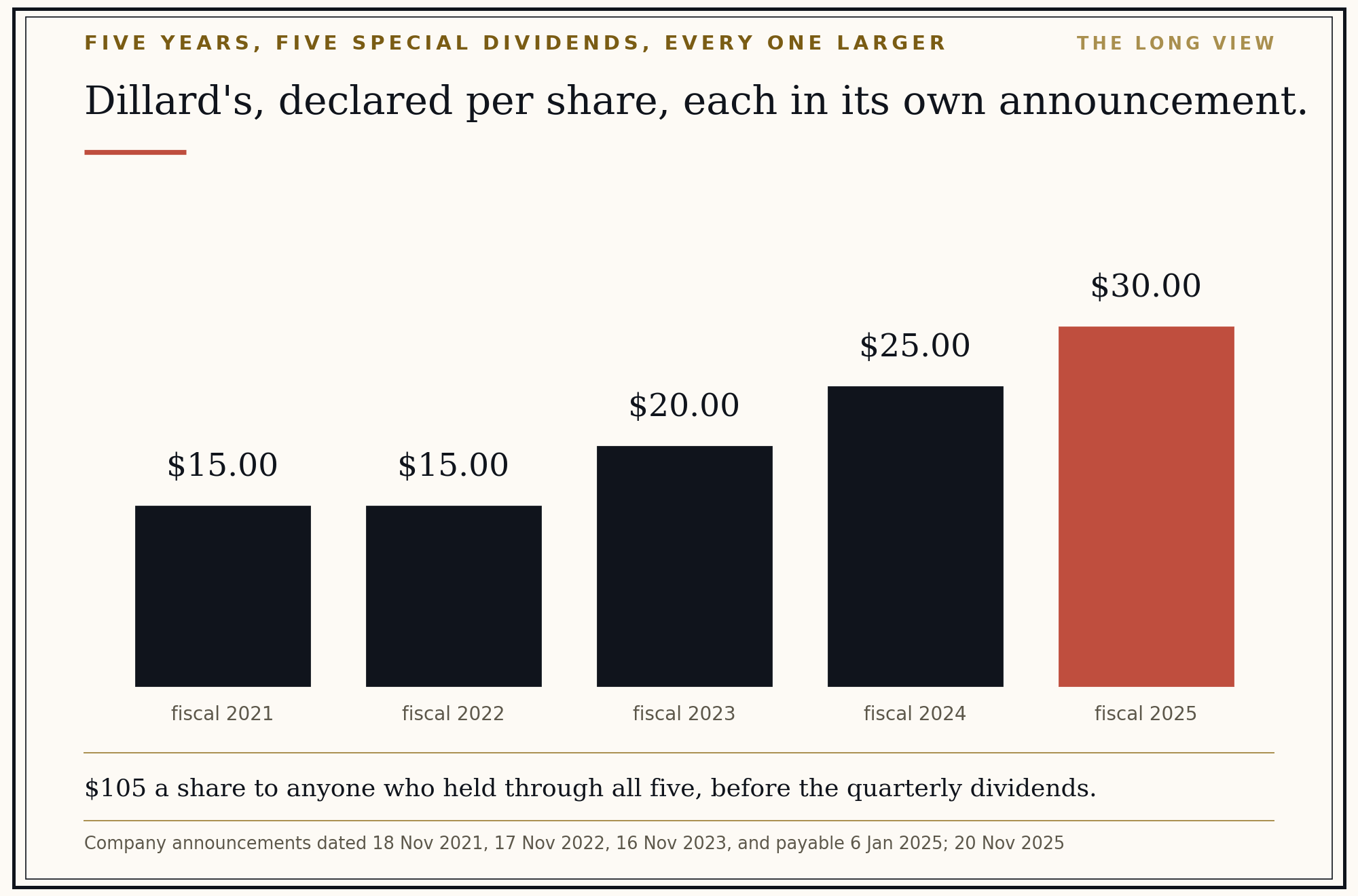
Dillard’s has declared one in each of the last five fiscal years, and the amounts have risen every time. $15.00 a share, announced 18 November 2021. $15.00 again, announced 17 November 2022. $20.00, announced 16 November 2023. $25.00, payable 6 January 2025. And $30.00, announced 20 November 2025, which the company called its largest dividend ever.
Across the same span the ordinary quarterly dividend went from $0.20 to $0.25 to $0.30.
Put a number on what that means for an owner. A shareholder holding through all five received $105 a share in special dividends alone, before the quarterly payments and before any change in the share price.
Macy’s paid $181 million of dividends in fiscal 2023, $192 million in 2024 and $197 million in 2025, and raised its quarterly rate by 5 percent to 19.15 cents a share on 27 February 2026. Steady, rising, and nothing like the same shape.
The part of the dividend that pays for itself
Here is something I did not know before this week and would not have found without reading the tax paragraph of a results release.
Dillard’s net income for the year ended 31 January 2026 includes federal and state tax benefits of $35.0 million, worth $2.24 a share, from a deduction on the portion of the $30.00 special dividend paid to the company’s employee stock ownership plan.
An employee stock ownership plan is a retirement scheme that holds company stock on behalf of staff. Dividends paid into one are deductible in a way ordinary dividends are not.
So a slice of the special dividend comes back as a tax benefit, because Dillard’s associates own so much of the company. The same mechanic appears in the prior year at $30.8 million, and the year before at $26.1 million.
That is a genuine structural feature and not an accounting trick. It also means the headline earnings per share of a company that pays large special dividends contains something that looks like operating performance and is not.
Two plans, one plan
A share repurchase is a company buying its own stock and cancelling it, which leaves every remaining owner with a slightly larger slice. An authorisation is the ceiling the board sets on how much it may spend doing that. Authorising is not spending, and the difference between the two is where you learn something.
Dillard’s has run two plans of $500 million each. The February 2022 plan was completed. The May 2023 plan had $165.2 million left at 31 January 2026, so roughly $335 million of it had been used.
Macy’s has one plan of $2 billion, which its board approved on 22 February 2022. At 1 August 2026 it had $1.02 billion left, so $976 million had been spent since it was approved.
And here is the figure that complicates the easy reading. Macy’s repurchased 17.7 million shares for $251 million in fiscal 2025 and a further 4.9 million shares in the first half of 2026 at an average cost of $20.48 a share. Dillard’s repurchased nothing at all in the quarter ended 2 May 2026.
The company I own, the one with the better margins and the disciplined reputation, was not buying its own stock this spring. The other one was.
The two conditions
There is a test for this that has been in print for years, and it has two parts, both of which have to be true.
A company should buy back its own shares only when it has ample funds beyond the needs of the business, and only when the stock is selling for materially less than a conservative estimate of what the business is worth.
Ample funds is easy here. At 1 August 2026 Dillard’s held $763.1 million of cash and $497.7 million of short-term investments, which is $1.26 billion together, against $425.7 million of total debt. Clear every dollar it owes and $835.1 million is still sitting there. It passes.
The second condition is the one that is not obvious. A company that stops buying its own stock after a long run may be telling you it no longer thinks the price is a bargain. Or it may be doing something else entirely. Nothing in any filing I read says which, and I am not going to guess.
Who actually decides
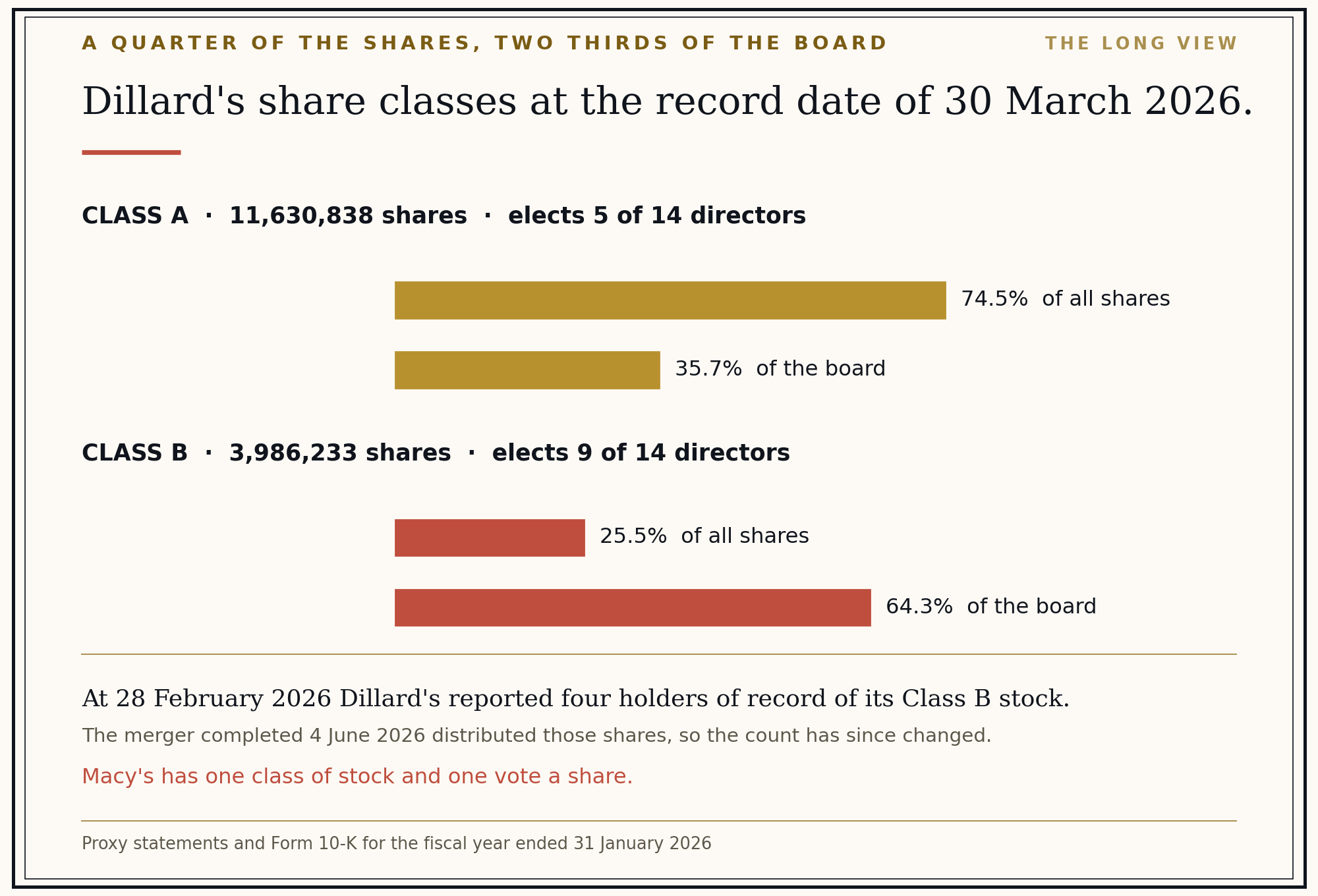
Dillard’s has two classes of shares. Class A and Class B carry one vote each on ordinary business. On the election of directors they do not.
Class A holders elect five of the fourteen directors nominated for 2026. Class B holders elect nine.
At the record date of 30 March 2026 there were 11,630,838 Class A shares and 3,986,233 Class B. So Class B is 25.5 percent of the company and elects 64 percent of the board.
Now the part that made me stop. A holder of record is the name printed on the share register, as opposed to someone who owns shares through a broker. At 28 February 2026 Dillard’s reported 2,079 holders of record of its Class A stock, and four of its Class B.
Four.
I have to flag the date on that, because it matters. The merger completed on 4 June 2026 distributed the Class B shares held by the family holding company to that company’s own shareholders, so the count is almost certainly higher now. I have not found a post-merger figure and I am not going to estimate one.
Macy’s has one class of stock, one vote a share, and 261.2 million shares outstanding.
The merger that moved twenty shares
Which brings us to the transaction announced in March.
W.D. Company was a holding company with no operations. Its activities were holding Dillard’s shares, receiving the dividends and passing them on to its own shareholders. The 2025 proxy put its position at 41,496 Class A shares and 3,985,776 Class B, which it described as about 99.99 percent of the Class B class.
On 4 June 2026 it merged into Dillard’s. Its shares were cancelled and returned to the pool of unissued stock. Almost exactly the same number were issued to its shareholders, plus $85,652.51 in cash for fractional entitlements.
Cancelled: 4,027,272 shares. Reissued: 4,027,252. A net reduction of twenty shares.
The filings put the value of the equity involved at about $2.39 billion, based on a Class A closing price of $592.64 on 2 June 2026.
So a transaction of that size removed one layer of ownership and changed the share count by twenty. Nothing about control moved, because control was never about the money. It was about a share class that elects most of the board.
What I got wrong, and where I was looking
On Wednesday I nearly wrote that Dillard’s does not disclose its employee numbers in the same form as Macy’s. It does. About 29,100 associates at 20 December 2025, of whom 20,400 are full-time and none represented by a union.
I had been looking in the human capital section at the front of the 10-K, where Macy’s puts its figure. Dillard’s puts its own in a different place.
The lesson is not about employee counts. It is about the sentence I almost wrote. “They do not disclose it” is a claim about every page of a document I have not read end to end. “I did not find it where I looked” is what I knew. From here I will write the second one.
For the record, the figures do not help either side. Dillard’s runs $222,474 of sales per associate and Macy’s $241,463, so headcount is not where the expense gap lives.
Tomorrow
Five days, two department stores, and one question left. Tomorrow, I put both companies against the criteria a famous buyer has published, look at what each price now requires the business to keep doing, and tell you which of the two gave a shareholder more to work with.
Not investment advice. The subscriber decides.