

It was flawless. Revenue grew 36 percent. Retention cleared our line. Guidance went up. And the stock had its worst day on record. This is what priced for perfection really looks like when the bill comes due.
Before Datadog reported, we published a piece called “The Company That Has to Be Perfect Forever,” and we drew two lines in advance. This is the grade against those lines. It is the strangest kind of grade we have run, because the company did everything we said it had to do, and the market punished it anyway. Understanding why is the most valuable thing we can teach you about what a price truly is.
The bar we set, before the number
We said it plainly two weeks ago. At roughly 100 times earnings, Datadog was not being asked to be good. It was being asked to be flawless, without pause, because the excellence was already in the price. So we set the bar where the valuation set it, high.
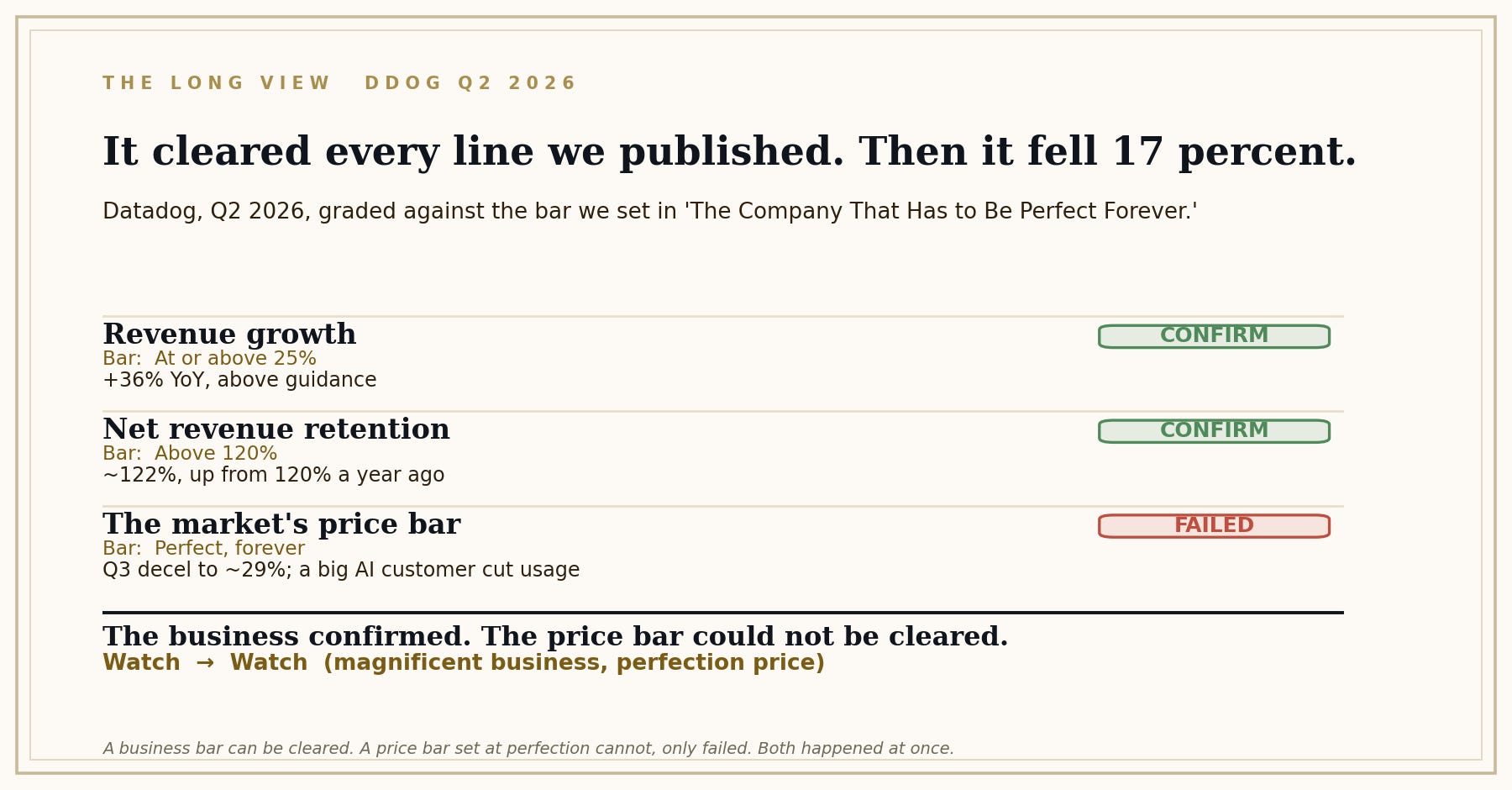
Confirmation required revenue growth holding at or above 25 percent, with net revenue retention staying north of 120 percent, evidence the AI tailwind was still filling the sails and the moat still widening. A break was growth decelerating below 22 percent or retention slipping below 115. We wrote those numbers down in public, before the print, where we could not move them afterward.
Test 1: Revenue growth
Published bar: growth at or above 25 percent confirms; below 22 percent breaks.
The number: revenue of $1.12 billion, up 36 percent year over year, above the high end of the company’s own guidance. Confirms, and not narrowly. Thirty-six percent is not just clearing the bar, it is clearing it with room to spare. On growth alone, Datadog was firing on every cylinder.
Test 2: Net revenue retention
Published bar: retention above 120 percent confirms the moat is still widening; below 115 breaks it.
The number: trailing net revenue retention in the low 120s, around 122 percent, up from 120 a year ago. Confirms. This was the number we said mattered most, the proof that existing customers keep spending more, that the platform gets stickier rather than merely holding. It did not just stay above our line. It ticked up. The moat widened.
The rest of the print, all of it good
Operating margin expanded to 23 percent, from 20 a year ago. Free cash flow was $279 million. Remaining performance obligations, the contracted future revenue, grew 43 percent. The count of customers worth more than $100,000 a year rose to about 4,720, up 23 percent. And management raised full-year guidance to roughly $4.45 billion, implying about 30 percent growth for the year. By every measure we published and several we did not, this was an excellent quarter from an excellent business.
The company was flawless. The stock fell 17 percent.
On the day, Datadog fell about 17 percent, its worst single day drop on record, worse than anything in the 2020 crash. A company that beat on revenue, beat on earnings, raised guidance, and grew retention lost roughly a sixth of its value in a session.
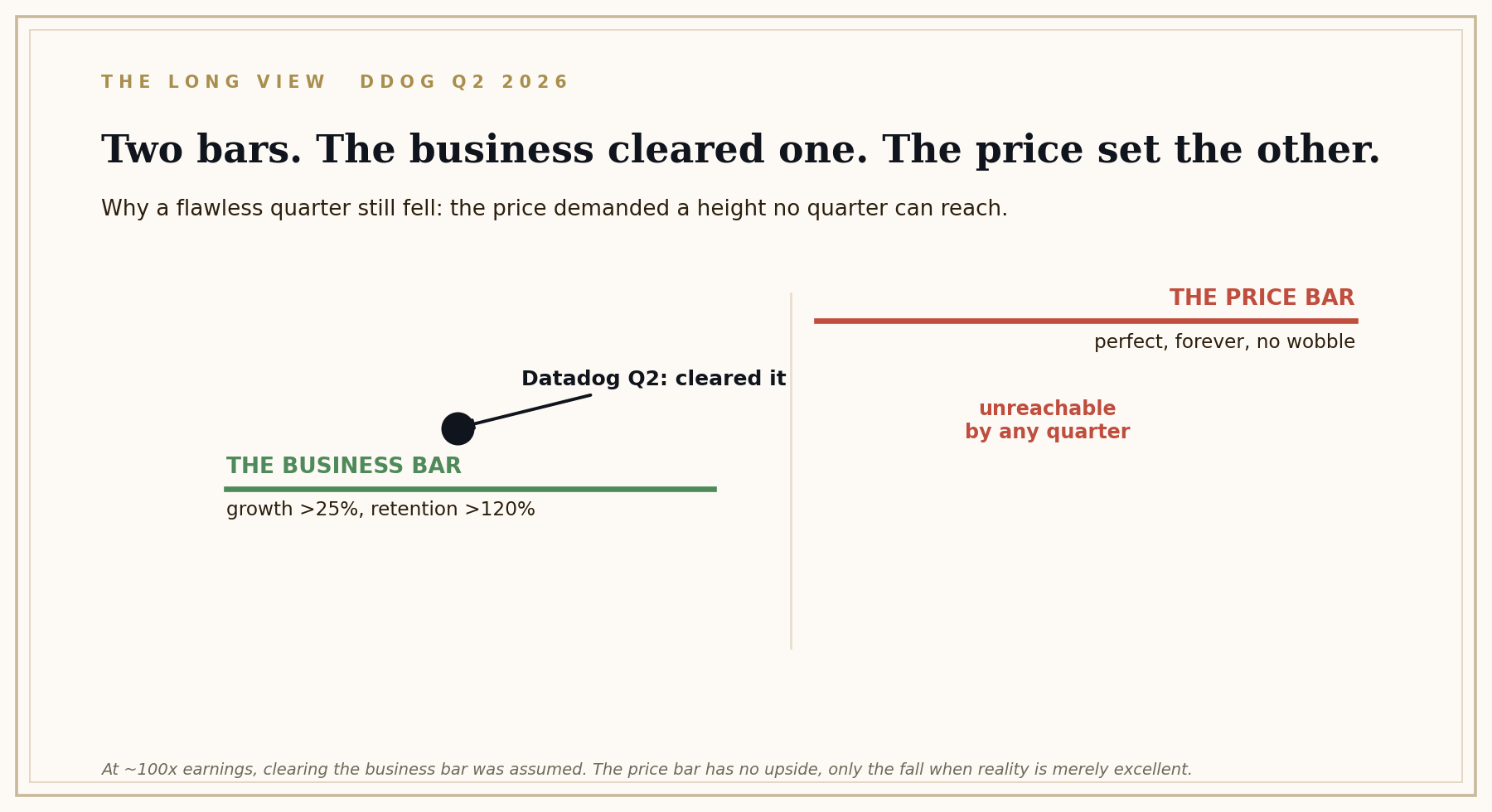
Read that twice, because it is the entire lesson of this grade, and of the piece we wrote before it. Our bar was a business bar, and the business cleared it cleanly. But the price had set a different bar, an invisible one, and that is the bar that moves the stock. At 100 times earnings, “confirm our published lines” was not the test the market was running. The market’s test was: keep accelerating, forever, with no new risk, no deceleration, no wobble in any single customer. And on that test, this flawless quarter contained two small cracks that at a cheaper price would not have mattered at all.
The two cracks that only matter at this price
First, guidance for next quarter implies growth slowing to 28 or 29 percent, down from this quarter’s 36. Still a spectacular rate. But at a perfection price, deceleration from extraordinary to merely excellent is not good news, it is the first evidence that the fastest days may be behind, and the multiple was built on the fastest days continuing.
Second, Datadog’s largest customer, which it does not name but which analysts widely believe to be OpenAI, reduced its usage, even as it renewed a nine-figure contract during the quarter. Management prudently de-risked its guidance to account for it. At a reasonable valuation, one big customer optimizing spend is a footnote. At this valuation, it is a reminder that a meaningful slice of the hypergrowth rides on a concentrated handful of AI-native accounts whose usage can move, and that concentration is a risk the price had not been treating as a risk. It is not even a new risk: the same story, one large customer optimizing, took a similar bite out of the stock in 2023, and the market repriced it then too, and forgot again.
Neither of these is a broken business. Both are the kind of thing that only becomes a 17 percent problem when the price has left no room for anything less than perfect. That is what priced for perfection means. It is not a phrase. It is a mechanism, and you just watched it fire.
The state change: the bar confirmed, the lesson delivered
So how do we grade a quarter that cleared every line we published and still cratered? Plainly, and precisely. Against our bar, Datadog confirmed. The business is doing what the story promised, growing fast, retaining and expanding customers, widening its moat. We do not get to pretend otherwise just because the stock fell. The lines we drew, it cleared.
But the classification does not improve, and here is why that is not a contradiction. Datadog was never on our watch list because we doubted the business. It was there because of the price. The quarter resolved the business question and left the price question exactly where it was, or rather, the market just answered the price question for us, violently, in the direction we had flagged. The company proved it is excellent. The market proved that excellent is not the same as worth 100 times earnings. Both things are true and holding both in your head at once is the whole discipline.
Datadog stays where it was: a magnificent business we do not own, because the price still asks for more than magnificent. It asks for perfect, forever, and this quarter showed what happens the first time reality falls a hair short of that impossible standard.
What we watch next, and when
Whether the deceleration continues. Q3 will tell us if 28 to 29 percent was conservatism or the start of a trend. At this valuation, the slope matters more than the level.
The AI-native customer concentration. We watch whether more large accounts optimize usage, because the price is carrying an assumption of smooth, uninterrupted expansion that a concentrated customer base can disrupt.
And the price itself, plainly. Datadog fell to around $237 from about $288. That is not our signal to move, it is the market repricing perfection toward merely excellent. If it keeps falling toward a multiple where excellent is enough, this magnificent business finally becomes a value question worth asking. It is not there yet. But for the first time, it is falling in that direction.
We said being wonderful would not be enough at this price, only being flawless-forever would, and even that might crack the first time it was tested. It was flawless. It cleared every line we published. And it fell 17 percent, because the price was never asking for flawless. It was asking for perfect, and perfect has no upside, only the long way down the first time the world notices it is merely excellent.
Run any company through the Stock Story Firewall, free, at firewall.readthelongview.com. Subscribers get the Watch Cards, the Evidence tool, and the full Research Tracker, including every test we have published and how each one scored.
Datadog is the best business in its industry. That was never the question. The question was whether the best business is the best stock when it has to be perfect to stay standing, and this week, for one brutal session, the answer was no.
Not investment advice. The subscriber decides.