

The data centers that Amazon (Nasdaq: AMZN), Alphabet (Nasdaq: GOOGL), Meta (Nasdaq: META) and Microsoft (Nasdaq: MSFT) are building connect to the same kind of power grid and water systems that serve homes. On one grid that serves 67 million people in 13 states and Washington, D.C., the independent market monitor says $29.4 billion of the charges for power plant capacity over four auctions resulted from data center demand. A review for the data center industry found no quantitative evidence to date that data centers have historically been subsidized by other customers. When you finish, you will know how a power bill pays for the grid, who is borrowing to build it, and the rules that decide whether your bill carries the risk.
Disclosure: the author holds no individual shares in any company named here. He owns broad index funds that include some of them.
The hookup comes before the rent
On Monday 2 November I set out the three yearly bills a data center creates: wear and tear, rent and interest.
Before a single tenant pays, the landlord needs a power hookup and water. Those are two of the gates, and they are the two that reach your own house.
A data center connects to the same wires, substations and power plants that serve the homes around it. Somebody has to build what it needs. Somebody has to pay for it.
How your power bill pays for the grid
The federal Energy Information Administration puts it plainly: “Electricity prices generally reflect the cost to build, finance, maintain, and operate power plants and the electricity grid.” It adds that “some for-profit utilities also include a financial return for owners and shareholders in their electricity prices.”
So a new power line is not paid for once. Say a utility spends $1 billion on a line. In practice, regulators let it recover that cost from customers over years, including the cost of financing it. Customers carry slices, in shares a regulator sets.
Who carries which slice is set by more than one regulator. State commissions set retail rates. The Federal Energy Regulatory Commission oversees transmission and wholesale markets like PJM’s, the grid in the next section.
Every cost built for a data center lands somewhere. A regulator’s rule decides whether it lands on the data center or in the pool your bill draws from.
The power companies are spending to build
Fitch Ratings described “record capital spending of around $240 billion in 2026” by utilities, Utility Dive’s Ethan Howland reported on 15 June 2026.
American Electric Power (Nasdaq: AEP), whose 15 gigawatts of new commitments were in the notes on Tuesday 3 November, sets out a $100 billion five-year plan in its release dated 28 October 2026. The same release says its contracted new load is expected to reach 84 gigawatts by 2031. A gigawatt is a billion watts.
The same release carries the risk in its own words: “projected increases in demand from data centers are subject to uncertainty and may not materialize.”
Dominion Energy (NYSE: D) said its Virginia segment had contracted nearly 53.8 gigawatts of data center capacity as of July 2026, Reuters reported on 31 July 2026.
How a utility pays for a build: loans and new shares
A utility pays for building by borrowing and by selling new shares. Xcel Energy (Nasdaq: XEL) shows both.
Its long-term debt was $36.54 billion on 30 September 2026, against $31.83 billion on 31 December 2025. Its release dated 29 October 2026 plans up to $8 billion of equity or equity-like financing from 2027 to 2031. In the September quarter it issued 10.5 million shares for net proceeds of $819 million.
Say a company is worth $100 and split into 10 shares, so each owns a tenth. It sells 2 new shares to pay for a power line. Now there are 12 shares, and each one owns a twelfth. That is called dilution: your slice of the company gets smaller.
If the new line earns its keep, the twelfth is worth as much as the tenth was. If not, owners hold a smaller slice for nothing.
One caution on Xcel. Its release says its capital plan “does not include” investments to serve future large load customers. Any data center build would come on top of these figures, not inside them.
The number the grid’s monitor put on it
PJM Interconnection runs the grid for 67 million people in 13 states and Washington, D.C., its website says. Virginia, where Dominion’s data center contracts sit, is one of them.
PJM pays power plants and other resources to stay available for the grid’s tightest hours, whether or not they run. Think of it as a retainer. The companies that sell power to homes, businesses and data centers pay for it as a capacity charge, and pass it into customers’ bills.
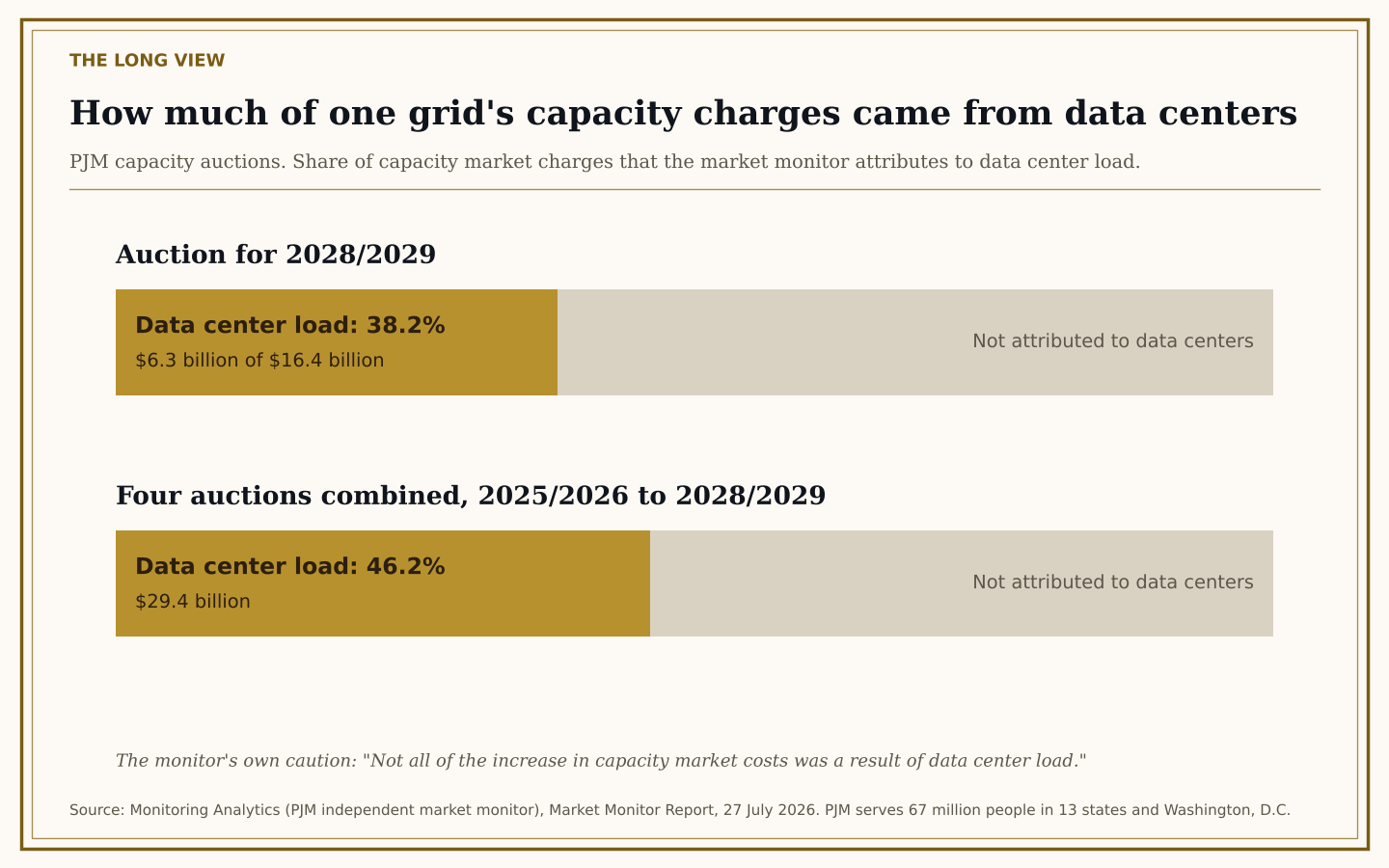
PJM’s independent market monitor, Monitoring Analytics, measured how much of that retainer data centers caused. Its presentation of 27 July 2026 says that in the auction for 2028/2029, $6.3 billion of the $16.4 billion in capacity charges was “a result of data center load,” or 38.2 percent.
Out of every $100 of capacity charges in that auction, $38.20 came from data center demand, by the monitor’s count. Across the four auctions for 2025/2026 to 2028/2029, it puts the total at $29.4 billion, or 46.2 percent.
The monitor adds its own caution: “Not all of the increase in capacity market costs was a result of data center load.”
Where it reaches a household bill
The monitor also put the cost per unit of power. In the first half of 2026, it says data center load raised the total cost of wholesale power by $11.11 per megawatt-hour, or 9.7 percent, to $114.50.
A megawatt-hour is 1,000 kilowatt-hours, the unit on your bill. So $11.11 per megawatt-hour is about 1.1 cents per kilowatt-hour. That estimate counts only two delivery years of the capacity auctions.
That is wholesale, one part of a retail bill. How much reaches you depends on your state and your utility.
The wires are a separate cost. In a release dated 15 September 2025, the Union of Concerned Scientists, an advocacy group, counted $4.3 billion of transmission projects approved in 2024 in seven PJM states to connect data centers to the high-voltage grid. It said more than 95 percent of those projects, by count, passed the connection cost to local customers.
Nationally, the electricity index rose 4.4 percent in the 12 months to September 2026, against 3.7 percent for all prices, the Bureau of Labor Statistics reported on 14 October 2026. The index does not say why.
The pipes are a smaller bill and a local fight
Water is often run by a different kind of supplier than power. That changes who decides.
The Environmental Protection Agency says: “The vast majority of systems are small and privately owned, but most people are customers of large publicly-owned systems.” Unlike the investor-owned companies that dominate electricity, “most water utilities are small not-for-profits,” E&E News’s Miranda Willson reported on 15 April 2026. In Columbus, Ohio, rate changes from the city’s utility go through City Council.
The scale is smaller and less settled. Researchers at the University of California, Riverside estimated that the water infrastructure for AI data center growth through 2030 will cost between $10 billion and $58 billion, E&E News reported. Experts told Willson it is unclear how AI’s rise is affecting household water bills. In a piece quoting Columbus’s water administrator, John Newsome, she reported that data centers so far use a small percentage of the area’s drinking supplies.
Columbus’s proposed surcharge on commercial customers whose water use spikes, covered in the Tuesday 3 November notes, has a public hearing on 12 November 2026.
The hidden assumption
The hidden assumption on the power side of the AI build is this: the data center pays for the wires and power plants built for it, even if its demand falls short.
For new contracts, some places have written that rule down. Ohio’s utility commission adopted a data center tariff for AEP Ohio on 9 July 2025. It covers new data centers and expansions of 25 megawatts or more. The customer pays a minimum bill tied to its contracted capacity or its recent peak demand, up to 85 percent of the capacity it signed for, even if it uses less. The first contract runs up to 12 years. A customer can leave five years after its ramp-up period ends by paying “an exit fee equal to minimum charges for 36 months after notice of termination.”
AEP’s chief executive, Bill Fehrman, says in its 28 October 2026 release that “AEP is committed to having new large-load customers bear the incremental system costs they create.” Xcel’s release says that under a deal for a Google data center in Minnesota, “Google will pay all costs for its new service for the duration of the contract.” A decision from Minnesota regulators is expected in early 2027.
For PJM’s capacity market, no such rule exists yet. The monitor recommends removing data center load from that market and buying its capacity in a dedicated auction, to “ensure that data centers pay for their own capacity and do not impose capacity costs on other customers.”
A protection rule is only as good as the day it gets used. In the tariff page and the AEP and Xcel releases I read, nothing shows that day yet.
Whether these rules hold if demand falls short is NOT PROVEN.
The other side, in its own numbers
A study by the consulting firm E3, commissioned by the Data Center Coalition, an industry group, found “no quantitative evidence to date that data centers have historically been subsidized by other customers,” Axios reported on 18 May 2026. Axios added that E3 does not hold data centers “completely blameless.”
The Lawrence Berkeley National Laboratory found in its July 2026 update that from 2019 to 2025, “states with the highest growth generally saw average retail prices decline in real terms.” The report says the answer depends on how well the grid that already exists can be used. It gives PJM as a case study, where fast growth with supply and delivery limits “leads to significant price increases.”
AEP’s own release makes the industry’s case in a number: it expects “up to $21 billion of fixed cost offsets for residential customers from large load contracts.” That is the company’s expectation, not a result.
Two rating agencies split. Fitch moved its outlook for the sector to “deteriorating” on 12 June 2026, citing affordability. S&P Global Ratings moved its North American utility outlook from negative to stable in May 2026, S&P Global’s Zack Hale reported.
Neither reading settles what happens where you live.
What it means for the builders, and what to check
For the four builders, the power gate shows up twice.
The first is time. The earnings in Monday’s test wait for the hookup. The second is cost. Where a rule like AEP Ohio’s applies, the customer on the tariff owes a minimum bill for a contract of up to 12 years, unless it pays to exit. When that customer is a builder, that is my reading of a fourth fixed bill beside wear and tear, rent and interest.
You can check your own side in five minutes. Open your electric bill. Find the line for supply or generation and the line for delivery or transmission. Then look up your utility’s most recent rate case on your state utility commission’s website.
The notes on Thursday 5 November cover the other gates: permits, equipment and workers. Friday 6 November scores the test.
Run any utility or builder through the free Stock Story Firewall at firewall.readthelongview.com. It asks the question this piece asked: what has to be true for this story to hold.
Not investment advice. The subscriber decides.