

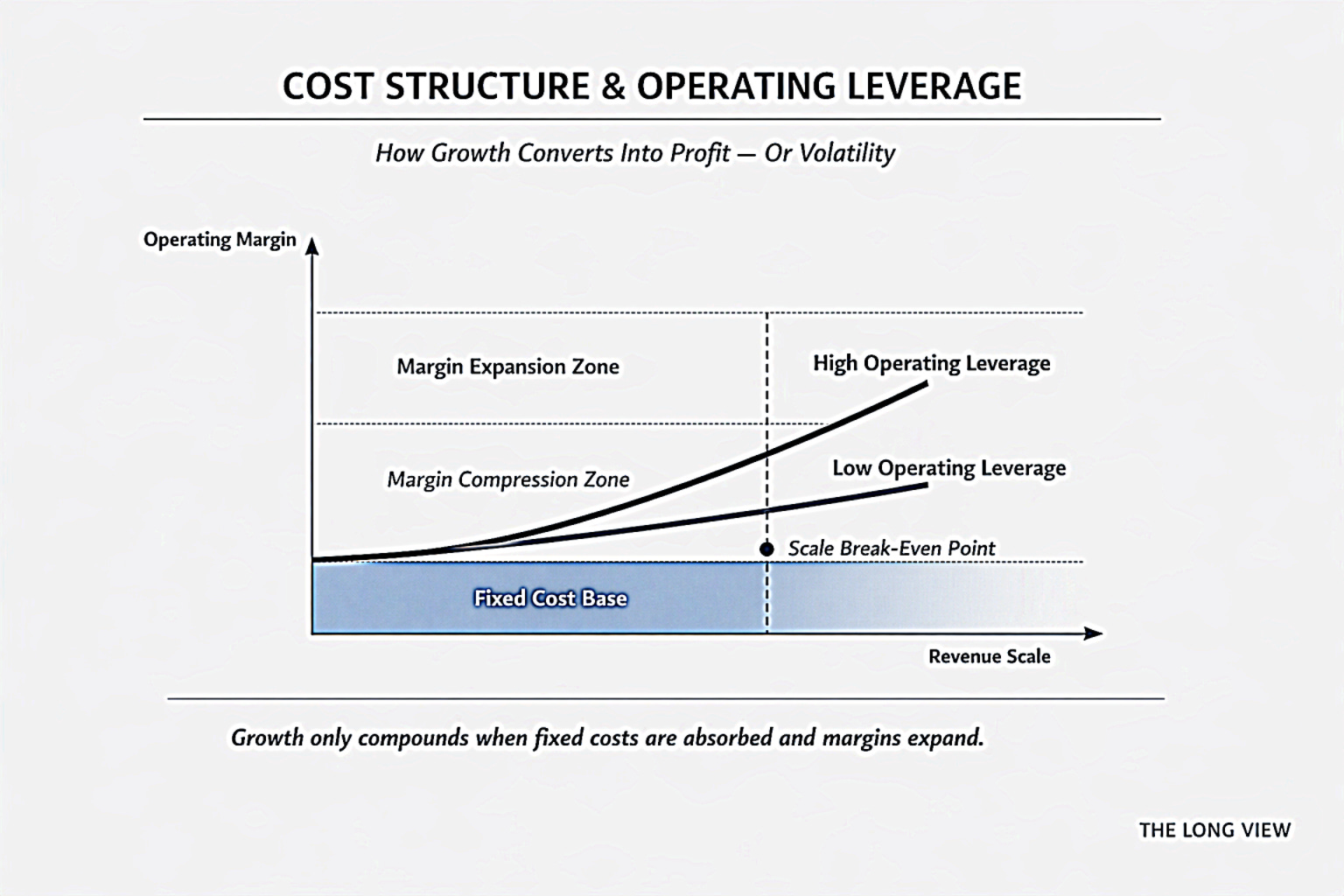
Operating leverage describes how a company’s cost structure shapes the relationship between revenue growth and profitability. Two businesses may grow at similar rates yet produce very different earnings outcomes depending on fixed and variable expense composition. Professionals begin not with revenue, but with cost absorption dynamics.
At Nvidia, substantial research and ecosystem investment create a predominantly fixed cost base. Once demand expands, incremental revenue flows through at elevated margins. This structure explains rapid earnings acceleration during AI infrastructure cycles. However, contraction periods reverse that effect. The leverage embedded in the cost structure amplifies both directions.
ASML demonstrates leverage through capital intensity. The development of advanced lithography systems requires large fixed engineering and manufacturing commitments. These investments create barriers to entry and long-term scale benefits. Yet profitability remains sensitive to semiconductor cycle timing. Fixed costs demand sustained utilization.
ServiceNow reflects subscription-based leverage. Early reinvestment masks margin potential. As revenue scales, operating costs grow more slowly relative to recurring revenue streams. Margin expansion becomes structural rather than cyclical. Institutions monitor renewal rates and expense discipline to assess durability.
Snowflake introduces a consumption-based model. Revenue fluctuates with customer usage, yet infrastructure scale supports incremental contribution over time. Short-term volatility may obscure long-term leverage. The key evaluation question becomes sustainability of adoption.
Evaluation Checklist:
• Are fixed costs structural or discretionary?
• How sensitive are margins to revenue slowdowns?
• Does incremental revenue produce higher contribution margins?
• Is leverage cyclical or structural?
Operating leverage is neither inherently positive nor negative. It magnifies structural strengths and weaknesses. Durable operating leverage depends on disciplined reinvestment, stable demand drivers, and cost visibility.
Frameworks allow investors to move beyond headlines and opinions and toward consistent evaluation. They provide a way to level-set a company’s long-term investability based on structure, discipline, and durability. The Long View’s weekly case studies are designed to help readers learn how to apply these frameworks across different businesses and market environments.