

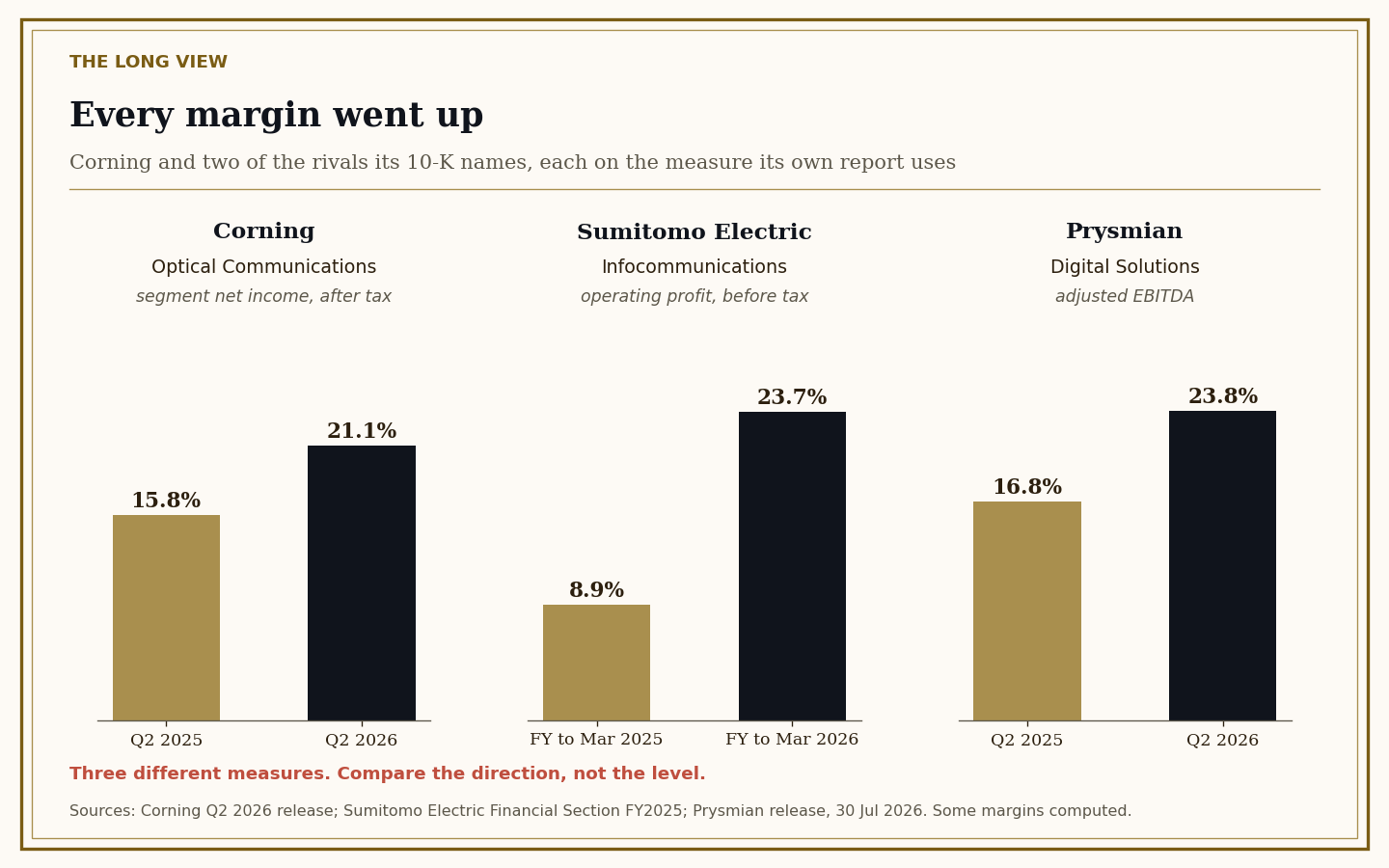
Corning Incorporated (NYSE: GLW) kept 21.1 cents of segment profit from every dollar of optical sales in the second quarter of 2026, up from 15.8 cents a year earlier. On its own, that looks like pricing power. Then you open its rivals’ reports. Sumitomo Electric’s info communications business widened its operating margin by 14.8 points in its last fiscal year, and Prysmian’s Digital Solutions business widened its margin by 7.0 points. When every producer’s margin rises at once, the first suspect is the market.
Disclosure: the author holds no position in GLW.
Tuesday’s piece ended on the question the contracts could not answer: what can Corning charge? Today Corning’s rivals testify, from their own reports, on price and on capacity. Then Corning’s annual report for 2002 testifies on what happened the last time the whole industry built at once.
What pricing power would look like
Pricing power is the ability to raise prices without losing customers. It is the thing a value investor most wants to find, because it is what lets a company keep its margin when costs rise or competitors arrive.
Filings can show it, but only in a particular shape. The company names price as a reason its profit grew, and its margin rises while its competitors’ margins do not. A margin that rises alongside everyone else’s shows a good market. It does not show that the good market belongs to one company.
A wide margin is evidence of good times. Pricing power is evidence that the good times belong to you.
Companies do name price in their filings when it moves. Corning’s own annual report for 2002 named pricing pressure when prices were falling, as the history below shows. So a filing that explains a rising margin without naming price is telling you something, even if it is not telling you everything.
So the test today has two parts: what each company says drove its profit, and whether Corning’s margin moved differently from its rivals’.
Corning’s own explanation
Corning’s results release for the quarter ended 30 June 2026 reports Optical Communications net income of $438 million on sales of $2.07 billion, against $247 million on $1.57 billion a year earlier. That is 21.1 cents per dollar of sales, up from 15.8, computed from the release.
Corning’s 10-Q for that quarter says the segment’s net income rose by $191 million, the main driver of the company’s growth in core net income. Its 10-Q for the quarter ended 31 March 2026 explains the segment’s sales growth by demand: its Enterprise business, driven by generative AI products, and its Carrier business, driven by data center interconnect and fiber-to-the-home products.
In the passages I read, Corning explains its growth by demand and does not name price. That leaves Corning’s pricing power NOT PROVEN from its filings. It does not mean Corning lacks it.
Sumitomo testifies
Sumitomo Electric’s financial section for the fiscal year ended 31 March 2026 is the clearest witness, because it explains each business separately.
Its info communications segment, which includes optical fiber cables and the devices that connect them, grew sales by 46.3 percent to ¥326.6 billion, on data center demand. The line for optical fiber cables, telecommunication cables and fusion splicers rose to ¥162.5 billion from ¥89.0 billion, an increase of 83 percent. Operating profit rose to ¥77.4 billion from ¥19.9 billion, and the operating margin improved by 14.8 points to 23.7 percent.
The report credits that profit to higher sales, an improved product mix and productivity. For the group as a whole it lists improved selling prices among several reasons, but the segment explanation does not. On the business that competes with Corning, Sumitomo’s own report credits selling more and selling better products. It does not list price.
Prysmian and Fujikura
Prysmian’s results release of 30 July 2026 reports an adjusted margin of 23.8 percent for its Digital Solutions business in the second quarter, up from 16.8 percent a year earlier, on sales of €540 million against €387 million. Adjusted EBITDA, the measure Prysmian uses, is profit before interest, tax, depreciation and some one-off items. I have Prysmian’s margin. I have not found its explanation, so what drove it is NOT PROVEN.
Fujikura is the gap I could not close. I was not able to open Fujikura’s own forecast revision or results summary. The summaries of them that I found disagree with each other about price, so I am printing neither. Fujikura’s pricing is NOT PROVEN.
Every margin went up
Put the three together and the shape is plain. Corning’s optical margin rose by 5.3 points. Sumitomo’s info communications margin rose by 14.8. Prysmian’s Digital Solutions margin rose by 7.0.
These are three different measures: Corning’s is segment profit after tax, Sumitomo’s is operating profit before tax, and Prysmian’s is adjusted EBITDA. The levels cannot be ranked against each other. The direction can be compared, and everyone points the same way.
When every producer’s margin rises at once, the first suspect is the market, not the moat.
That is my reading of three filings side by side. It does not prove Corning lacks pricing power. It means the margin alone cannot prove that it has it, because its rivals’ margins show the same thing.
Everyone is building
The second witness question is capacity, and every document I opened says the same thing: more.
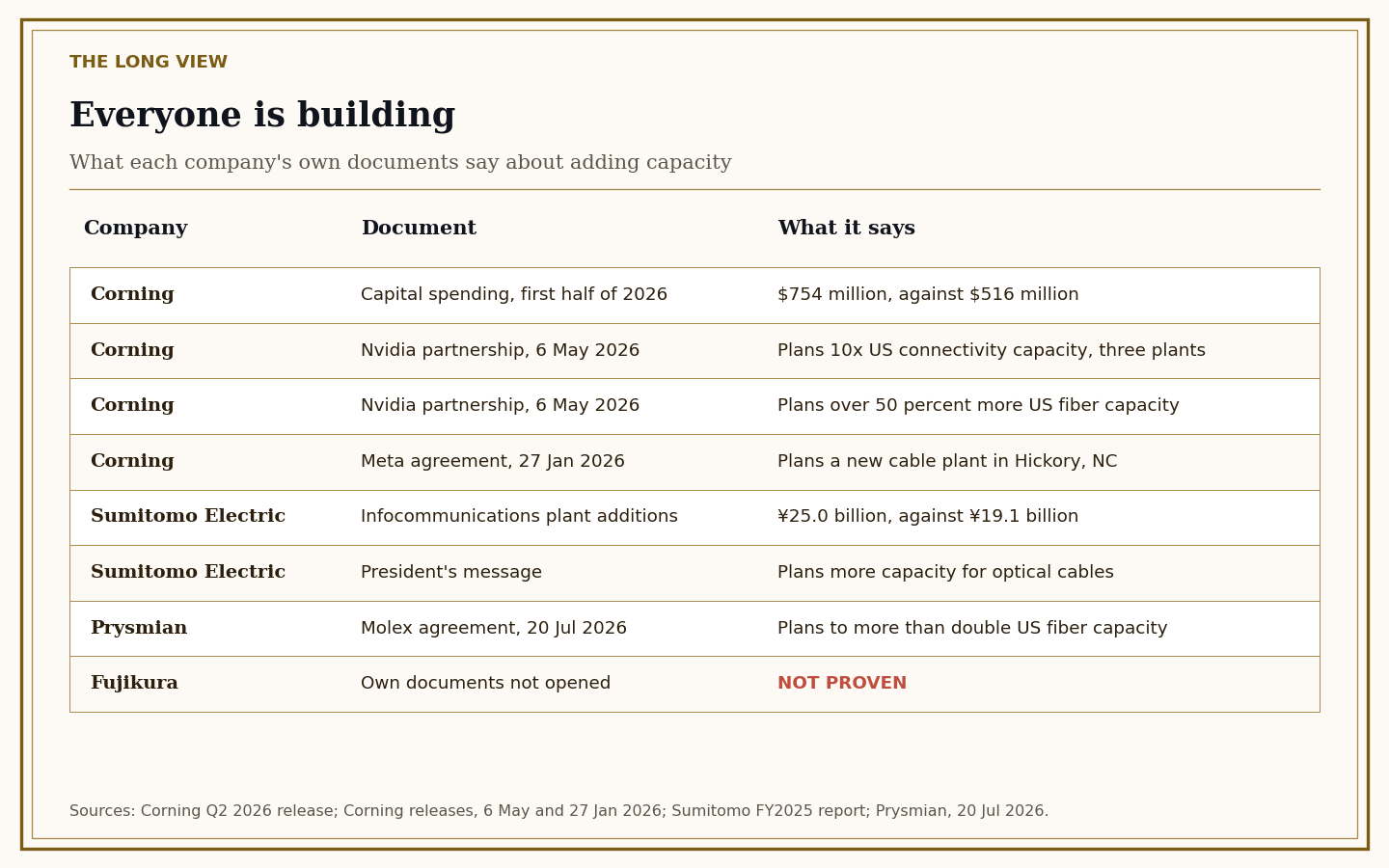
Corning’s second-quarter results release shows capital spending of $754 million in the first half of 2026, against $516 million in the first half of 2025, an increase of 46 percent. Its 6 May 2026 release with Nvidia commits Corning to a tenfold increase in US connectivity capacity, more than half again as much US fiber capacity, and three new plants. Its Meta release includes a new cable plant in Hickory, North Carolina.
Sumitomo’s financial section shows additions to plant in its info communications segment of ¥25.0 billion in its last fiscal year, against ¥19.1 billion the year before. The segment’s assets rose to ¥367.4 billion from ¥284.6 billion, an increase of 29 percent. Its president’s message says the company will strengthen production capacity for optical cables, connectors and optical devices for data centers.
Prysmian is building in the United States. Its release of 20 July 2026 announces an agreement of up to €5.5 billion with Molex, part of the large private American company Koch, for optical cables used inside data centers. It runs for up to ten years and includes a €550 million upfront payment. Prysmian says it will more than double its US fiber capacity, including the stage where the glass is made, and Molex’s own release puts the new US jobs at about 600.
What Corning wrote in 2000
Corning has written this paragraph before.
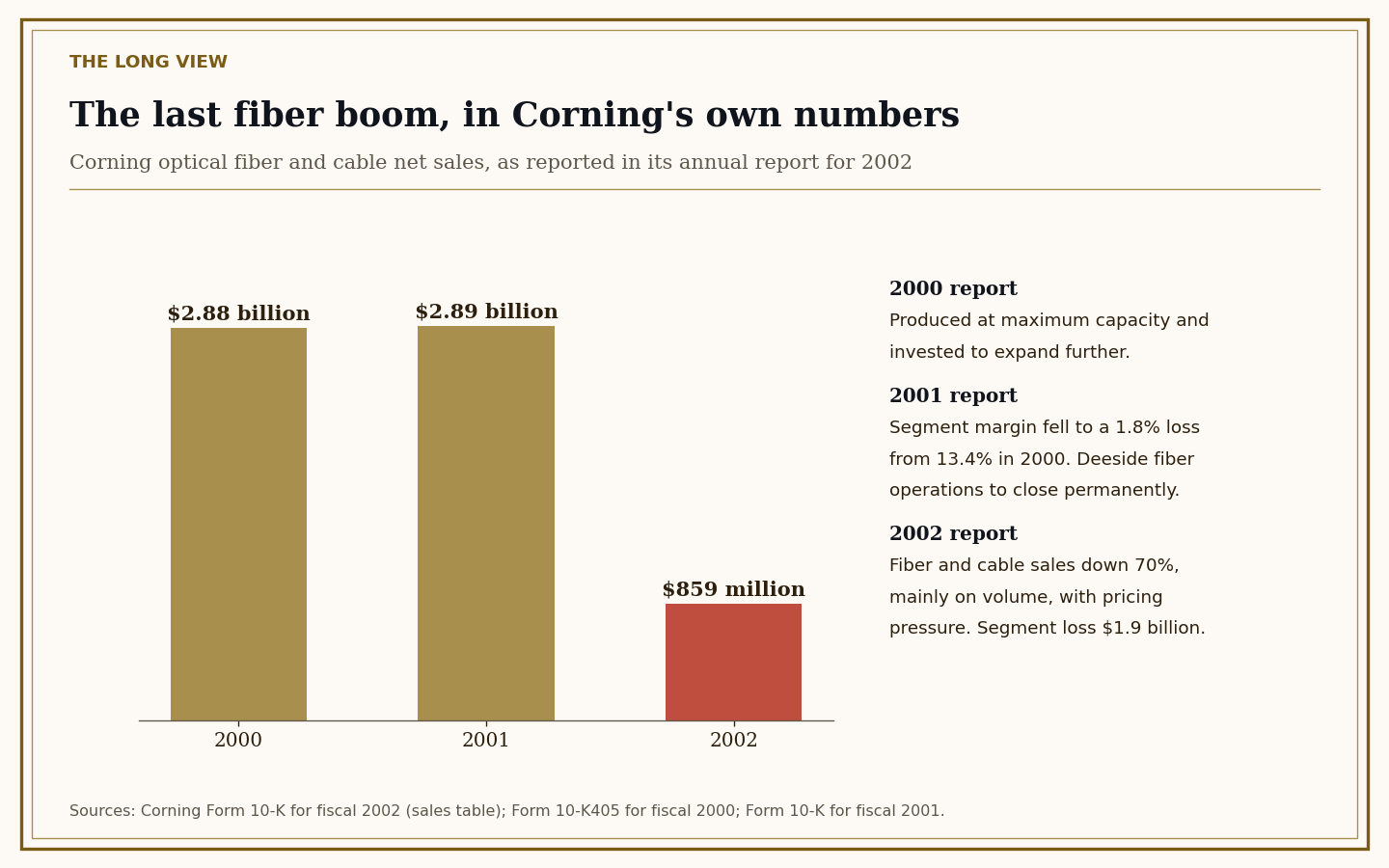
Its annual report for 2000, filed with the SEC, says sales in its Telecommunications segment grew 73 percent that year, driven by demand for premium fiber, cable and photonic products and by acquisitions. It says Corning continued to produce at maximum manufacturing capacity and invested capital to expand further. It lists the fiber capacity expansions announced that year, one of which would increase a fiber plant’s capacity by more than 50 percent.
The margin was wide then too. Corning’s annual report for 2001 shows Telecommunications segment net income at 13.4 percent of segment sales in 2000. In 2001 the segment lost money, at 1.8 percent of sales. That segment was defined differently from today’s Optical Communications, so its levels cannot be set against the 21.1 cents above. The direction is the lesson. A wide margin in a boom year said nothing about the year that followed.
The 2000 report also notes that in early 2001 several customers announced their order rate might be lower than expected.
What Corning wrote in 2002
Corning’s annual report for 2002 gives the outcome in its own table. Optical fiber and cable sales were $2.88 billion in 2000 and $2.89 billion in 2001. In 2002 they were $859 million.
The report says those sales fell 70 percent in 2002, primarily on a decline in volume, and it names pricing pressure in 2002. The whole Telecommunications segment, which also made photonic components, fell to $1.63 billion in 2002 from $5.19 billion in 2000. The Telecommunications segment lost $1.9 billion that year, including restructuring and impairment charges.
The capacity went into reverse as well. Corning’s 2001 annual report says it would permanently close its optical fiber operations in Deeside, North Wales, and its 2002 report refers to construction projects in the optical fiber business that had been stopped in 2001.
The technology was right in 2000. By 2002 the volume and the price were both wrong.
What is different now, and what is not
Some things are different. Corning’s 2001 annual report tied the slump to falling long-haul demand from telecommunications carriers. Today’s largest buyers are hyperscale cloud companies, and Tuesday’s piece showed one of them paid a $1.0 billion deposit under an agreement running through 31 December 2029. I found nothing like that deposit in the 2000 report, though I did not read every page of it. Corning is also not the only producer being paid in advance now: Prysmian’s Molex agreement carries a €550 million upfront payment.
One question these filings cannot settle is where the value in an AI cluster ends up. Light has to be made before it travels down glass, and the laser components that make it come from companies such as Lumentum (Nasdaq: LITE). A Form 8-K exhibit Lumentum filed on 2 March 2026 says Nvidia is investing $2 billion in it, alongside a multibillion-dollar purchase commitment for laser components. That is four times the $500 million Nvidia paid Corning. It does not make one company the better investment. It does show Nvidia committed more cash to the light source than to the glass, and Friday follows that road.
Some things are the same. Producers are adding capacity at the same time, and margins are rising across the industry at the same time. Corning’s 2000 report describes both.
Neither the filings nor I can say when, or whether, demand slows. Uncertain timing is not the same as unlikely. What the filings do show is that the hidden assumption this week, that Corning earns margins its competitors cannot match, is NOT PROVEN. The margins its competitors report look much like its own.
Tomorrow
Corning’s position is strong and its margin is rising. Its rivals report the same. There is one more fact in Prysmian’s release worth carrying into tomorrow. Prysmian describes itself as one of just three US manufacturers of fiber and optical cable. Corning is another, and of those two, only Corning trades on a US stock exchange. Amphenol (NYSE: APH) is the other US-listed company on Corning’s list of rivals, through its CommScope connectivity and cable unit, but it reports no fiber segment of its own.
Tomorrow the question becomes the price: what today’s share price assumes about growth and margin, and whether being the one clean US door into AI fiber has been priced in already.
Reply to this post with the question you most want answered about Corning’s price. Replies come straight to me, and I read them all.
Not investment advice. The subscriber decides.