

Corning Incorporated (NYSE: GLW) has spent 2026 announcing agreements with Meta, Amazon, Nvidia, Verizon, AT&T and two hyperscalers it has not named. The largest dollar figure in any of those announcements is Meta’s, and it is a ceiling: up to $6 billion. The firmest figure I found is in Corning’s quarterly report on Form 10-Q: a $1.0 billion deposit one customer paid in the second quarter, under a supply agreement that runs through 31 December 2029.
Disclosure: the author holds no position in GLW.
Monday’s piece set out who Corning competes with. Today reads what its customers have agreed to, document by document, and asks the question each announcement leaves open: what does it oblige anyone to buy?
What “up to” means
Corning’s release of 27 January 2026 describes a multiyear, up to $6 billion commitment from Meta for optical fiber, cable and connectivity. Meta is the anchor customer for a capacity expansion at Corning’s cable plant in Hickory, North Carolina, and the release adds a new cable facility there.
“Up to” sets a ceiling. It tells you the most the agreement could be worth. It does not tell you the least. The release gives no minimum purchase, no price per unit and no end date, so from the release alone the floor is NOT PROVEN.
A ceiling with an anchor customer and a new plant behind it still tells you something. Corning is building capacity around this customer. What the ceiling cannot tell you is how much revenue arrives, or when.
Seven agreements, read the same way
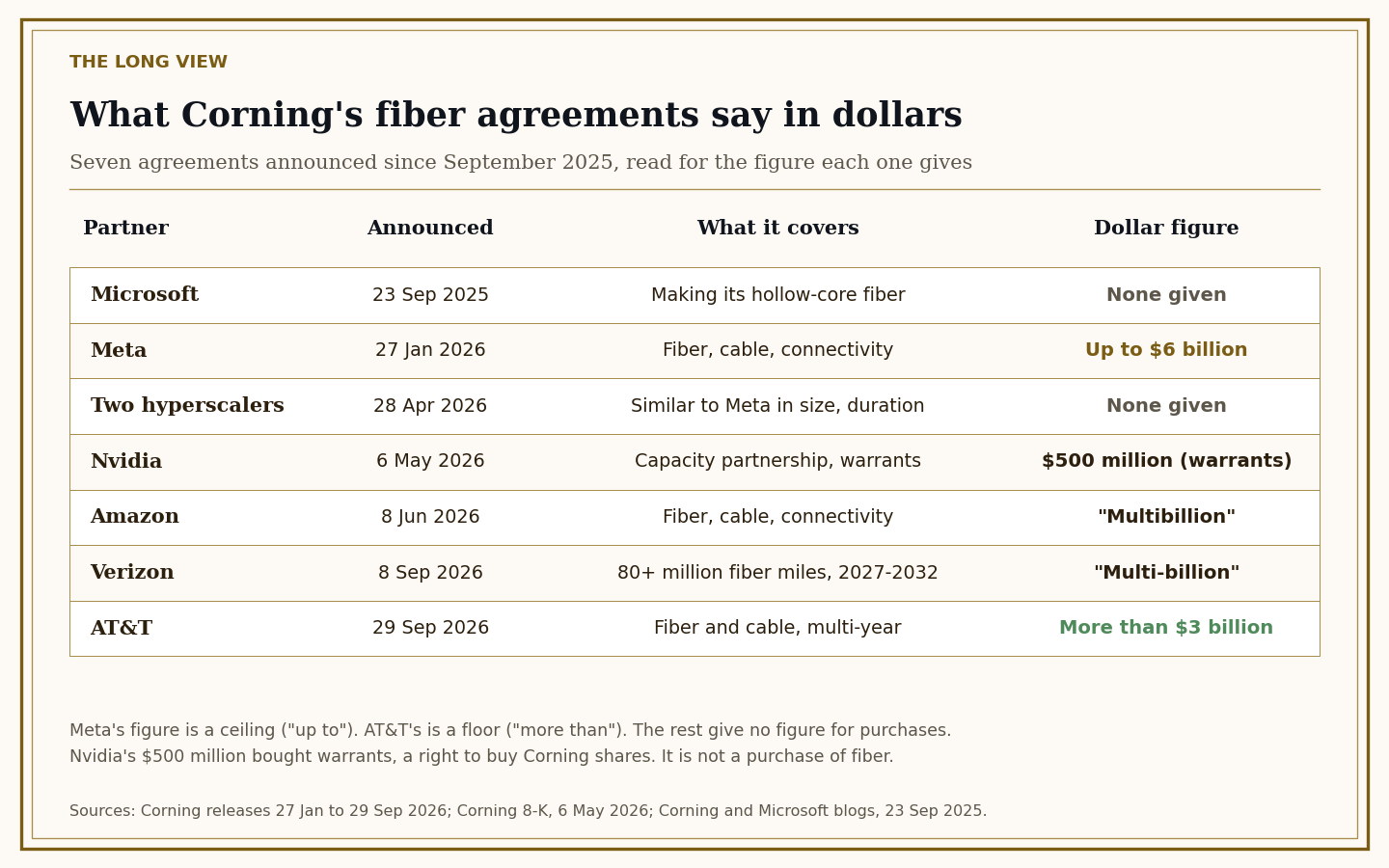
Here are seven fiber agreements Corning has announced since September 2025, each read for what it puts in dollars.
Microsoft, 23 September 2025: a manufacturing collaboration to produce Microsoft’s hollow-core fiber, which carries light through air instead of solid glass, in Corning’s North Carolina plants. Microsoft’s blog of that date names Corning and Heraeus as its first manufacturing collaborators for that fiber. No figure is given. Meta, 27 January 2026: up to $6 billion. Two hyperscalers, disclosed in Corning’s first-quarter results release of 28 April 2026: no names and no figures. Nvidia, 6 May 2026: a partnership under which Corning will increase its US optical connectivity capacity tenfold and its US fiber capacity by more than 50 percent, plus warrants Nvidia bought for $500 million. Amazon, 8 June 2026: a multiyear, multibillion-dollar supply agreement. Verizon, 8 September 2026: a multi-billion dollar agreement for more than 80 million fiber miles from 2027 to 2032. AT&T, 29 September 2026: a multi-year agreement valued at more than $3 billion for fiber and cable.
“Multibillion” is a size word. It rules out a small deal and nothing else.
Of the seven, two put a dollar figure on what the customer may buy, and they point in opposite directions. Meta’s is a ceiling: up to $6 billion. AT&T’s is a floor: more than $3 billion. A ceiling tells you the most a deal can be worth. A floor tells you the least. Nvidia’s $500 million is a different kind of number, and it gets its own section below.
Two of the seven cannot be checked from the customer’s side. Corning’s first-quarter results release says two additional hyperscale customers entered into large, long-term agreements, similar in size and duration to the Meta agreement, and it does not name them. Their existence comes from Corning’s filing with the SEC, and that counts. Who signed them, and on what terms, is NOT PROVEN.
Nvidia: $500 million paid, $2.7 billion optional
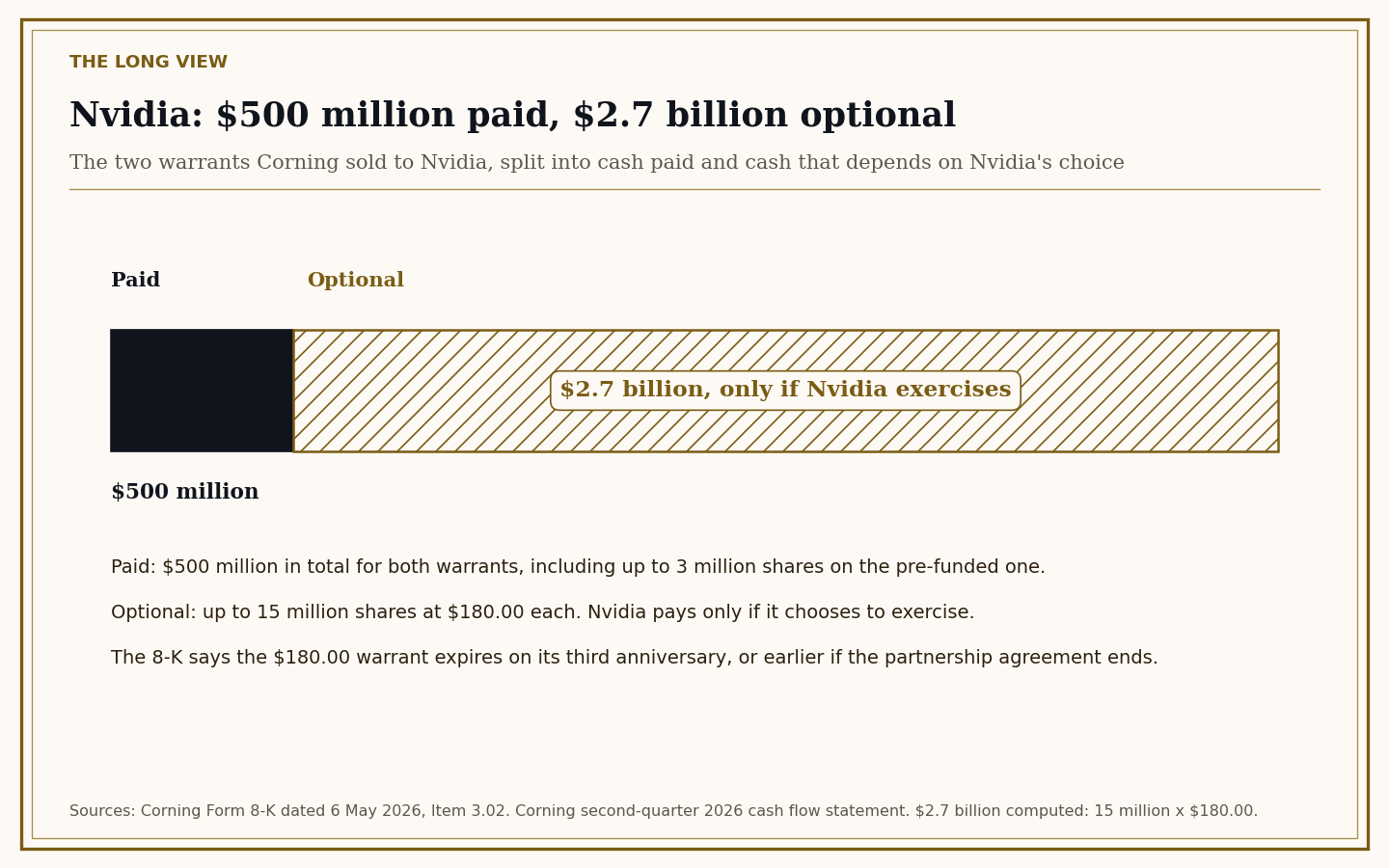
Corning’s Form 8-K dated 6 May 2026 describes two warrants sold to Nvidia. A warrant is a right to buy shares later at a fixed price. The first lets Nvidia buy up to 15 million shares at $180.00 each. The second, called pre-funded because the price was paid up front, lets it buy up to 3 million shares for $0.0001 each.
Nvidia paid $500 million for the two together, and Corning’s second-quarter cash flow statement records that sum as proceeds from warrants. The rest is optional. Buying all 15 million shares at $180.00 would cost Nvidia $2.7 billion, and only if it chooses to. The 8-K says that warrant expires on the third anniversary of its issue, or earlier if the partnership agreement ends.
One technology news site, AI Business, reported that Nvidia “invested $3.2B in Corning.” That figure adds an option to a payment.
Nvidia has committed $500 million in cash and holds the right to spend $2.7 billion more.
Amazon and Verizon: size words, no figures
Corning’s second-quarter results release describes Amazon’s agreement as multiyear and multibillion-dollar, covering fiber, cable and connectivity for Amazon’s US data centers. AWS chief executive Matt Garman said it would create 1,000 new jobs at Corning’s facilities, according to Optics & Photonics News.
Verizon’s agreement is the only one with a volume and a calendar: more than 80 million fiber miles from 2027 to 2032. The release I read gives no dollar figure beyond “multi-billion.” Its headline pairs broadband expansion with AI infrastructure, so not all of that fiber is for data centers.
A volume and a calendar make Verizon’s agreement the easiest to track. Between 2027 and 2032, Verizon’s own reports on its fiber buildout will show whether the miles are being laid.
Where the binding money shows up
Announcements describe intentions. The 10-Q shows cash.
Corning’s Form 10-Q for the quarter ended 30 June 2026 says customer deposits let customers secure rights to products under long-term supply agreements, typically for up to 10 years. Its 10-Q for the quarter ended 31 March 2026 adds that most of these deposits were non-refundable. A customer that pays a non-refundable deposit has put money down, rather than a signature alone.
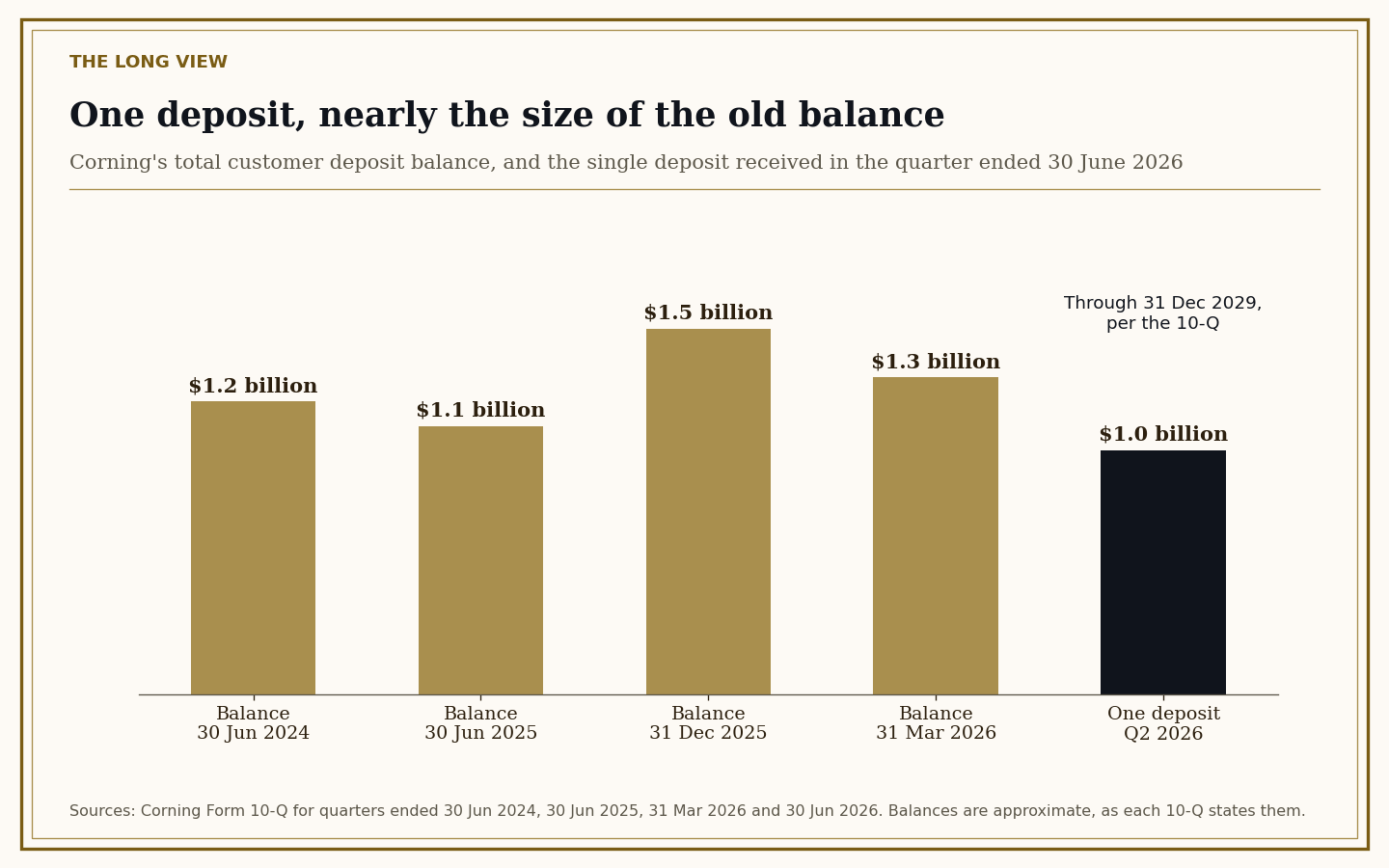
In the second quarter, the 10-Q records a $1.0 billion customer deposit under a long-term supply agreement extending through 31 December 2029. Corning’s cash flow statement shows customer deposits and government incentives adding $880 million to operating cash flow in that quarter, against $59 million in the second quarter of 2025.
Contract liabilities, the money Corning holds for products it has not yet delivered, stood at $2.7 billion on 30 June 2026, against $2.3 billion on 31 December 2025. Not all of that is fiber. Corning’s first-quarter 10-Q put customer deposits at about $1.3 billion and deferred revenue at about $737 million on 31 March 2026, and said the deferred revenue relates primarily to Hemlock Semiconductor, a business in its Solar segment. The $2.7 billion is a company-wide figure, and the fiber share of it is NOT PROVEN.
An announcement tells you what a customer might buy. A deposit tells you what it paid to hold its place.
A billion against two years of deposits
The size of that one deposit matters more when you set it beside what came before.
Corning’s 10-Q for the quarter ended 30 June 2024 put total customer deposits at about $1.2 billion. Its 10-Q for the quarter ended 30 June 2025 put them at about $1.1 billion. Its first-quarter 10-Q for 2026 put them at about $1.5 billion on 31 December 2025 and about $1.3 billion on 31 March 2026.
Then, in the quarter ended 30 June 2026, one customer deposited $1.0 billion. One agreement, in one quarter, added close to as much as Corning’s entire deposit balance at 30 June 2025.
Deposits also get used up. The second-quarter 10-Q says Corning applied $214 million of earlier customer deposits to customer bills in the first half of 2026, which is what happens as products ship. A deposit is a prepayment, and it becomes revenue only as products are delivered.
Who paid the billion
The 10-Q does not name the customer. It does say the $1.0 billion deposit was partly offset by $296 million for a warrant issued to that same customer, which Corning records as consideration payable to a customer. In plain terms, the accounting treats the warrant’s value as a discount given to the buyer.
The only warrants I found Corning issuing in that quarter are the two it sold to Nvidia, described in the 6 May 8-K. My reading is that the deposit came from Nvidia. That is a reading of two filings side by side, not a statement either filing makes.
What a deposit proves, and what it does not
A deposit proves that one customer committed real money for a fixed period. In what I read, it is the strongest evidence of commitment Corning has published this year.
It does not prove the price. The filings I read do not show a price per unit in any of these agreements, and whether the warrant bought better terms for the customer is not something they say. So whether Corning is charging more, less or the same as before is NOT PROVEN from the contracts.
That is the part the contracts cannot settle, and it is where the rivals come in.
The hidden assumption, after the contracts
The hidden assumption this week is that Corning’s size, contracts and technology turn into AI fiber revenue at margins its competitors cannot match, at a price that has not already paid for all of it.
Today tested the middle word. The contracts are real, and one of them is backed by $1.0 billion of cash. Most of what has been announced, though, is ceilings, size words and one floor, and none of it shows a margin. The contracts support the revenue half of the assumption. They say nothing about the margin half.
Tomorrow
Contracts tell you who wants Corning’s fiber. They do not tell you what Corning can charge for it. Tomorrow the rivals testify on that: Sumitomo and Fujikura on pricing, all of them on capacity, and what happened to fiber suppliers the last time the industry built at once.
Reply to this post with a company whose contracts you would like to read this way. I read every reply.
Not investment advice. The subscriber decides.