

Nvidia (Nasdaq: NVDA), Corning (NYSE: GLW) and Amphenol (NYSE: APH) each supply the AI data centers that Meta, Alphabet, Amazon and Microsoft are building. When those builders spend, the money turns into the suppliers’ sales. Which supplier depends most on a handful of buyers paying? I read each company’s own filings. The answer is not a tidy ranking, and two filings, read together, show the money does not stop at the first supplier it reaches. By the end you will know three places in a filing that show who pays a supplier, and where each trail runs out.
Disclosure: the author holds none of the companies named here.
The short answer to who leans hardest
On the figures I could open, Nvidia’s looks the most concentrated, with a caution below. Its quarterly report shows five direct customers made up 70 percent of the money customers owed it on 26 July 2026.
Corning’s fiber business comes next. Its annual report for 2025 shows two end customers made up 28 percent of that business’s sales. Amphenol’s annual report for 2025 shows no single customer at 10 percent or more of its sales.
One caution before you rank them. Those are three different measures: money owed on one day, a year of one business’s sales, and a year of total sales. They are not the same ruler. None of the documents I read tells you how much comes from Meta, Alphabet, Amazon or Microsoft by name.
Three places a filing shows who pays a supplier
The first is the customer note. I showed on 21 October how to find it: search a quarterly or annual report for the words “accounted for.”
The second is the end market. Some companies say how much of their sales go to one kind of buyer. If a company sells $100 of products and $36 goes to one kind of buyer, that market is 36 percent of its sales.
The third is money paid in advance. A customer deposit is cash a customer hands over before it receives anything, to make sure the product will be there. Say a customer pays $10 up front for fiber delivered over four years. The supplier has the $10, and it owes $10 of fiber. Accountants call that debt in products a contract liability.
A large deposit tells you two things. A customer wants the supply badly enough to pay early. And the supplier is tied to that customer for as long as the agreement runs.
Corning’s quarter: fiber sales up 44 percent
Corning reported its quarter to 30 September 2026 on 27 October. Its Optical Communications business, which makes fiber, cable and connectors, sold $2.38 billion. A year earlier it sold $1.65 billion. That is growth of 44 percent.
That business has two sides. Carrier networks serve companies that sell video, data and voice services. Enterprise networks are sold “to businesses, governments and individuals for their own use,” Corning’s annual report says, and the range includes products for very large data centers. Enterprise sales grew 84 percent in the quarter.
In the fiber business, Corning said it doubled its “Gen AI sales” from a year earlier, “outpacing GPU unit growth.” GPUs are the chips that run AI, the kind Nvidia sells.
Profit grew faster than sales. The fiber business earned $532 million in the quarter, against $295 million a year earlier. Corning as a whole grew more slowly: total sales rose 18 percent, to $4.86 billion.
The $1.0 billion deposit
Corning’s quarterly report for the three months to 30 June 2026 holds the most useful line in this piece. In that quarter, Corning recorded “a $1.0 billion customer deposit under a long-term supply agreement extending through December 31, 2029.”
The same sentence nets it against “$296 million for a warrant issued to the customer,” so Corning booked about $0.7 billion net. A warrant is the right to buy a company’s shares later at a set price. If the set price is $180 and the shares trade at $200, each warrant is worth $20.
Corning treats the $296 million as a discount on the customer’s price, taken off revenue “as sales occur under the agreement.” Put plainly, the customer committed $1.0 billion before delivery and got part of its price back in the form of a claim on Corning’s shares.
Corning’s total contract liabilities rose from $2.3 billion at 31 December 2025 to $2.7 billion at 30 June 2026.
A customer that commits $1.0 billion before delivery is telling you how much it wants the product. It is also telling you who the supplier now depends on.
Matching two filings: the trail leads to Nvidia
The note does not name the customer. Two other lines in the same quarterly report help. It records warrants issued on 6 May 2026 for up to 18 million shares. And it says the warrants were issued “in connection with the long-term partnership with a customer to strengthen U.S. manufacturing for AI infrastructure.”
Corning filed a current report, called an 8-K, dated 6 May 2026. It uses almost the same words, “long-term partnership to strengthen U.S. manufacturing for AI infrastructure,” and it names the other side: NVIDIA. Nvidia paid $500 million for the right to 3 million Corning shares at almost no further cost and got the right to buy up to 15 million more at $180 each.
Corning’s results release for that quarter adds a line: “We continue to deepen our long-term customer partnerships with industry leaders, most recently with Amazon and NVIDIA.”
Put together, the filings point to Nvidia as the customer behind the deposit. That is my reading of documents that share a date, a share count and nearly the same words. No single document says it in one sentence, and you should hold it at that strength.
You can check this in two searches. Open Corning’s quarterly report for the three months to 30 June 2026 and search “customer deposit.” Then open the 8-K dated 6 May 2026 and search “partnership.” Compare the wording and the share counts yourself.
The money does not stop at the builders
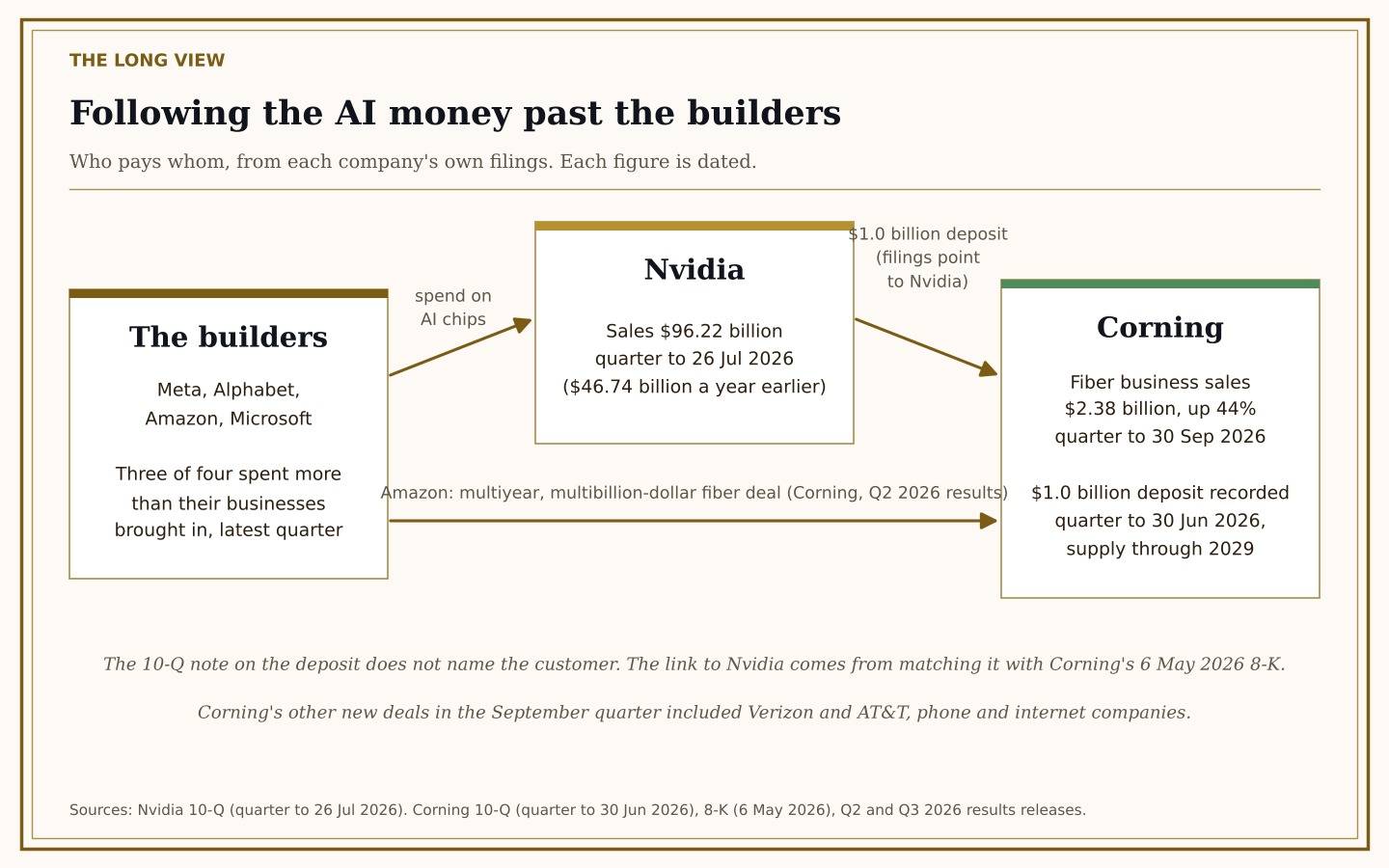
This changes how to think about who gets paid.
Nvidia’s sales in its quarter to 26 July 2026 were $96.22 billion, against $46.74 billion a year earlier. Its quarterly report lists the kinds of buyers it sells to directly, including cloud providers, AI model makers and the companies that assemble servers.
So money a builder spends on AI chips reaches Nvidia, directly or through the companies that assemble its servers. If the filings are read correctly, some of Nvidia’s money then went to Corning as a deposit, to lock in fiber through 2029.
The builders also pay Corning directly. Corning’s results for the quarter to 30 June 2026 name a “multiyear, multibillion-dollar agreement” to supply fiber, cable and connections for “Amazon’s expanding data center infrastructure across the United States.”
A supplier’s customer can be another supplier. Follow the money one more step than the headline does.
Corning’s other new deals went to phone companies
Here is the number beside the AI story. In its quarter to 30 September 2026, Corning said it “secured four long-term, multibillion-dollar customer agreements, including with Verizon and AT&T.”
Verizon and AT&T are phone and internet companies, not AI builders. The release does not say what the fiber is for. On its face, some of Corning’s new long-term business is with carriers, not with the four builders.
Corning’s annual report also warns that “a relatively small number of end customers account for a high percentage of our net sales in each of our business segments.” For the fiber business, that was two end customers and 28 percent of sales in 2025. The report gives the count and the share. It does not give the names.
Amphenol: spread out, with one large market
Amphenol makes connectors, sensors and other parts that link electronics together. Its annual report for 2025 says: “No single customer accounted for 10% or more of the Company’s net sales.”
The end market tells you more. “Sales into the IT datacom market represented approximately 36% of the Company’s net sales in 2025,” the report says. That is the largest of the markets it lists. Industrial came next at about 19 percent.
So no single customer brings Amphenol a tenth of its sales, but more than a third comes from one kind of buyer. Amphenol holds its call on the September quarter on 28 October, at 1:00 p.m. Eastern.
The hidden assumption
Owning an AI supplier rests on a hidden assumption: that its sales are paid for out of the builders’ earnings.
The builders’ own latest reports show that, for three of the four, they do not fully. In their latest quarter, Meta, Alphabet and Amazon each spent more on property and equipment than their businesses produced in cash. They covered the gap with borrowing and savings.
When a builder borrows to build, part of its suppliers’ sales rests on that borrowing too.
That is not a warning about any one supplier. It is a reason to read two sets of filings, the supplier’s and its customers’, instead of one.
Where each trail ran out
Every trail in this piece stopped before it reached a name and a percentage together.
Nvidia gives percentages for the customers that owe it most, and no names in the lines I read. Corning names partners in its results releases, gives a count and a share in its annual report, and does not put the two together in the documents I read. The deposit customer appears only by matching two filings. Amphenol reports no customer at 10 percent or more, and its customer note names none.
How much of any of these three suppliers’ sales comes from Meta, Alphabet, Amazon or Microsoft: NOT PROVEN, from the documents I read.
Of the three, Corning put the most in front of a shareholder. It named Amazon, Nvidia, Verizon and AT&T, and it put the $1.0 billion deposit in plain view.
What 28 and 29 October bring
Amphenol discusses its quarter on 28 October. The Federal Reserve’s rate decision comes that afternoon, and Alphabet’s and Microsoft’s results follow once trading ends. Amazon’s arrive on 29 October.
On Friday 30 October, the scorecard reads all four builders on the test set out on 26 October: spending plan, cash after spending, and debt. It adds two readings for Corning and Amphenol: sales growth against a year earlier, and the share from data center or AI buyers where the company gives it.
If there is a supplier you want traced the same way, reply to this post with its name. I read every reply.
Not investment advice. The subscriber decides.