

In the week of 12 October, insuring the debt of CoreWeave (Nasdaq: CRWV) against default came to cost more than 10 cents per dollar, every year, and the selling spread to companies around it. This week I am following that price through six AI-related companies’ filings, starting with the borrower where it began. By the end of this piece you will know the one assumption CoreWeave’s story rests on, and the number in its own 10-Q that tests it.
Disclosure: the author holds none of the companies named here.
The week the lenders raised their price
The week started with an inflation report. On Wednesday 14 October the Bureau of Labor Statistics reported that consumer prices rose 3.7 percent in the 12 months ending September, up from 3.4 percent for the 12 months ending August, with gasoline accounting for more than half of the monthly increase. Inflation that refuses to fall keeps another rate rise on the table, and a borrower feels that before anyone else.
CoreWeave, which rents out AI computing power, fell 15 percent that day, according to Forbes. By the end of the week, CNBC reported that insuring CoreWeave’s debt cost more than a tenth of the amount insured, every year, alongside a jump in the yields on its bonds. A rising yield means the bonds’ price fell.
Nvidia’s chief executive, Jensen Huang, told Bloomberg that CoreWeave’s position was stable and improving, and the stock closed higher that day. On Friday it fell again, by nearly 12 percent, and the Nasdaq Composite finished the week down about 4.5 percent, per CNBC. From $82.08 at the 9 October close to $61.39 at the 16 October close, CoreWeave’s shares fell 25.2 percent.
Nebius (Nasdaq: NBIS), which runs the same kind of business, fell from $221.07 to $165.47 between the 9 October and 16 October closes, also 25.2 percent. Its most recent quarterly results were released on 12 August, per the company.
In August I wrote that the AI build was increasingly paid for with borrowed money, and that credit spreads were one of four gauges worth watching. This was the week that gauge moved, for one company.
What a credit default swap measures
A credit default swap is insurance on a loan. The buyer pays a yearly fee, and if the borrower fails to pay, the seller covers the loss. The fee is quoted in basis points, hundredths of a percentage point, so 1,000 basis points means 10 percent of the amount insured, every year.
A stock price is what buyers will pay for the upside. A swap price is what lenders charge to carry the downside.
The lenders’ price comes from the same filing anyone can download. So I opened it.
What CoreWeave’s 10-Q shows
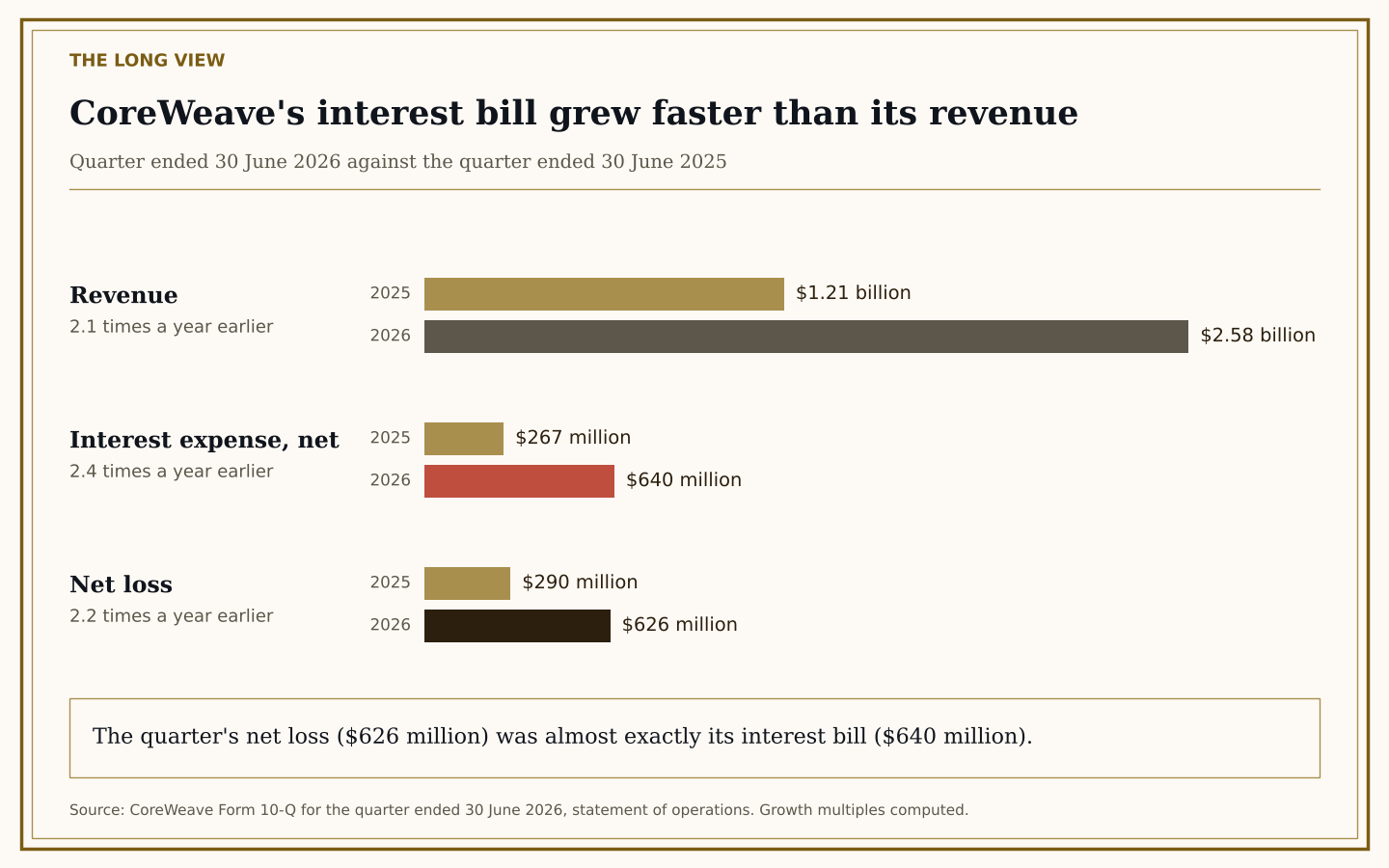
CoreWeave’s Form 10-Q for the quarter ended 30 June 2026 tells a growth story first. Revenue was $2.58 billion, against $1.21 billion in the same quarter of 2025, an increase of 112 percent.
Then read further down the income statement. Interest expense, net, was $640 million, against $267 million a year earlier, about 2.4 times as much. The business itself ran an operating loss of $49 million. The net loss for the quarter was $626 million.
The quarter’s net loss was almost exactly the quarter’s interest bill.
Revenue grew fast. The cost of the money that built the capacity grew faster. That gap is the reason a growing company can still frighten its lenders.
How the debt got there
The debt note in the same filing puts recourse debt at $31.41 billion and non-recourse debt at $3.66 billion on 30 June 2026, about $35.07 billion in total. On 31 December 2025 the same two lines totalled $21.37 billion. Recourse debt is money the company itself must repay. On non-recourse debt, lenders can look only to specific assets.
Add $16.54 billion of lease liabilities and you reach $51.6 billion, which matches the more than $51 billion of debt and obligations in CNBC’s coverage. When you see that number, know that it includes leases.
The cash flow statement shows why the debt grew. In the six months ended 30 June 2026, CoreWeave spent $14.12 billion on property and equipment. Its operations brought in $3.66 billion. It covered the gap by raising $16.75 billion of new debt, repaying $5.22 billion, and selling $2.98 billion of stock.
The price of that money is in the note too. The delayed-draw loan facilities carry effective rates of 9 to 15 percent, the senior notes 9 to 10 percent, and the convertible notes 2 percent. Of the total, $7.51 billion was classed as due within a year of 30 June 2026.
The hidden assumption
Against that debt sits a promise. The 10-Q reports $103.7 billion of remaining performance obligations at 30 June 2026. That is contracted work not yet delivered. The company expects 41 percent of it, about $42.5 billion, to become revenue in the 24 months ending 30 June 2028.
So here is the hidden assumption, stated plainly: CoreWeave’s customers pay on schedule, and that money arrives faster than the debt costs and comes due.
The filing tests part of it. One customer made up 36 percent of revenue in the quarter ended 30 June 2026, a second 26 percent and a third 10 percent. The revenue note labels them only as Customer A, B and C. Three customers produced 72 percent of the quarter’s revenue.
$103.7 billion of promises is not $103.7 billion of cash.
Some of it has been paid in advance. The same filing shows $9.7 billion of deferred revenue, customer money received for work not yet done. The rest arrives only as the work is delivered.
The filing tells you how much is owed to CoreWeave and by roughly when. It cannot tell you whether those three customers will keep paying.
What the bond market did not say
Three limits belong here. A default swap price is not a forecast of default. It is a price, and it can reverse in a day, as Thursday showed. This was also one borrower. On 9 October, the Friday before, ProShares noted that investment-grade credit spreads had barely moved, with nearly the whole rise in corporate bond yields coming from Treasury rates. Whether that held through the week is one of the gauges Friday’s piece checks. And nothing here tells you why any particular investor sold.
What the week does show is where the stress appeared first: in the price of lending to a company whose quarterly loss matches its interest bill.
The company that owes nothing
Here is what CoreWeave’s filing cannot explain. Fabrinet (NYSE: FN), which does optical and precision manufacturing for communications and data center customers, reported $875.1 million of cash and short-term investments and no outstanding debt at 26 June 2026, in its Form 10-K. It has no bonds for lenders to reprice.
Its stock fell anyway, from $486.28 at the 9 October close to $363.51 on 16 October. That is a fall of 25.2 percent, the same as CoreWeave’s to one decimal place.
Debt that is not yours can still reach you. Tomorrow’s notes lay out the clues. Wednesday’s piece follows the route from the borrower to the companies around it: Fabrinet, Bloom Energy, Corning and CrowdStrike.
Not investment advice. The subscriber decides.