

Chipotle passed every quality test we run, then fell far enough that, for the first time in years, the deep dive is worth starting. This is the piece that comes before the deep dive: whether the price has earned it. It has. Barely, and with a live question attached.
All week we showed the system saying no, fast. Sherwin-Williams beat its quarter and missed the bar its price set. Starbucks proved its turnaround and still costs too much. Both stayed on the watch list, and both saved you the two hours a deep dive would have taken. Today is the other half of the method, the part a filter that only rejects can never show you: a company that made it through.
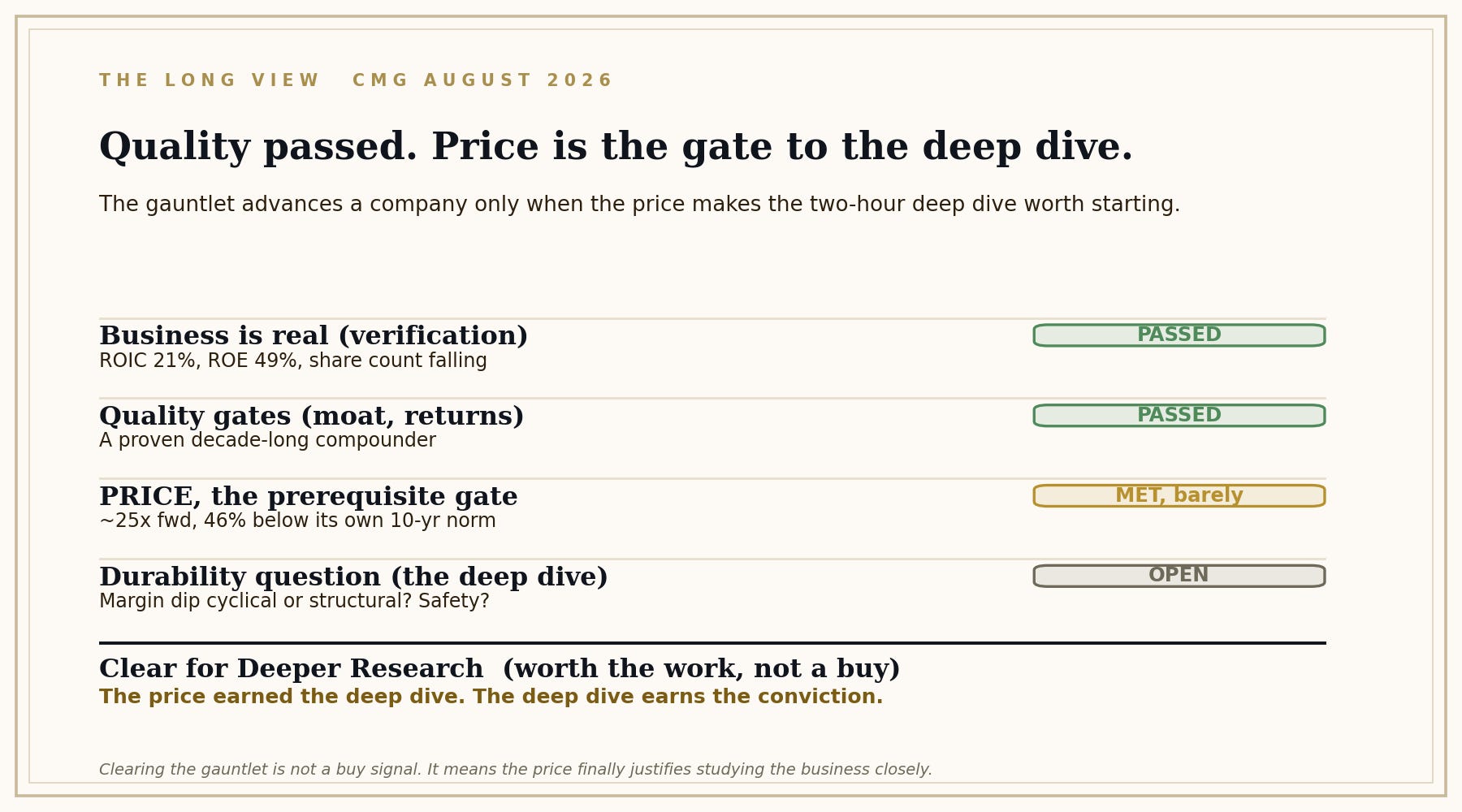
Chipotle cleared our gauntlet. It passed verification, and it passed the first gates, the business is real, the returns are high, the story holds. That is rare, and it is the reason Chipotle earns a different kind of piece than the other two. But clearing the gauntlet is not the finish line. There is one more gate, and it is the one this whole week has been about. Price sets the height of the bar, and the last question the gauntlet asks is whether the price has fallen far enough to make the deep dive worth doing at all.
The gauntlet is not a buy signal. It is an invitation to look harder.
Here is the distinction almost nobody draws. A company clearing our quality gates does not mean buy it. It means the business is good enough to be worth studying closely, if, and only if, the price gives you a reason to. A wonderful business at an absurd price is not a research priority; it is a company to admire and ignore until the price changes. So the gauntlet advances a company to one final question before any deep dive begins: has the price come to a level where two hours of your life would be well spent. That is the prerequisite, and you do not start the deep dive until it is met. For most of the last decade Chipotle failed it, trading at fifty, sixty, seventy times earnings, a magnificent company at a price that left nothing for the buyer. Something changed this year.
What the price is now
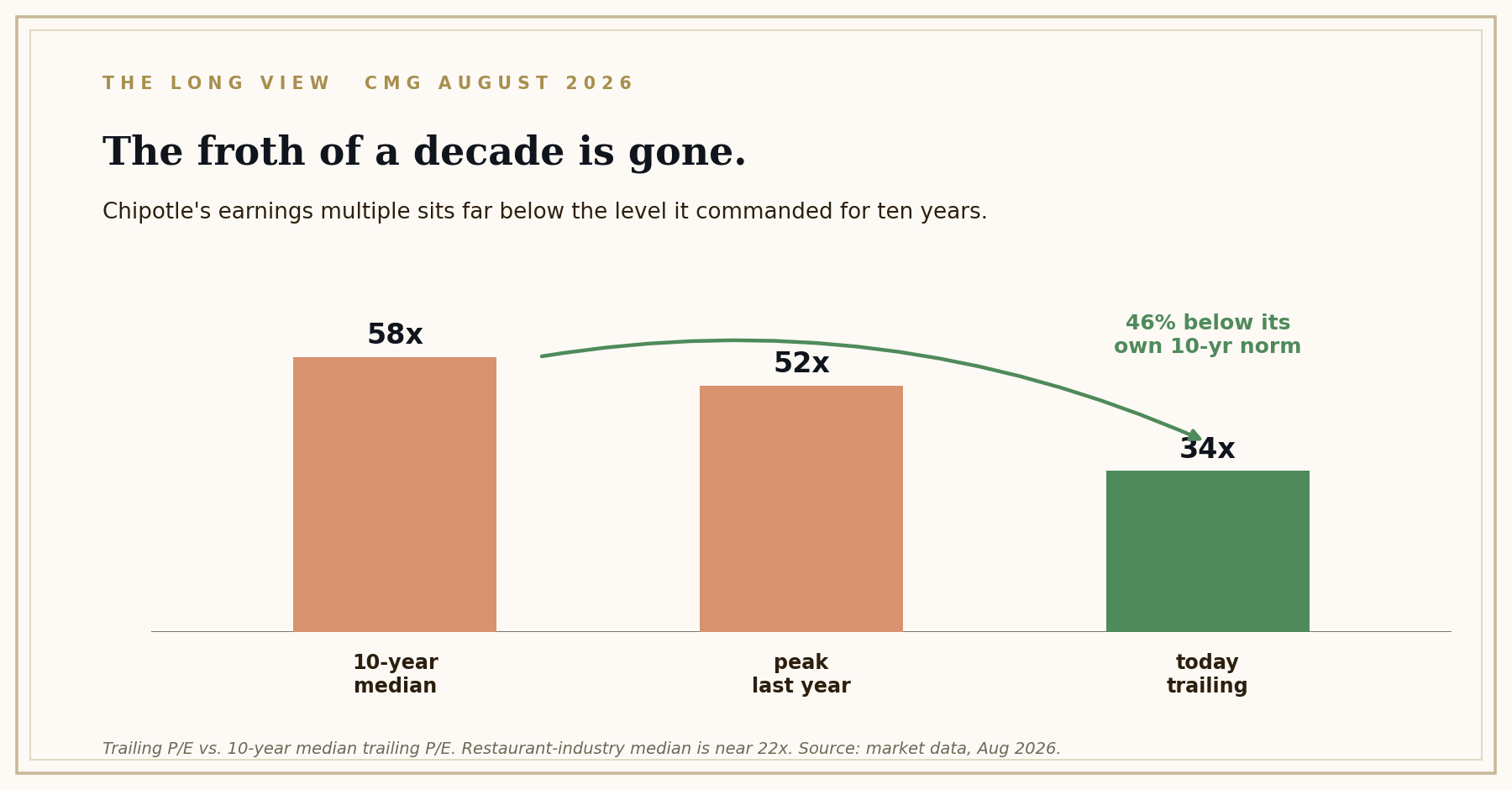
Chipotle has fallen roughly 38% over the past year. It trades near 25 times forward earnings, and about 34 times trailing. Hold those numbers against its own history: the ten-year median trailing multiple is close to 58. The stock sits about 46% below the valuation it has typically commanded. The froth of a decade is gone.
That is what makes this different from Starbucks, which we graded yesterday at forty times earnings, a price still assuming the ending. Chipotle is the opposite motion. This is a high-quality business that the market has truly marked down, not a hopeful one the market is paying up for. And the quality is not in question the way it is at a turnaround. Chipotle earns a return on invested capital above 21%, a return on equity near 49%, and it has been shrinking its share count. These are the numbers of a business that compounds, and they are still intact.
So the prerequisite is close to met. A business that compounds, at 25 times forward earnings and 46% below its own history, is, for the first time in years, priced well enough to be worth the deep dive. Not cheap. Good value, possibly, which is a different and higher standard. We are not looking for a low number. We are looking for a good business at a price that leaves us margin, and those are not the same thing.
The price we are using, and the prices we are not
Because the whole judgment rests on the price, the price has to be honest, with none of the sleight of hand that both the company and the Street use to make a stock look cheaper than it is. So here is exactly what we are counting, and what we are refusing to count.
We are refusing the company’s adjusted earnings. Chipotle, like everyone, will steer you toward figures that strip out the inconvenient parts, the outbreak impact, the one-time costs, the items management would rather you ignore. We value the whole company, ugly quarters included, on real earnings, because you are buying all of it, not the annotated version.
We are treating the forward multiple as a bet, not a fact. The stock looks cheaper on next year’s estimated earnings than on this year’s real earnings, and the entire gap between those two numbers is the Street’s assumption that the margin compression reverses. That assumption is the exact thing in question. So we show both: about 34 times the earnings that exist today, and about 25 times the earnings analysts are projecting if the recovery arrives. The trailing number is what you pay now. The forward number is what you pay if the bet works. Quoting only the forward figure, as most coverage does, quietly assumes the answer.
And we are ignoring two cosmetics. The share price near thirty-four dollars looks small only because of a fifty-for-one split; price per share is meaningless, the multiple is everything. And part of Chipotle’s per-share earnings growth is simply a shrinking share count from buybacks, not the business earning more, so we judge the earning power of the whole enterprise, not the flattered per-share optics.
Strip all of that away and the honest picture holds: a genuine compounder, at roughly 34 times real trailing earnings and 25 times a projected recovery, well below its own decade-long norm but still above its restaurant peers. That is the real price. Whether it is good value depends on the one thing the deep dive has to settle.
But the price fell for a reason, and that is the deep dive’s job
A stock does not drop 38% because the market got generous. It fell because something got worse, and naming that something is what the deep dive exists to do. Chipotle’s most recent quarter is the tell. Comparable sales grew just 2.2%, modest for a company that used to compound at double digits, and underneath, profitability compressed: restaurant-level margin dropped to 25.2% from 27.4% a year earlier, squeezed by beef, freight, and labor. The company beat and raised guidance, the stock jumped double digits on the day, and that applause is exactly what tempts an investor to skip the one question that matters. Is the margin compression cyclical or structural. If cyclical, this is a great business having a hard year at a rare discount, and the deep dive builds the conviction to act. If structural, if costs have permanently reset and Chipotle can no longer price back to prior margins without losing traffic, then the discount is not a discount, it is a fair price for a slower company. Same multiple, two opposite meanings, and only a deep dive resolves which.
And this week added a fresh complication that sharpens the point. A salmonella outbreak in Minnesota was traced to Chipotle, the company pulled jalapenos, and the stock fell about 7% on the news. Food-safety incidents are the one recurring scar in Chipotle’s history, and they matter to the exact question the deep dive must answer, because they hit both the near-term numbers and the long-term brand. Whether this is a contained event or part of a pattern is not something today’s article decides. It is something the deep dive investigates.
Where it sits: the prerequisite is met, the deep dive is earned
Chipotle moves to Clear for Deeper Research, and it is worth being precise about what that does and does not mean. It does not mean buy. It does not mean the margin question is answered, or the outbreak is behind them. It means one specific thing: the price has finally fallen far enough that a high-quality business is worth the two hours a real deep dive takes. For years it was not. Now it is.
That is the whole function of the prerequisite. It is the gate between “good company” and “good company worth studying at this price.” Sherwin cleared the quality bar and failed this gate, too expensive, stay on watch. Starbucks the same. Chipotle is the first company of the week to clear it, not because its business is better than Sherwin’s, but because its price fell and theirs did not. Price set the height of the bar, and Chipotle’s price finally came down to a height worth clearing.
What the deep dive would have to prove, and what would make it a buy
Here is the forward picture, so you know exactly what we are watching for. The deep dive turns into conviction only if three things line up. The margin compression proves cyclical, restaurant-level margin stabilizing and then recovering back toward the high 20s over the next two or three quarters, showing the cost reset was temporary. Comparable sales reaccelerating from the low single digits, proving the brand still pulls traffic and the growth engine is not permanently slower. And the food-safety issue proving contained, no pattern, no lasting dent to the brand that took twenty years to build.
Put those together with a price still near or below today’s 25 times forward, and Chipotle stops being a company we are researching and becomes a wonderful business at a fair price, the only kind we buy. Miss any of them, margins stay compressed, comps stall, or the safety issue recurs, and the discount was not a discount, it was the market correctly pricing a business that changed. We do not know yet which it is. That honesty is the point. The price has earned the deep dive. The deep dive earns the conviction. And we do not skip a single step, because skipping steps at the wrong price is exactly how good investors lose money on great companies.
This is where the week’s method comes full circle. The filter said no to Sherwin and Starbucks in minutes and saved you the hours. It said yes to Chipotle, not “buy,” but “now it is worth the work,” and it said so only because the price finally justified it. That is the whole system in one week: reject fast, advance rarely, and let price decide when a great company is finally worth your time.
Run any company through the Stock Story Firewall, free, at firewall.readthelongview.com. Subscribers get the Watch Cards, the Evidence tool, and the full Research Tracker, including every company we are watching and exactly what would move it from watch to work to conviction.
Chipotle cleared the gauntlet. The price earned it the deep dive. Whether it earns the buy is the next question, and it is the one we do not answer until we have done the two hours the price has finally made worth spending.
Not investment advice. The subscriber decides.