

What each of them keeps
Two department stores closed a quarter on the same day, 1 August 2026. They sell the same national brands to the same customer out of the same malls. Out of every dollar that went through the till, Dillard’s kept 4.6 cents and Macy’s kept 1.98. Both figures have the tariff refund taken out, because both companies got one and neither headline survives without saying so. More than twice the money, off the same racks, from the same labels. Today is about where that gap is, where it is not, and what each company would and would not let me see while I looked.
Dillard’s earned net income of $97.7 million on net sales of $1.51 billion in the quarter. Take out the $28.4 million after-tax tariff refund disclosed in its release dated 13 August 2026 and $69.3 million is left, which is 4.6 cents per dollar of sales.
Macy’s earned net income of $169 million on net sales of $4.87 billion. Its Form 10-Q attributes a 180 basis point rise in gross margin rate mainly to roughly $95 million of gross tariff refunds. Take that out on the same basis and about $96 million is left, which is 1.98 cents per dollar.
Now the interesting part, which is where that difference does not come from.
Not from what they charge
Dillard’s reported retail gross margin of 40.9 percent. Macy’s reported 41.5 percent of net sales.
Six tenths of a point apart, in favor of the one that sends discount codes.
Strip the tariff refund from both and Dillard’s falls to 38.3 percent while Macy’s falls to 39.5. The company with the promotional inbox is still ahead.
I did not expect that, and I would have bet money the other way. Owning your buildings, selling your own labels and never running a sitewide code ought to show up as a fatter margin on each sale. It does not.
How a store that cuts to 65 percent holds a 38 percent margin
Nothing in any filing explains this. The explanation arrived in my inbox.
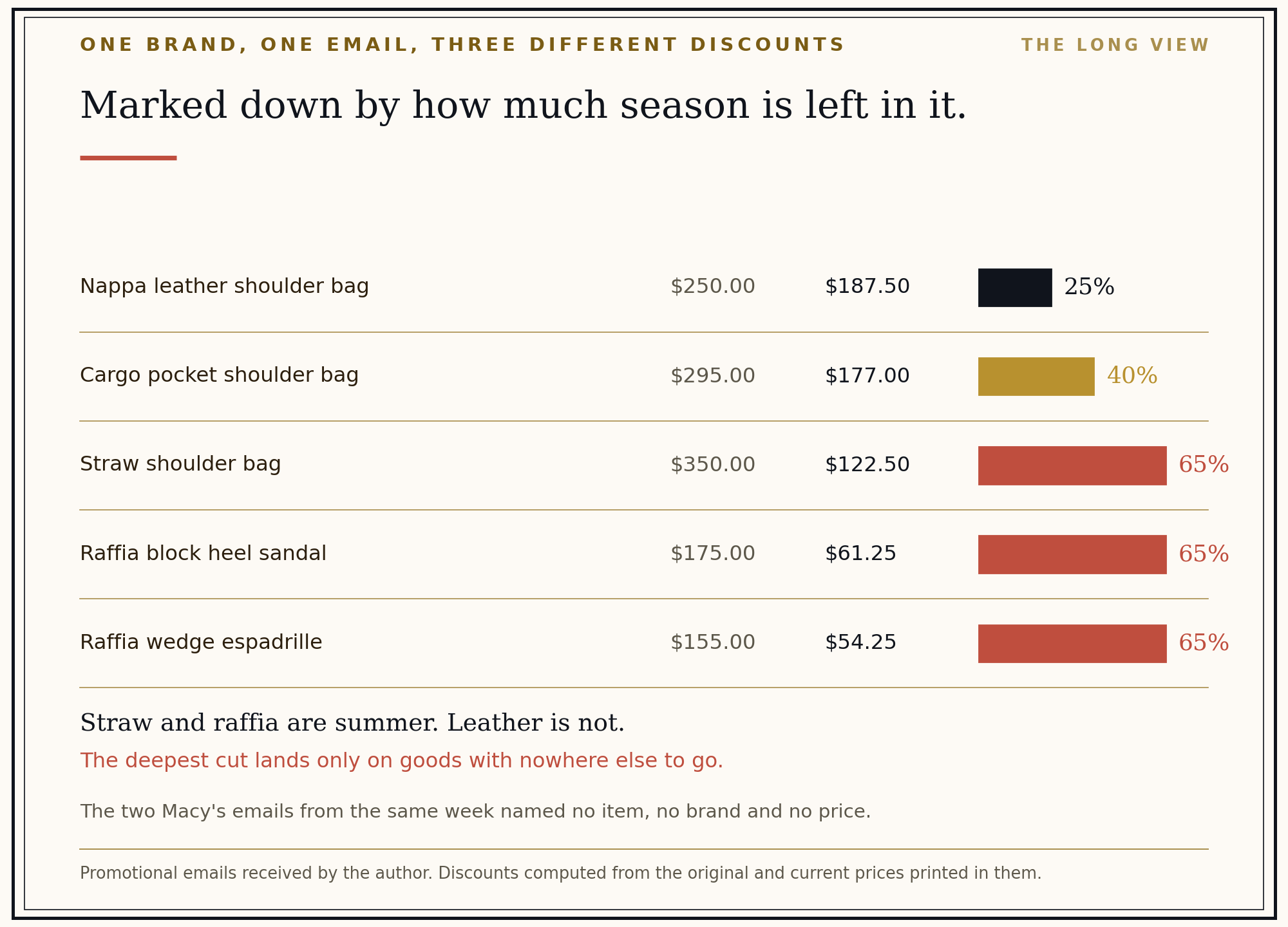
Dillard’s sent me an email of selected reductions. One brand, Lauren Ralph Lauren, appeared six times in it at three different discounts.
A straw shoulder bag, $350 down to $122.50, which is 65 percent off. A nappa leather shoulder bag, $250 down to $187.50, which is 25 percent off. A third bag, $295 down to $177, which is 40 percent.
Same brand, same category, same email, three different prices off.
Now look at what sits at 65 percent. Straw. Raffia espadrilles. Raffia block heels. Summer materials at the end of summer. The leather bag, which will sell in October, is at 25.
That is not a sale. It is a ladder that moves each item down as its season runs out, so the deepest cut lands only on goods with nowhere else to go.
And the same week, from the other one
On 1 September 2026, Macy’s sent me two emails ten hours apart.
The first offered $10 in Star Money, which the email describes as 1,000 bonus points, for shopping any two of five categories before the end of the month. Shoes, dresses, fashion jewellery, bed and bath.
The second was headed up to 70 percent off new clearance markdowns, and inside it said 40 to 70 percent off clearance, across nine departments.
Neither email named a single item. Neither printed an original price or a current one. Neither named a brand.
So one company tells me what one Lauren Ralph Lauren bag costs today and what it cost last month. The other tells me a department is somewhere between 40 and 70 percent off and offers me points for visiting two of them.
There is one more line worth reading, in the small print at the bottom of both Macy’s emails. Regular and original prices reflect offering prices that may not have resulted in actual sales. That is the company telling you, in its own footer, that the price it is discounting from may never have been a price anyone paid.
The Dillard’s emails I have do not carry that line. I have three of them, which is not enough to call it a policy, and it is enough to notice.
I am not going to tell you either of these is the better way to sell clothes. I will tell you that the company with the higher operating cost is the one that cannot, or will not, show you the price of a single thing.
It comes from the cost of running the store
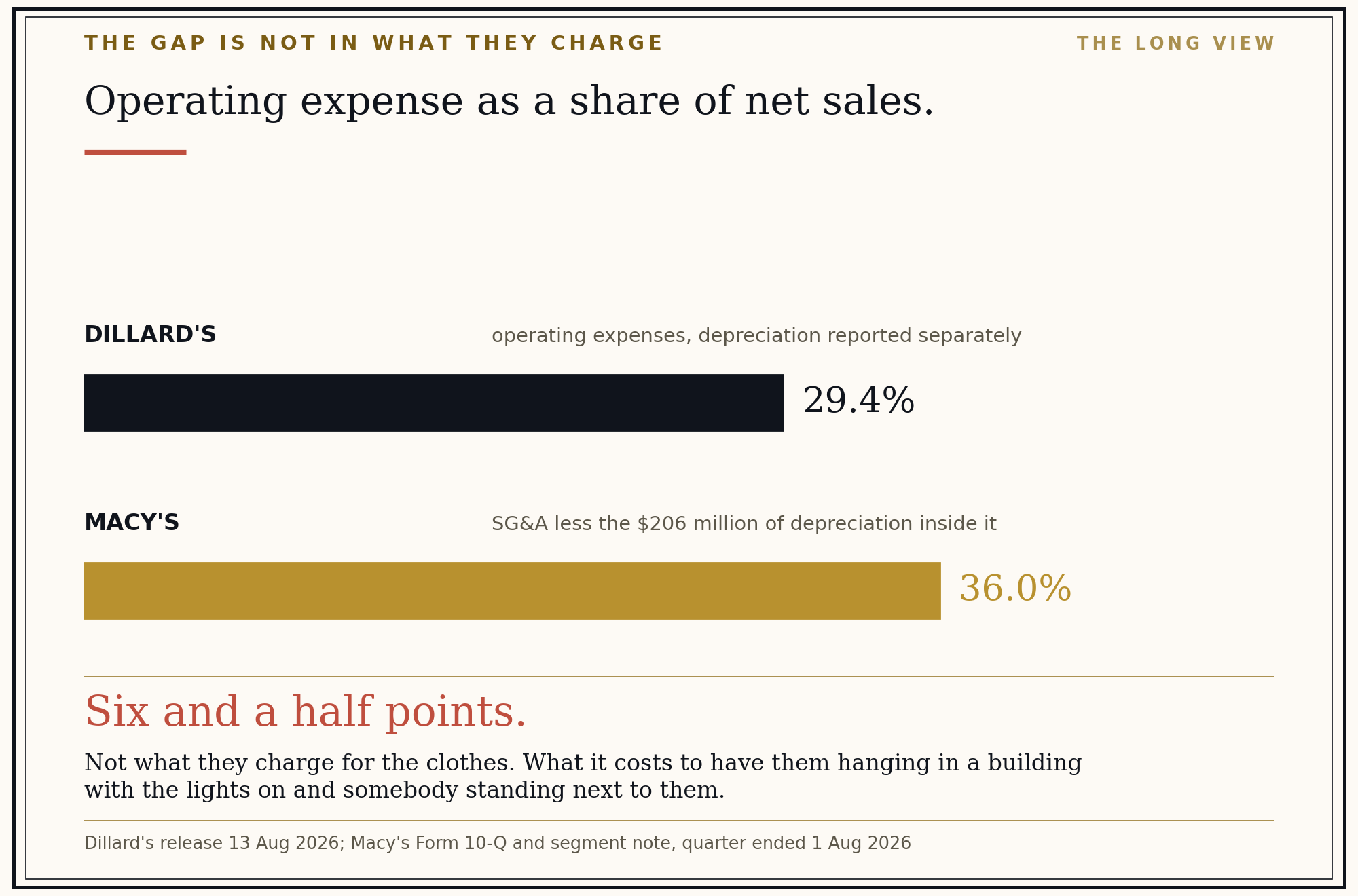
Dillard’s reported operating expenses of $443.6 million for the quarter, which is 29.4 percent of net sales, with depreciation on its own line below.
Macy’s reported selling, general and administrative expenses of $1.96 billion. The segment note in its Form 10-Q discloses that $206 million of that figure is depreciation and amortisation.
That matters, because the two lines are not the same measure until it is corrected. Take the depreciation out and Macy’s operating cost is $1.75 billion, which is 36.0 percent of net sales, against Dillard’s 29.4 percent.
Six and a half points. Not what they charge for a Ralph Lauren shirt. What it costs to have that shirt hanging in a building with the lights on and somebody standing next to it.
That is the entire difference between these two businesses in one line, and it is a thousand decisions rather than one.
What each company let me see
Here is a habit worth more than any single figure, and this quarter made the case for it.
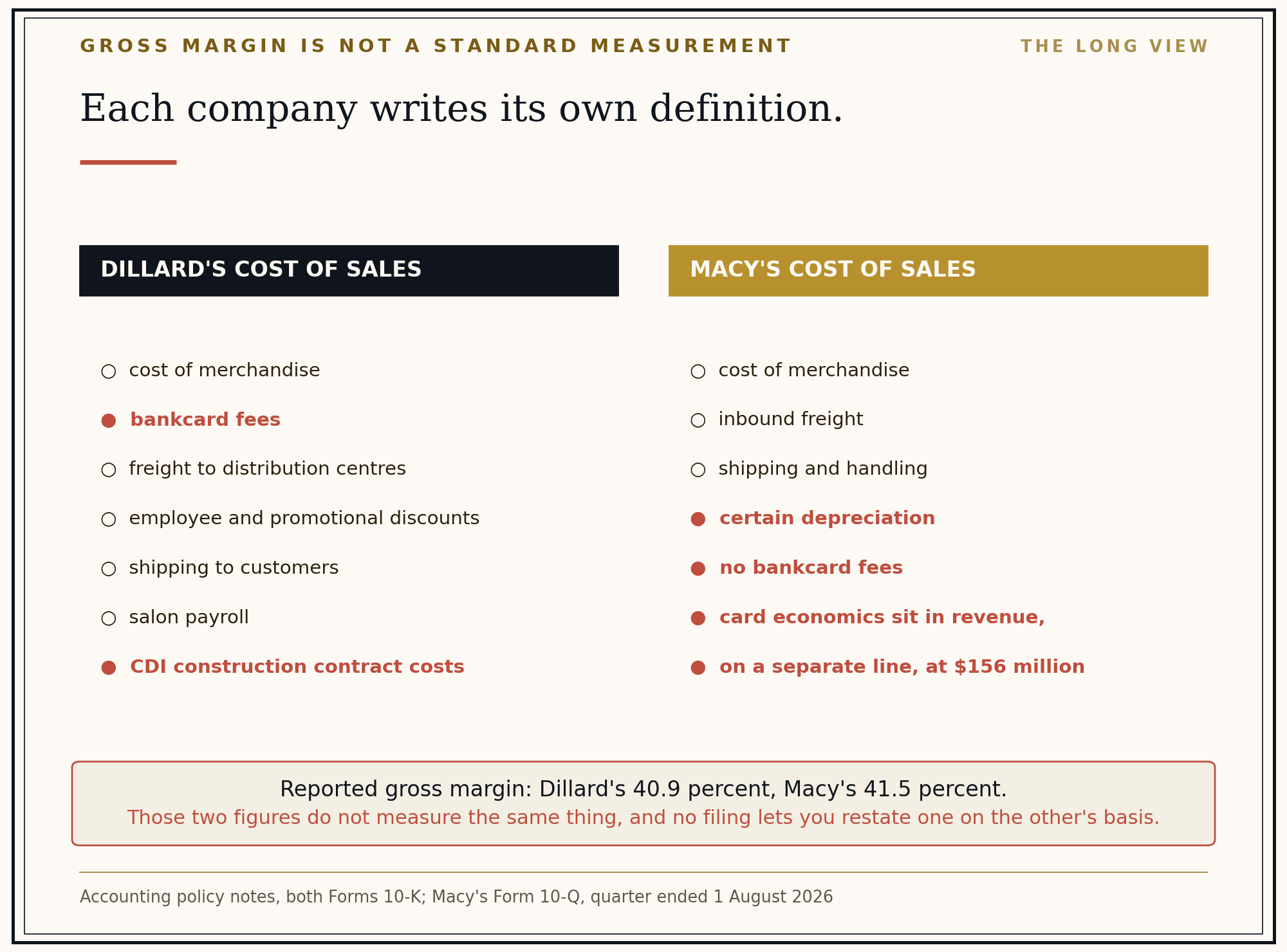
Before comparing two margins, open the accounting policy note in each company’s 10-K and read what each one puts in cost of sales. It takes about four minutes.
Dillard’s puts bankcard fees in there. Macy’s does not, and reports $156 million of credit card revenue on a separate line instead, so one company shows card economics as a cost inside the margin and the other as revenue outside it. Macy’s puts certain depreciation in cost of sales. Dillard’s keeps depreciation out of both lines.
Which means those two gross margins were never comparable and no arithmetic fixes it, and I would have compared them anyway if I had not read four paragraphs of boilerplate.
So I have started keeping score of something else. Every time this week one of these companies has stopped me finding an answer, I have written down whose wall it was.
Macy’s will not show square footage by ownership type, will not break out what its off-price business earns, and aggregates seven operating divisions into one reporting segment on the stated basis that they have similar economic characteristics.
Dillard’s will not break out its clearance centers either, does not separate occupancy inside operating expenses, and does not disclose the components of cost of sales.
Neither is doing anything improper. Both are within the rules. But conviction is built out of disclosure, and by Friday I will tell you which of these two companies gave a shareholder more to work with, because that turns out to be worth knowing on its own.
The method, in four minutes
This is the part you can take away even if you never look at either company again.
One. Open the accounting policy note in each 10-K and read what each company puts in cost of sales. If the lists differ, the gross margins are not comparable. No arithmetic fixes it and no analyst note will warn you.
Two. Find the operating expense line in each and check where depreciation sits. One company will often bury it inside and the other report it separately. Correct for it before comparing, and write down that you did.
Three. Check the period ends match. Two companies reporting a week apart is fine. Two reporting a quarter apart is not a comparison.
Four. Divide what is left after everything by sales. That figure survives almost any definitional difference, because by then every cost has been counted somewhere.
Four minutes of reading in front of every comparison you make. It is the difference between a number and an answer.
Where the six and a half points might sit
I can tell you the gap is real. I cannot tell you what it is made of, because neither company breaks operating expenses into parts. The candidates are rent, since Macy’s leases 340 of its 665 locations; store size, since 172 of those locations are small Bluemercury shops and small units cost more per dollar of sales than large ones; and digital, which Macy’s says was 31 percent of net sales in the quarter, and picking and shipping one order to a house costs more than selling it off a rack.
Three candidates, no proof on any, and each would be settled by a disclosure neither company provides. Which is another mark in the column I started keeping above.
Dillard’s, on the quarter’s own terms
Retail sales of $1.455 billion against $1.447 billion a year earlier, which is growth of one percent. Comparable store sales up one percent.
Retail gross margin of 38.3 percent with the refund removed, against 38.1 percent in the same quarter last year. That is flat, not improving.
Operating costs of 29.4 percent of sales against 28.7 percent a year earlier. Slightly worse.
So the quarter underneath the headline is a business holding its ground on a high margin and paying a little more to do it. The headline, at $6.25 a share against $4.66, tells a story of a company surging. $1.82 of that increase is a tariff rebate.
Macy’s, on the quarter’s own terms
Net sales up 1.1 percent and comparable sales up 2.7 percent, which is the better growth number of the two by a distance.
Then $193 million of other revenue that has nothing to do with selling clothes: $156 million from the credit card programme and $37 million from the media network. That is a second business attached to the first, and it carries almost no cost of goods.
And a gross margin that beat the company I assumed was the better merchant.
What it does not have is the expense line. Thirty-six cents of every sales dollar goes on running the operation before a penny of profit, against twenty-nine at the other company, and that is what turns a better top line into a thinner result.
Tomorrow
A business that keeps 4.6 cents of every dollar and a business that keeps two are not the same business, whatever the shop floor looks like. What happens next depends on what each one does with the money once it has it. Tomorrow: share counts, dividends, a merger completed in June, and who gets to decide.
Not investment advice. The subscriber decides.