

From the parking lot, these are the same business. Both anchor shopping malls. Both sell apparel, cosmetics and home goods. Both hang national brands on the rack beside labels they own outright. An outsider would assume two versions of one company, earning, keeping and spending money the same way. One of them sells more than three times as much as the other. Almost nothing else about them matches, and over five days I am going to show you exactly where they separate, using documents you can open for free.
One of these companies has a parade on national television, a flagship on 34th Street and a name that needs no explanation.
The other is a regional chain whose stores sit mostly in the south, the southwest and the midwest.
I own the regional one, and regular readers have heard me say so before. I will state it once and then set it down. My average cost is $33.43 and the shares have not been near that in a long time. That purchase is not the subject of this week and I am not going to spend five days admiring it.
I bought it because I had shopped there for years and never once walked out feeling I had overpaid. I buy clothes the way I buy stocks, which is to say I buy expensive things on sale. That is a customer’s edge, it is real, it is not analysis, and I did the filings work as well.
I do not own the famous one, and there is a problem with me that belongs at the top rather than buried. There is no Macy’s near me. I have bought from it online and the experience was fine. On Macy’s I have no customer edge at all, so everything I tell you about it this week has to come out of documents.
There is a second problem with the easy version of this comparison, and it is the more interesting one. The Dillard’s I bought and the Dillard’s that exists today are not the same investment. One was a company priced below the accounting value of its own assets. The other has multiplied many times over and is priced at more than four times that value.
So the week runs two comparisons rather than one. Macy’s today against Dillard’s today, which is a comparison of two businesses. And Macy’s today against Dillard’s in the condition it was in when I bought it, which is a comparison of two situations. Knowing one company well helps with both, and it helps in different ways.
Berkshire Hathaway has just bought the famous one, which is what put it on my desk.
Dillard’s, on its own terms
The Form 10-K for the fiscal year ended 31 January 2026 says Dillard’s was founded in 1938 by William T. Dillard, incorporated in Delaware in 1964 and reincorporated in Texas in 2025. The chief executive is William T. Dillard, II.
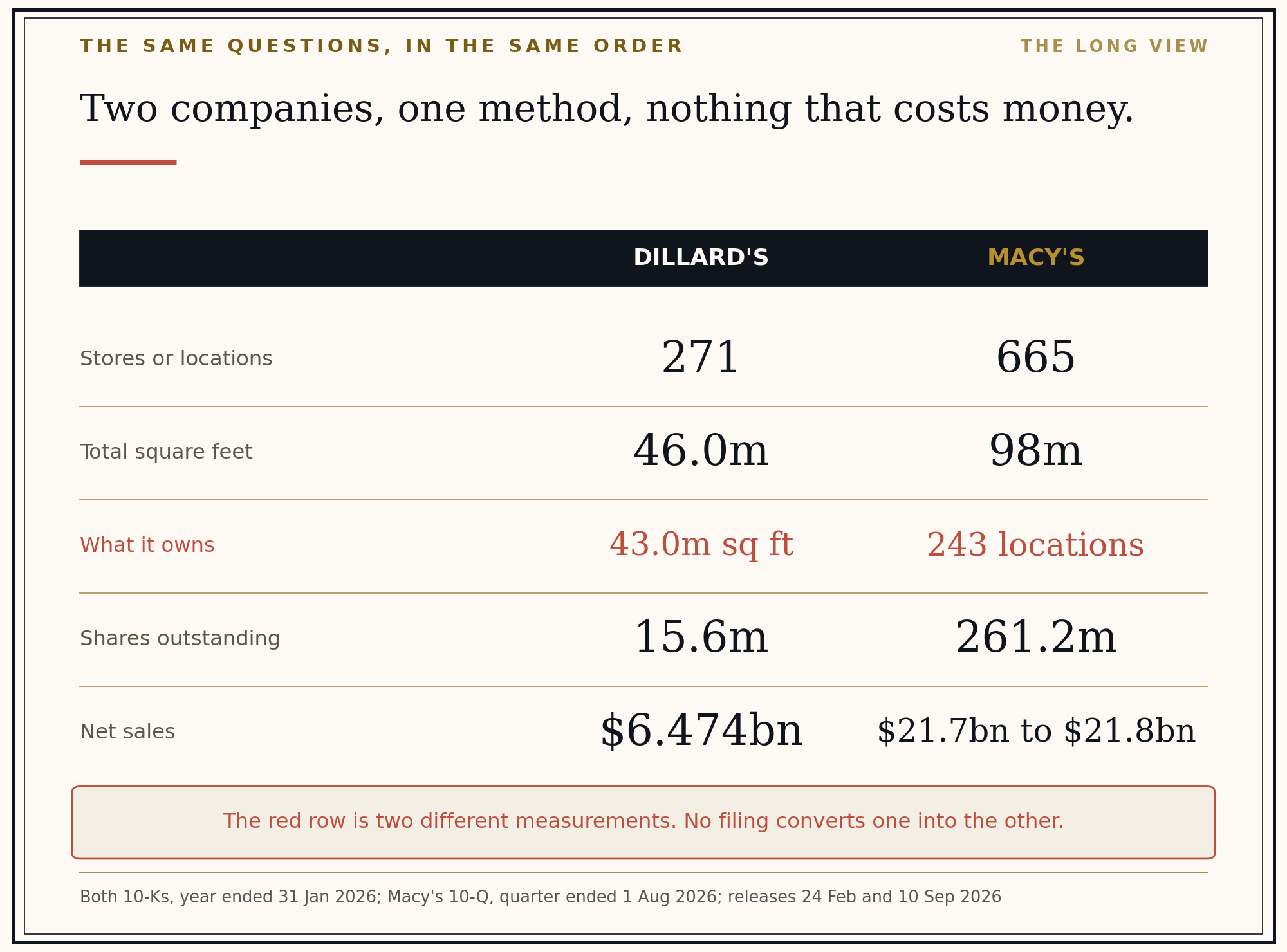
The same filing counts 271 stores in 30 states, including 28 clearance centres, totalling about 46.0 million square feet, of which the company owned about 43.0 million. It also runs a general contracting business, CDI Contractors, that builds and remodels its own stores.
For the 52 weeks ended 31 January 2026 the results release dated 24 February 2026 reports net sales of $6.474 billion, net income of $570.2 million and earnings of $36.42 a share. Shares outstanding at that date were 15.6 million.
For the 13 weeks ended 1 August 2026 the release dated 13 August 2026 reports total retail sales of $1.455 billion against $1.447 billion for the 13 weeks ended 2 August 2025, an increase of one percent, with comparable store sales up one percent. The company finished that quarter holding more than $1.2 billion in cash and short-term investments after repaying $96 million of debt. The margins and the expense lines are Wednesday’s work.
One line from the February release points the opposite way to Macy’s. Dillard’s said it planned to open a 160,000 square foot store in Beavercreek, Ohio.
Macy’s, on its own terms
The Form 10-K for the fiscal year ended 31 January 2026 counts 665 locations across 43 states, the District of Columbia, Puerto Rico and Guam, totalling about 98 million square feet.
Of those 665 locations, 243 were owned, 340 were leased, 79 were buildings the company owned on land it leased and three were partly owned and partly leased. All owned properties are held free and clear of mortgages. By nameplate: 432 Macy’s, 61 Bloomingdale’s, 172 Bluemercury.
Note 1 of the Form 10-Q for the quarter ended 1 August 2026 lists seven operating divisions: Macy’s, Macy’s Backstage, Macy’s small format, Bloomingdale’s, Bloomingdale’s The Outlet, Bloomie’s and Bluemercury. All seven are aggregated into one reporting segment, on the stated basis that they have similar economic characteristics.
For the same 13 weeks ended 1 August 2026 that Form 10-Q reports net sales of $4,866 million, up 1.1 percent, with comparable sales up 2.7 percent. It also reports $193 million of other revenue that has nothing to do with selling clothes: $156 million of credit card revenue and $37 million from Macy’s Media Network. Net income was $169 million and diluted earnings were $0.62 a share.
The release dated 10 September 2026 raised the outlook to net sales of $21.675 billion to $21.825 billion and adjusted diluted earnings of $2.15 to $2.35 a share for the fiscal year.
Read those two sections again and notice the shape of them. The same questions, for both companies, in the same order, out of documents that cost nothing. That is the whole method, and you can run it on any two companies you like.
The first thing that does not match
Both of those quarters ended on 1 August 2026. The two companies run the same fiscal calendar, which is what makes this comparison legitimate rather than approximate.
Now put the two full years beside each other. Dillard’s sold $6.474 billion of merchandise in its last completed year. Macy’s has guided to between $21.675 billion and $21.825 billion in its current one. The famous company is more than three times the size of the regional one.
Then look at how each company divides itself up. Dillard’s had 15.6 million shares outstanding at 31 January 2026. Macy’s had 261,176,646 at 29 August 2026, per the cover page of its Form 10-Q.
A Dillard’s share costs several hundred dollars and a Macy’s share costs about twenty, and that tells you nothing whatsoever about which is expensive. A share price is a company divided by a number the company chose. Dillard’s chose a small number. Macy’s chose a large one.
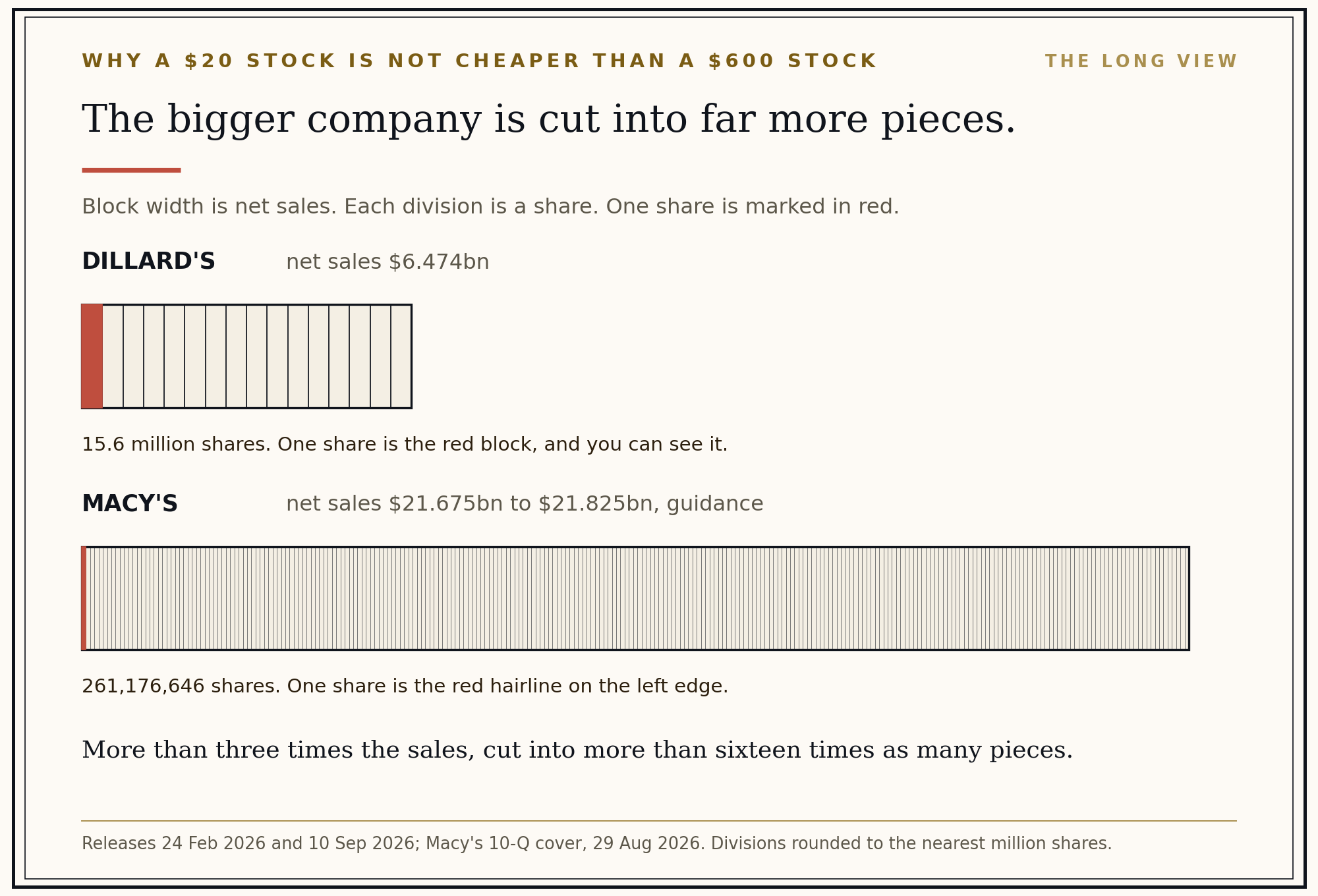
The same effect runs through the earnings line. Dillard’s earned $36.42 a share last year and Macy’s guides to about $2.25, which measures how finely each company sliced itself rather than how good it is.
So the outsider’s assumption has already failed once, and we have not opened a balance sheet yet.
Why Macy’s is on my desk at all
Berkshire Hathaway files a Form 13F every quarter, listing the American-listed shares it held on the last day of the quarter, up to 45 days after that day has passed.
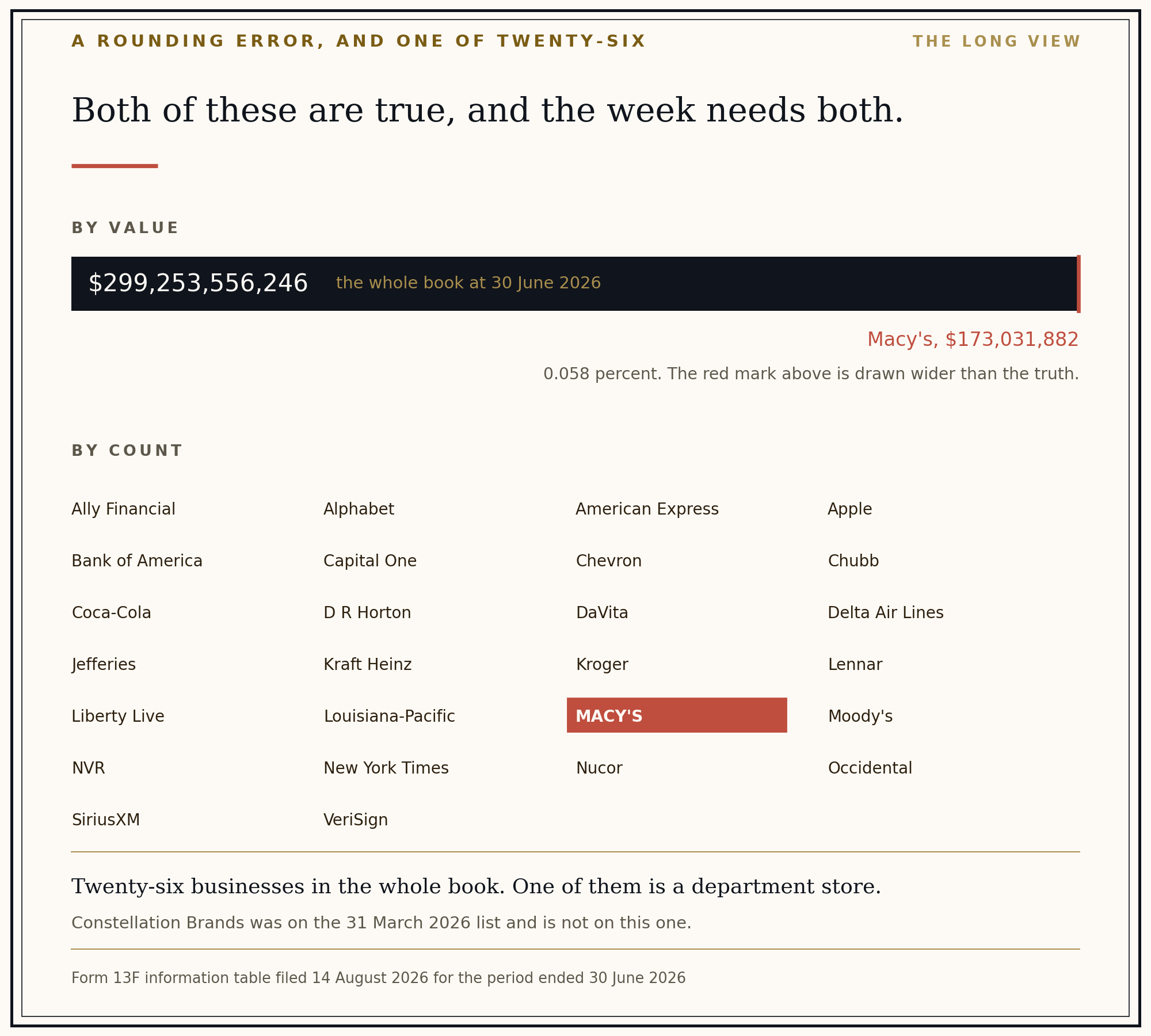
The information table in the Form 13F filed on 15 May 2026, for the period ended 31 March 2026, shows Berkshire holding 3,038,355 Macy’s shares valued at $54,963,842. The table in the Form 13F filed on 14 August 2026, for the period ended 30 June 2026, shows 7,347,426 shares valued at $173,031,882. The position was raised by 4,309,071 shares, which is 141.8 percent.
Add up every line of the June table and it totals $299,253,556,246. Count each company once, even where two share classes appear, and the table lists twenty-six businesses. Macy’s is 0.058 percent of that book.
Both of those are true and the week needs both. Macy’s is a rounding error in that portfolio. Macy’s is also one of twenty-six companies in it.
Here is what the filing does not do. It does not say who chose, or why, or what was paid. It does not show cash, bonds, shares listed outside America, or anything bought and sold inside the quarter. No one can read a motive out of it.
But there is a difference between claiming to know why somebody bought and asking what was there to be bought. The second question is work, and it can be done, because this buyer has published what it looks for. In print since around 1983: demonstrated consistent earning power, good returns on equity with little debt, management already in place, a simple business, and no turnarounds.
They were written for buying whole companies rather than small stakes, a distinction I will hold all week, but they are stated in public by the buyer, which makes them testable.
So this week runs them as a checklist against Macy’s, and against Dillard’s at the same time, because a checklist tested on one company teaches nothing. One of the five is already a problem and I am not going to make you wait for it. Macy’s is in the third year of a turnaround it announced in a release dated 27 February 2024.
Constellation Brands sits in the March table and is gone from the June one, which is a useful reminder of what appearing on that list is worth as a guarantee.
The five tests this week runs
Each is arithmetic on a free document.
Tuesday, what they own. Dillard’s owns about 43.0 million of its 46.0 million square feet. Macy’s owns 243 of its 665 locations. Those two disclosures are not the same measurement, which is a lesson in itself.
Wednesday, what each keeps from a dollar. The same thirteen weeks, gross margin against operating cost, with the tariff refund stripped from both sides before anything is compared.
Thursday, where the money went and who decided. Share counts, dividends, repurchase authorisations, new stores, closed stores, and a merger Dillard’s completed on 4 June 2026. One of these companies has a share class structure and a family behind it. The other fought off an outside bid.
Friday, the scorecard. The five published criteria, run against Macy’s with Dillard’s scored on the same five as the control. Where the evidence does not exist the answer is NOT PROVEN, which is a verdict and not a gap. Then each company’s price set against the accounting value of its own assets, for Macy’s today, Dillard’s today, and Dillard’s in the year I bought it. That measure is what made Dillard’s look cheap to me, and it is where you can check my judgement against my record instead of my opinion.
What this week will not do
It will not tell you what to buy.
It will not value either company. That is a separate week with its own standard of proof.
It will not tell you why Berkshire bought Macy’s, because no public document says. It will tell you which of the five published criteria Macy’s meets and which it does not, which is a different question and an answerable one.
And it will not tell you what the off-price business earns at either company. Macy’s aggregates its divisions into one reporting segment and Dillard’s does not break out its clearance centres, so that test cannot be run. On Tuesday I will give you the method anyway.
Tomorrow
Two companies sold the same brands to the same customer in the same thirteen weeks and ended up in different places. The trail starts with the least glamorous question in retail, which is who owns the floor the store is standing on.
Not investment advice. The subscriber decides.