

Amphenol Corporation (NYSE: APH) closed at $86.19 on 12 October 2026, per CNBC, which is 43.2 times what it earned over its last four quarters. That looks expensive until you set it beside growth: Amphenol’s earnings per share rose 74 percent in 2025. On Monday’s bar, that passes. The caveat sits one line lower in its own releases, where sales growth without acquisitions has slowed from 41 percent to 30 percent over three quarters. By the end you will know why both numbers are true, and which one the price is betting on.
Disclosure: the author holds no position in APH.
Amphenol is the second company this week to pass the bar, after Dycom on Tuesday. A bar that passes two companies in a row deserves a harder look, not a softer one, so today’s piece spends as long on the caveat as on the pass.
Where Amphenol sits on the road
Amphenol makes the connectors, cables and assemblies that join everything in a data center rack, and a great deal outside data centers too. Its 10-K for 2025 describes “active and passive fiber optic interconnect technologies” for the IT datacom market and lists optical fiber among its raw materials.
On 9 January 2026 it completed the purchase of CommScope’s Connectivity and Cable Solutions business for about $10.5 billion. Its closing release says the deal “adds significant fiber optic interconnect capabilities for the IT datacom and communications networks markets,” along with products “for the building infrastructure connectivity market.” Its 29 July 2026 release now expects that business to bring in $4.6 billion of sales this year, up from an earlier $4.1 billion.
From the day it closed to 30 June 2026, the CommScope business contributed $2.10 billion of sales and $190.2 million of net income, according to Amphenol’s second-quarter 10-Q.
Its 10-K names its primary competitors. Corning is on the list, alongside TE Connectivity, Molex, Belden and others.
Who pays Amphenol
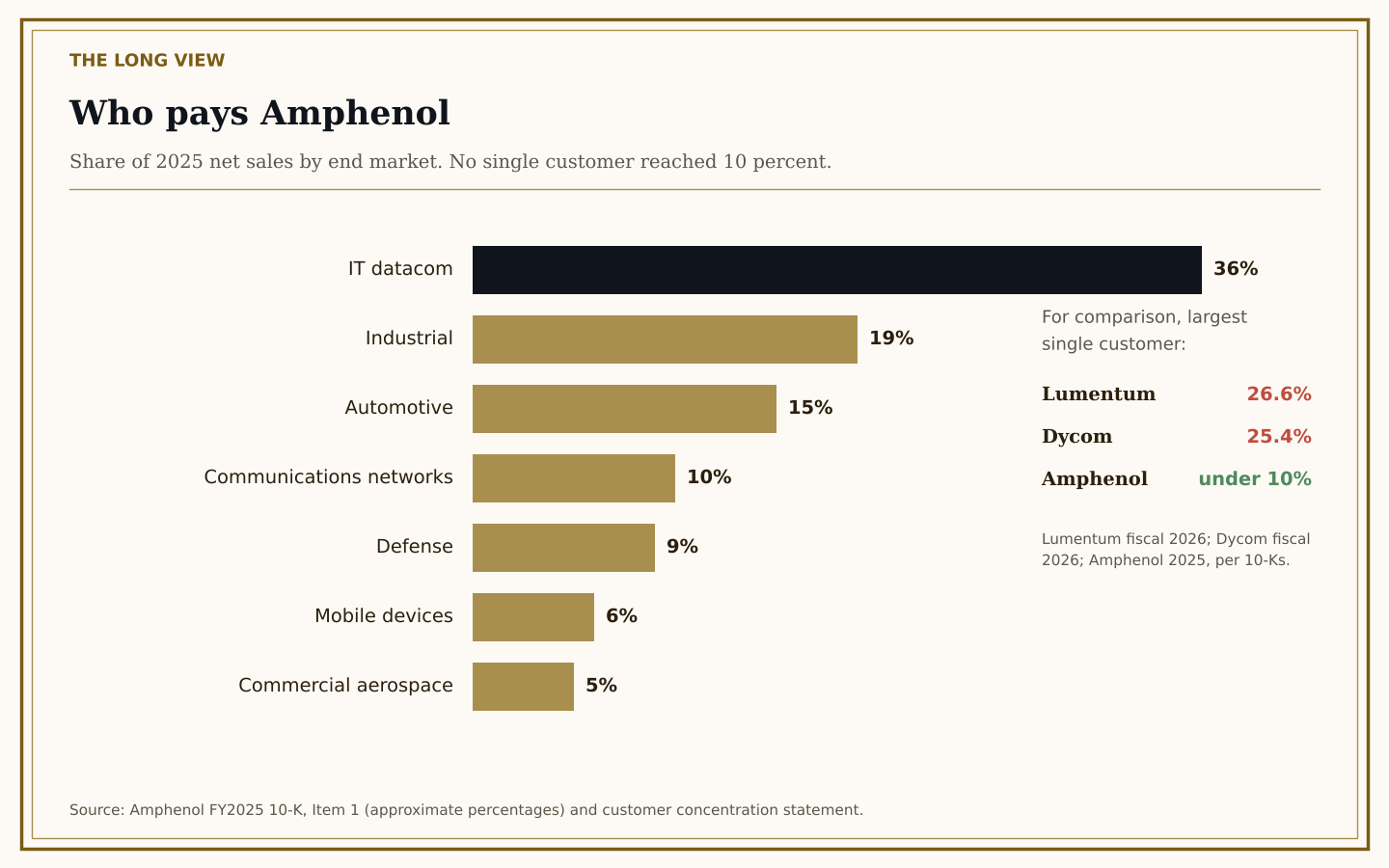
This is where Amphenol differs from every other company this week. Its 10-K says: “No single customer accounted for 10% or more of the Company’s net sales.”
Its sales spread across markets. In 2025, by its 10-K, IT datacom was about 36 percent of net sales, industrial 19 percent, automotive 15 percent, communications networks 10 percent, defense 9 percent, mobile devices 6 percent and commercial aerospace 5 percent.
IT datacom, the market that includes data centers, is the largest slice. The growth is concentrated in the segment that serves it. In the second quarter, Communications Solutions sold $5.38 billion against $2.91 billion a year earlier, with 42 percent organic growth. Harsh Environment Solutions grew to $1.86 billion from $1.45 billion, and Interconnect and Sensor Systems to $1.52 billion from $1.30 billion. No single buyer carries the weight that Lumentum’s largest customer does: one unnamed customer was 26.6 percent of Lumentum’s revenue last fiscal year.
The building connectivity Friday’s Corning piece pointed to sits inside the CommScope business. Amphenol does not split that business by market in the documents I read, so how much of it goes into ordinary buildings rather than data centers is NOT PROVEN.
Which earnings, after the split
Amphenol split its shares two for one, with the new shares distributed on 2 September 2026. Every per-share figure it printed before that date is on the old basis, including all four of its last quarterly results. Halving them is my arithmetic, not a company figure.
On that basis, standard-accounting earnings over the last four quarters add up to $3.99 a share before the split, or about $2.00 after it. Amphenol’s adjusted figure is $4.31, or about $2.16. The gap is mostly the first quarter of 2026, when discrete tax items and acquisition costs cut standard earnings to $0.72 against $1.06 adjusted.
Amphenol’s filings put its first-half 2026 tax accruals at $329.0 million, including $130.0 million from China tax determinations and $160.0 million from reassessing prior years. Its adjusted figure removes discrete tax items of this kind. Standard accounting keeps them.
One more item sits inside both. The second quarter included “an $80 million ($0.04 per share) net benefit related to the recovery of IEEPA tariffs.” Its third-quarter guidance, by its own words, “does not include any additional tariff recoveries.”
Amphenol’s earnings need two corrections before they can be priced: halve them for the split, and set the tariff refund aside.
The hidden assumption, tested
The Firewall’s hidden assumption for Amphenol is that its products are so embedded in AI data centers that demand stays structurally elevated, with above-average organic growth and expanding margins for years.
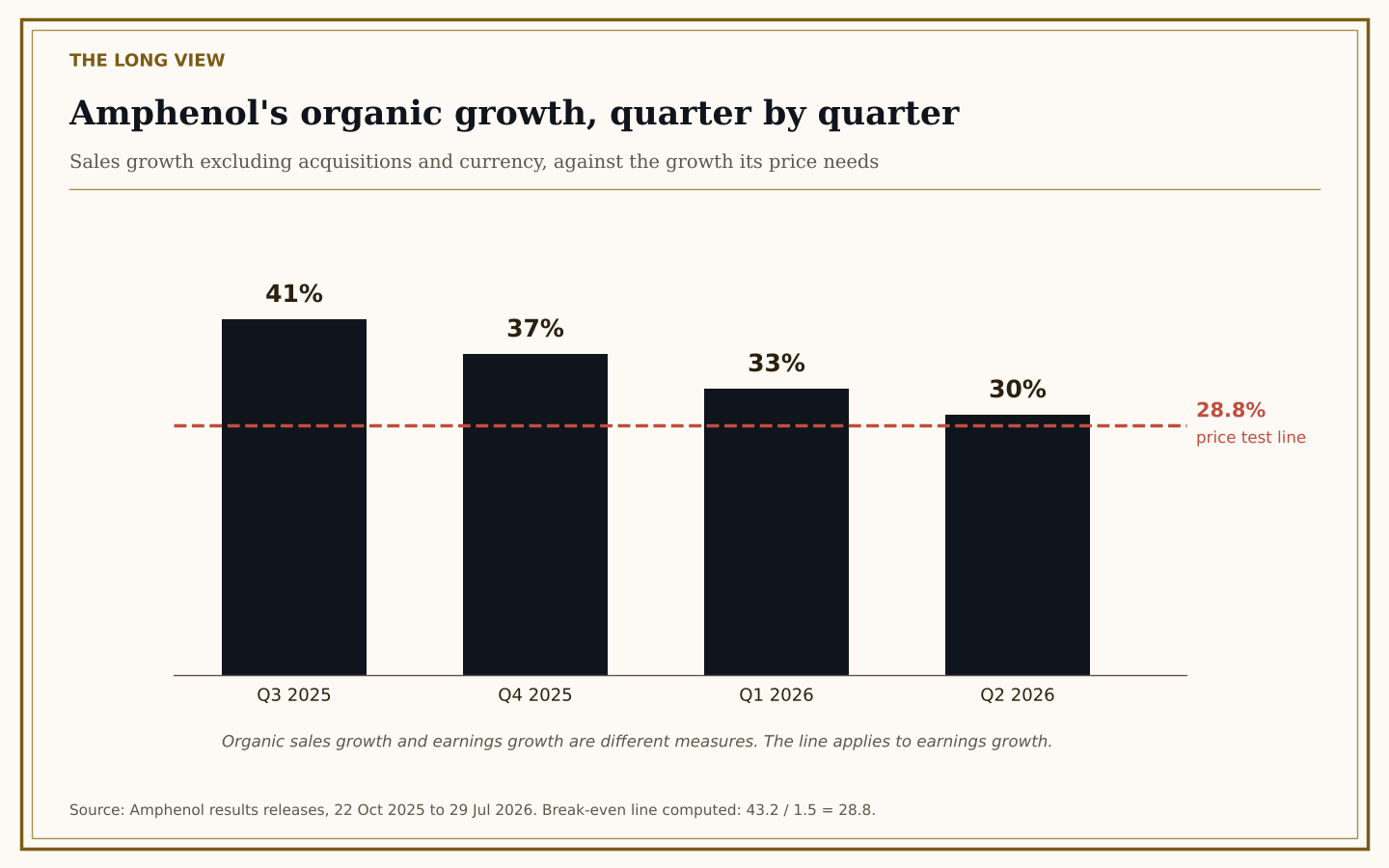
Organic growth strips out acquisitions and currency. Amphenol’s releases give it quarter by quarter: 41 percent in the third quarter of 2025, then 37, then 33, then 30 percent in the quarter to 30 June 2026. Still far above average. Also slower each time.
Orders point the same way. Amphenol booked $10.7 billion of orders in the second quarter against $8.76 billion of sales, a book-to-bill of 1.23 to 1. More orders came in than went out the door.
Margins are expanding. Adjusted operating margin was 29.8 percent in the second quarter, against 25.6 percent a year earlier. Take out the $80 million tariff refund and it is about 28.9 percent, still higher.
So the assumption holds today, on both counts. “For years” is the part no filing can test yet, and the organic trend is the number that will answer it first.
The growth rate the bar uses
On Tuesday, Dycom was measured on its standard-accounting earnings growth in its last fiscal year. Amphenol gets the same treatment. Its 2025 earnings per share were $3.34, against $1.92 in 2024, a rise of 74.0 percent.
Measured over the last four quarters instead, standard-accounting earnings per share grew 59 percent and adjusted earnings 73 percent against the four quarters before. Every version of the number is high.
That growth includes acquisitions and the AI demand wave at once. Sales rose 52 percent in 2025, 38 percent of it organic, by Amphenol’s fourth-quarter release. Earnings per share grew faster than sales.
Peter Lynch, in One Up on Wall Street, described fast growers as small, aggressive companies growing 20 to 25 percent a year. Amphenol is valued at about $212.5 billion and grew earnings 74 percent. That combination is rare, and my reading is that Lynch would ask first how long it can last.
Amphenol against the bar
Test one, defensible earnings: yes, about $2.00 a share of standard-accounting earnings over the last four quarters, after the split, with the tariff refund noted. Test two, price against growth: at $86.19, the shares trade at 43.2 times those earnings. Against 74.0 percent growth, that is 0.58 times the growth rate. The bar allows 1.5. Test three, cash: free cash flow was $4.39 billion in 2025, positive.
Amphenol passes all three tests of the bar. It is classed deserves serious review, the second company this week to earn the deep dive.
The pass is real. So is the condition attached to it: the price needs growth to stay above about 29 percent a year.
The caveat, in one number
At 43.2 times earnings, Amphenol stays inside the bar as long as growth stays above 28.8 percent. Below that, it fails.
Organic sales growth was 30 percent in the latest quarter. Sales growth and earnings growth are not the same measure, but they have moved together here, and the organic line is falling toward the edge of the bar. On that measure, the same price is 1.44 times growth. At 25 percent, it would be 1.73, and Amphenol would fail.
The near term argues the other way. Amphenol’s guidance for the quarter to 30 September calls for sales of $9.3 billion to $9.4 billion, up 50 to 52 percent, and adjusted earnings per share up 51 to 53 percent on the old share basis. If that arrives, growth stays far above the line for at least one more quarter. Guidance is a forecast, and the release on 28 October will settle it.
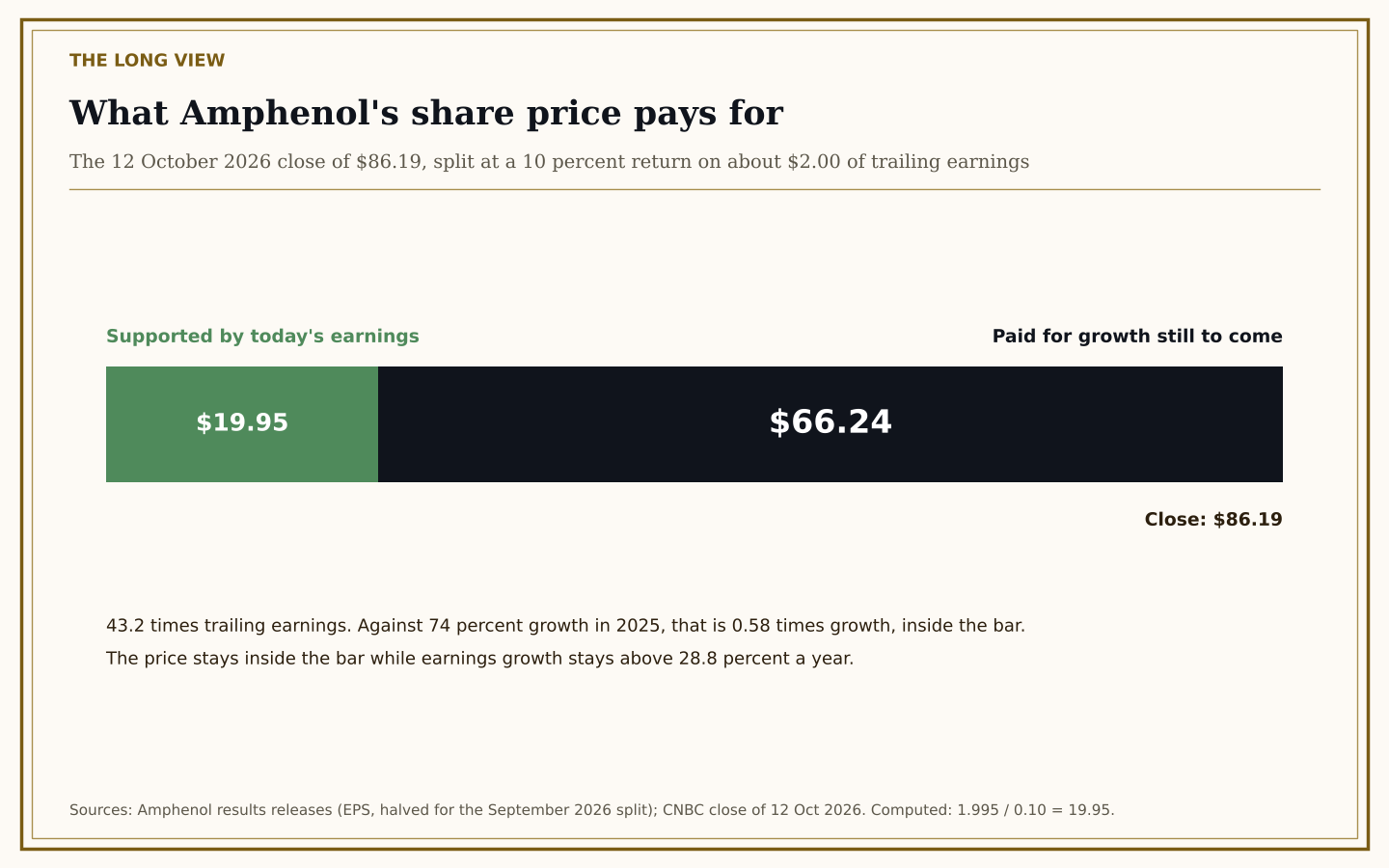
Buffett’s first question gives the same answer from another side. At a 10 percent return, the last four quarters of earnings support about $19.95 a share. The remaining $66.24 is paid for growth still to come.
Five thousand dollars
Five thousand dollars at $86.19 buys 58.01 shares. Counting a dividend of $0.125 a quarter, a total gain of 30 percent by October 2031 needs the shares at about $109.55. Thirty percent a year needs about $317.52. The dividend is small beside the price: Amphenol declared $0.745 a share for 2025 and $0.55 for 2024, both on the old share basis, about $0.37 and $0.28 after the split.
Every $100 of Amphenol stock is backed by about $2.07 of 2025’s free cash flow. Debt was $18.81 billion at 30 June 2026, against $5.42 billion of cash and short-term investments, some of it raised to pay for CommScope, according to its 10-Q.
Amphenol reports its third quarter on 28 October, per its investor site. The organic growth rate in that release is the number this piece says to watch.
Tomorrow
Tomorrow is Lumentum and Coherent, the companies that make the light that travels down the fiber. On 2 March 2026, Nvidia put $2 billion into each of them. Their customers are far more concentrated than Amphenol’s, and Coherent’s cash flow tells a different story from its earnings.
One question to carry until then: when a company’s price only works if growth stays above a line, how close to that line would you let it get before you stopped calling it a pass?
Not investment advice. The subscriber decides.