

Amazon (Nasdaq: AMZN) put $75.88 billion into buildings and equipment between 1 July and 30 September 2026. Over those same three months, it booked $20.95 billion of depreciation and amortization, the slow cost of wearing things out. The gap between those two numbers is the point. Most of the bill for this year’s building has not arrived yet. This piece opens a week built on one question: will the AI build pay for itself? It starts with the three yearly bills the build creates, how fast each is growing, and the test that will say whether the earnings are keeping up.
Disclosure: the author holds no individual shares in any company named here. He owns broad index funds that include some of them.
The week’s question: what the build has to earn
For two weeks I have asked how the AI build is paid for. The first week asked whether lenders were scared, and on 23 October the answer was that the fear stayed narrow. The second asked who was paying. On 30 October the scorecard showed Amazon was $33.46 billion short in a single quarter and borrowed to cover it, while Microsoft paid from earnings.
The week of 2 November asks the question underneath both. Will the build pay for itself? I am calling it what the build has to earn.
It runs in four steps. Monday measures the bills the build creates every year. Wednesday follows the build to your own house, through power and water. Thursday’s notes look at the gates that can delay the earnings: permits, equipment and workers. Friday sets the earnings beside the bills and scores them.
By Friday you will be able to look at any company building data centers and answer three plain questions. How big is the yearly bill? What could slow the earnings? Are the earnings keeping up?
Spending is not the same as cost
Picture a landlord who builds an apartment block for $600 million. The money leaves the bank account on the day the builders are paid. But the building does not get used up on that day. It wears out slowly, year after year.
So accountants spread the cost over the years the building is expected to last. That yearly slice is called depreciation. If the landlord expects the block to last six years, the yearly cost is $600 million divided by six, or $100 million a year.
The same rule applies to a data center. When Amazon buys servers, the cash goes out at once. The cost shows up in its profit a little at a time, as depreciation.
The spending tells you how much went out of the door. Depreciation tells you how much of it is being used up each year. Profit is charged with the second number.
One thing to hold onto. Depreciation is not cash leaving again. The cash left on the day of purchase. Depreciation is the accounting charge that spreads that cost over time. The other two bills below, rent and interest, are cash paid out.
The landlord picture, which carries the week
Keep the landlord in mind all week, because every idea fits on him.
The building wears out each year. That is depreciation. Some of the land and floors are rented from someone else, on contracts that start on set dates. Those are leases. The loan that paid for the building charges interest every year.
Then there are tenants who have signed but not moved in yet. That is a backlog: a promise of future rent, not cash in hand.
And before any tenant pays a cent, the landlord needs permits, a power hookup, water, materials and builders. Those are the gates. Wednesday is about the two gates that reach your own house, power and water. Thursday covers the rest.
Bill one arrives late, by design
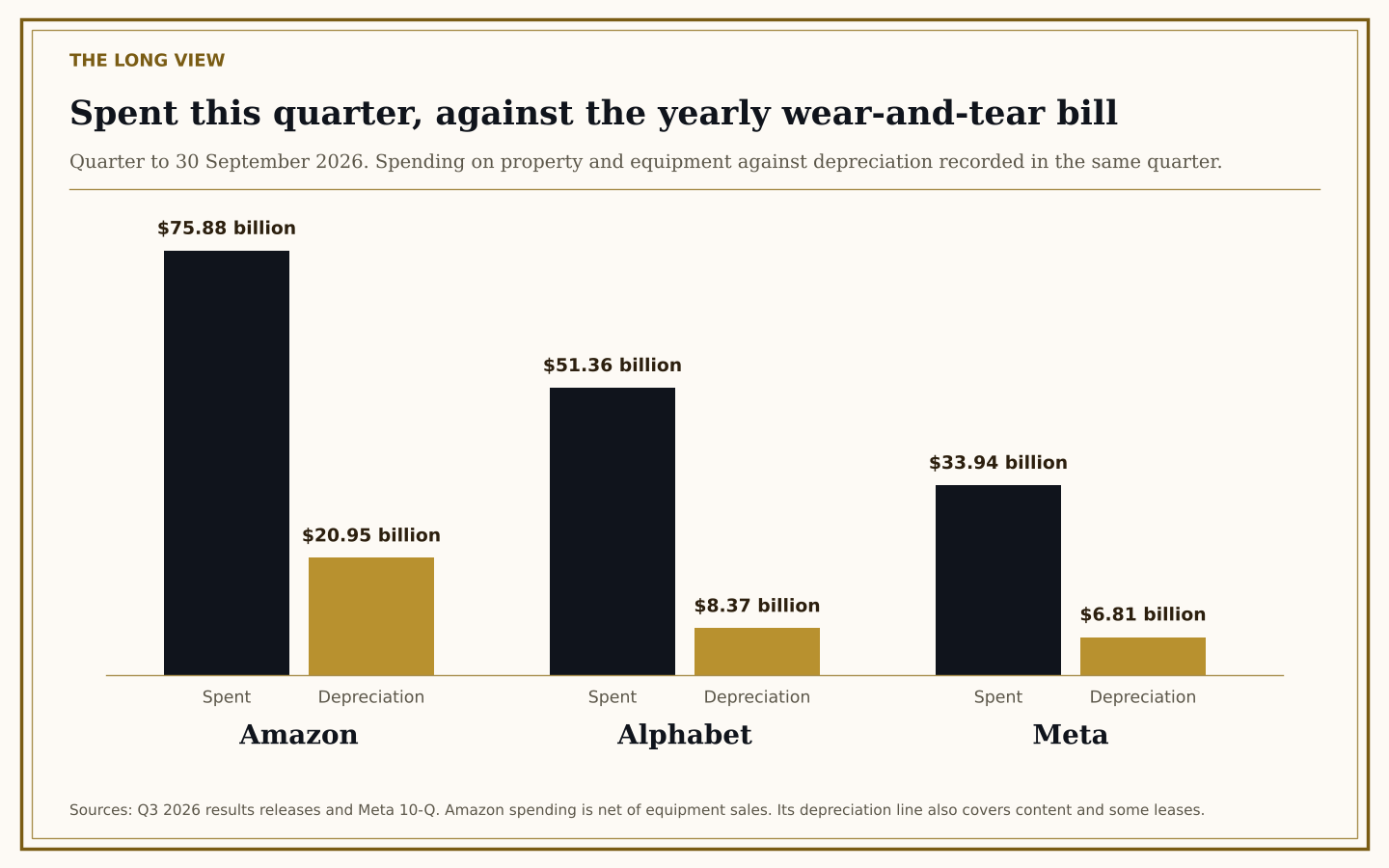
Here is the gap for the three builders whose September-quarter figures I have read.
Amazon’s spending on property and equipment, net of proceeds from equipment sales and incentives, was $75.88 billion. It recorded $20.95 billion of depreciation and amortization. Alphabet (Nasdaq: GOOGL) spent $51.36 billion and recorded $8.37 billion of depreciation. Meta (Nasdaq: META) spent $33.94 billion and recorded $6.81 billion of depreciation.
My reading: the depreciation in each quarter mostly reflects equipment bought in earlier years. What these companies are buying now joins the charge as it goes into service, and then stays on it, a slice at a time, for years.
The figures I read do not split out how much of this quarter’s spending has started to depreciate. They show the two totals side by side, and the gap between them is large.
You can find both numbers yourself in two minutes. Open Amazon’s or Alphabet’s quarterly results and go to the cash flow statement. One line near the top says depreciation. One line further down says purchases of property and equipment. Set them side by side. For Meta, the depreciation figure used here is in its quarterly report’s property and equipment note. Its cash flow line, $7.15 billion, also includes amortization.
The bill for this year’s building has not arrived yet. It arrives a slice at a time, every year, whether the earnings arrive or not.
The first bill is already growing fast
Even before most of this year’s building lands, the wear-and-tear bill is climbing.
Amazon’s depreciation and amortization rose from $16.80 billion in the quarter to 30 September 2025 to $20.95 billion a year later, up 25 percent. Alphabet’s depreciation rose from $5.61 billion to $8.37 billion, up 49 percent. Meta’s rose from $4.76 billion to $6.81 billion, up 43 percent.
Inside Meta’s figure, the part for servers and network equipment rose from $3.60 billion to $5.34 billion. That includes the machines that run AI.
One caution. Amazon’s line also includes content costs and some leases, so it is a wider measure than the other two. I have used each company’s own line and named it.
The number of years a company chooses
There is a lever inside depreciation that is easy to miss. The company chooses how many years it expects its equipment to last. That choice is called the useful life.
A longer useful life makes the yearly bill smaller. Our landlord’s $600 million block costs $100 million a year over six years, but only $60 million a year over ten. The total is the same. The timing changes.
Meta lengthened the useful life of most servers and network equipment to 5.5 years from 1 January 2025. Its quarterly report for the period to 30 September 2025 says that cut depreciation by $2.29 billion in the first nine months of 2025.
Microsoft (Nasdaq: MSFT) lengthened the life of its data centers and office buildings from 15 to 25 years from the start of its 2027 fiscal year, chief financial officer Amy Hood said on its call on 29 July 2026. “This change affects only the timing of future depreciation,” she said, as Data center Dynamics reported.
To feel the size of it, take a company that buys $10 billion of servers and spreads the cost over 5.5 years, the life Meta uses. The yearly bill is about $1.82 billion, and it repeats for five and a half years. Buy another $10 billion the next year and the bill stacks on top.
When you compare depreciation from one year to the next, check the useful-life note first.
Bill two is rent that starts on a date
Not every data center is owned. Some are leased, and once a lease starts, the rent is owed on its schedule.
Meta’s quarterly report lists about $355.73 billion of leases it has signed that had not begun by 30 September 2026, covering data centers, power and network gear. The report says they will start between the rest of 2026 and 2036. The 30 October piece flagged that figure, which sits outside Meta’s debt line.
Here, the point is timing. Once a lease begins, the rent is owed whether or not the revenue has shown up.
Bill three is the interest on the loan
The third yearly bill is interest, and for the borrowers it has jumped.
Amazon’s interest expense was $538 million in the quarter to 30 September 2025 and $1.69 billion a year later. Alphabet’s went from $143 million to $967 million. Meta’s interest on its notes went from $205 million to $882 million.
Each is small next to the size of these businesses. Amazon’s $1.69 billion compares with $201.94 billion of sales in the same quarter. The direction is the point. All three borrowed heavily in 2026, and the 30 October piece showed how that borrowing works and when it comes due.
The hidden assumption
Underneath the AI build sits a hidden assumption: that the earnings it produces will grow faster than the three yearly bills it creates, and keep growing faster as the late part of the depreciation bill arrives.
A reader, Butterfly Market Insider, put the risk plainly in a reply on 30 October: “the debt payments don’t shrink if AI demand turns out softer than hoped.” The same is true of lease payments once they start. Depreciation keeps coming too, on the schedule the company sets.
That does not mean the earnings will fall short. It means the earnings have to keep pace with a bill that is still growing into its full size.
The test, set before the earnings
Friday 6 November scores each builder this way. The figures are already public. I fixed the rule on 31 October, before putting them side by side, so the results could not choose it.
For each builder, compare the quarter to 30 September 2026 with a year earlier. Take the dollar increase in sales from the business the build serves: Amazon Web Services, Google Cloud, Microsoft’s cloud business, and Meta’s advertising. Then take the dollar increase in depreciation.
If sales grew by more dollars than depreciation, the reading is earning ahead. If depreciation grew by more, the reading is falling behind. If the filing does not let the two be compared, the reading is NOT PROVEN.
Two honest limits. The depreciation figures used here are company-wide, and the sales are for one business, so this is a rough match. Friday will say so beside every reading. And the test covers the first bill only. Rent and interest sit beside it on Friday as context, not as part of the score.
Microsoft recast how it reports its businesses on 28 October, and I have not yet read the recast figures for its cloud business, so it may land as NOT PROVEN.
What comes next
Tuesday’s notes take the bills one builder at a time, starting with the useful-life choices behind each depreciation figure.
Wednesday is the gate that reaches your house. Utilities are spending heavily to connect data centers. That piece asks how much of the cost reaches household power and water bills, and prints both sides.
The bill comes every year. The earnings have to come every year too.
Reply to this post with the yearly bill you think matters most for these builders: wear and tear, rent or interest. I read every reply.
Not investment advice. The subscriber decides.