

Amazon (Nasdaq: AMZN) reported a net loss of $720 million for 1999. In the same filing, on the cash flow statement, net cash used by operating activities was $90.9 million. The loss everybody quoted and the money that left the business were different by a factor of eight. That gap is the reason Amazon survived, and it was visible at the time, in a document anyone could download. This week is about gaps like that one, because Rigetti (RGTI) and IonQ (IONQ) cannot be valued on earnings they do not have. Nobody here is being called the next Amazon. The hidden assumption inside every comparison to Amazon is that losing money is a phase and that patience is all it takes to get through it, and Webvan lost money too. What this week builds is a lens, not a verdict.
Disclosure: the author holds a small position in Rigetti and no position in IonQ. He also holds IBM. This is analysis, not a recommendation.
The number everyone quotes, and the number that mattered
Amazon’s 1999 annual report is worth reading now, because nobody reading it then knew how the story ended.
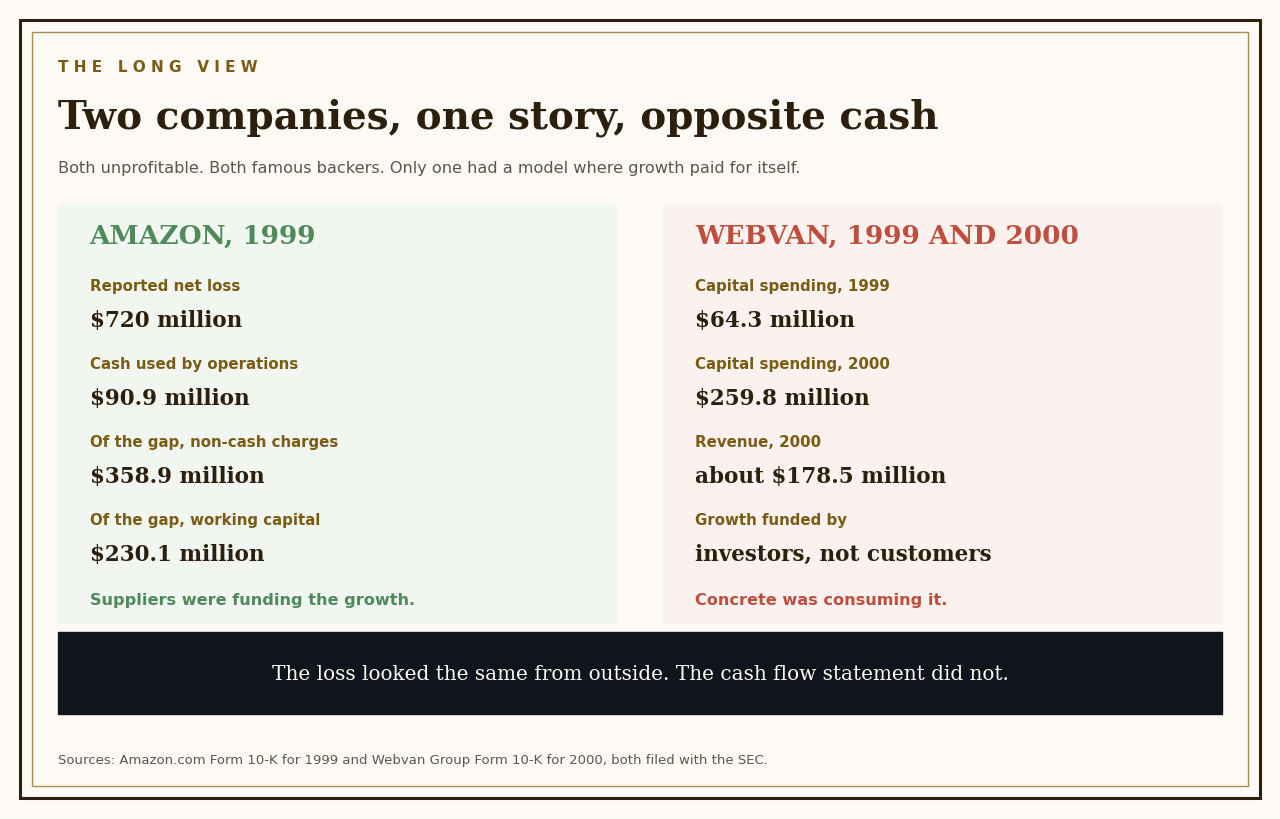
The net loss was $720 million. The cash consumed by operations was $90.9 million. The company explains the difference itself: $358.9 million of the loss was non-cash, things like depreciation, stock compensation and goodwill amortization, and a further $230.1 million came from changes in operating assets and liabilities, mostly accounts payable rising faster than inventory.
Read that last part slowly, because it is the whole thing. Suppliers shipped Amazon books and waited to be paid, while customers paid immediately. Growth was financed by the people Amazon bought from, and the faster it grew, the more of their money it held.
That is not a story about vision or patience. It is a structural feature of the business model, and it sat in the liquidity section of the filing.
The same document shows where the rest came from. Investing consumed $922.3 million in 1999 and financing brought in $1.104 billion, mostly from a $1.25 billion convertible note sale in February. Amazon was raising money hand over fist. What matters is what the operating business was doing while that happened, and it was close to paying for itself.
The same years, a company that looked identical from the outside
Webvan went public in November 1999, two weeks before Amazon’s quarter closed, selling 28,750,000 shares at $15.00 each. Same market, same story, same kind of investor letter.
Then look at what it did with the money. Capital expenditure was $64.3 million in 1999 and $259.8 million in 2000, building automated warehouses and a delivery fleet. Revenue in 2000 was about $178.5 million. The company spent more on building capacity in one year than customers spent with it.
Amazon’s growth pulled cash in from suppliers. Webvan’s growth pushed cash out into concrete. Both were unprofitable internet companies with famous backers and a large addressable market. Only one of them had a model where scale helped.
What makes Webvan worth studying rather than mocking is that its unit numbers were not fantasy. Management expected a distribution center to break even at 40 to 50 percent utilization, and utilization ran at 25 to 30 percent while more centers were being built. The plan worked at scale and the company ran out of time before reaching scale, which is a different failure from a bad idea and much easier to miss.
Why the comparison people reach for does not work
Here is the trap, and I have fallen into it myself with Rigetti.
When someone questions a pre-profit holding, the answer that comes out is that Amazon lost money for years. True, and useless, because it compares outcomes. In 1999 nobody knew Amazon was Amazon. They knew it was a company with a large loss and a big idea, which is exactly what Webvan was.
Comparing outcomes tells you some companies in this position went on to be enormous. It cannot tell you which, because it starts from the answer and works backwards. Survivors get books written about them and failures get forgotten, so the pattern looks stronger than it was.
The same error gets used against young companies. Pointing at Webvan to dismiss anything unprofitable substitutes a famous outcome for the evidence in front of you, exactly as the Amazon argument does.
What can be compared is conditions. Not what happened next, but what was in the documents at the time, on both sides.
What this is, and what it is not
Let me be plain here, because this is the part that gets misread.
I am not saying Rigetti is the next Amazon. I am not saying IonQ is the next Tesla, or the next Webvan. I do not know, and nor does anybody else. No company in this week is being predicted, and any piece that tells you a young company is the next anything is selling a forecast dressed as analysis.
What this does is narrower. Companies that later became great left evidence behind while they were still unproven, in ordinary filings anybody could read at the time. So did the companies that failed. Learn what that evidence looks like and you have something to check a quarterly report against, instead of a story to agree or disagree with.
The reason any of it transfers is that Amazon was not always Amazon. In 1999 it was an unprofitable retailer with a big idea, a funding requirement and no earnings to be valued against, which is the same ground Rigetti and IonQ are crossing right now. The terrain repeats even when the destination does not. Companies crossing it leave the same kinds of marks in their filings, and those marks are what this week collects.
That is a lens. It does not tell you what Rigetti will be in ten years. It tells you which lines of its filing are worth more than its press releases, and what a good answer and a bad answer look like on each one.
Used properly it runs in both directions. It can build a case for patience and it can take one away, and this week it does both to a company I own.
The rule that keeps it usable
Everything in this week has to be visible in a filing while the outcome is still unknown, and markable as present, absent or not yet disclosed. Not yet disclosed is a real answer, because an absence of disclosure is itself information about a company.
Amazon’s payables funding its inventory qualifies. Bezos being a visionary does not, because that only becomes obvious once the share price has already done the work. Management quality, addressable market and technological lead all matter, and none of them can be checked by a reader on a Tuesday afternoon. This week uses only what can.
The mistake that cost people both ways
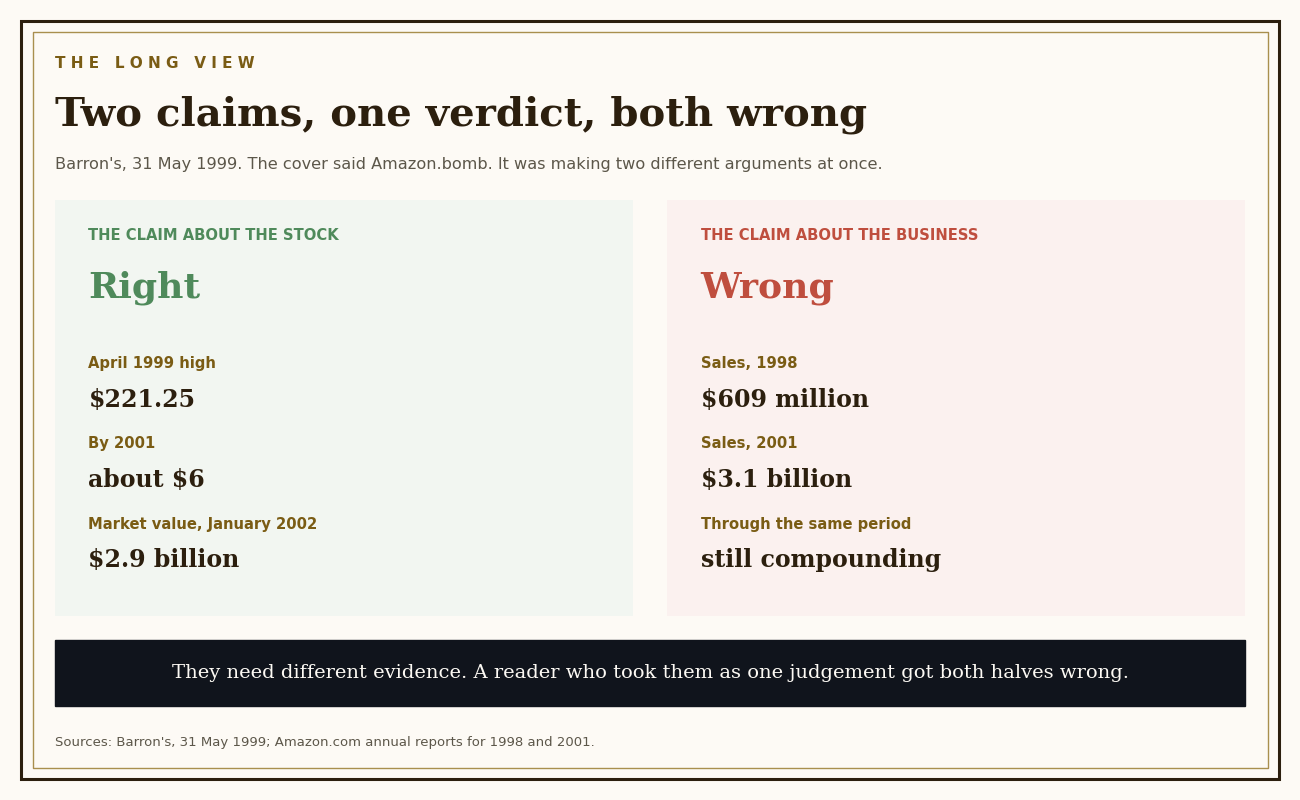
On 31 May 1999, Barron’s ran a cover story headlined Amazon.bomb. It called Bezos “just another middleman” and cited analyses valuing the shares below $10.
On the stock, it was right. Amazon fell from $221.25 in April 1999 to around $6 by 2001, and the market value bottomed near $2.9 billion in January 2002. On the business, it was wrong. Sales went from $609 million in 1998 to $3.1 billion in 2001, straight through the collapse.
Look at what happened there, because it is the most useful thing in this week. Two separate claims got fused into one verdict. This stock is overpriced. This business will fail. They need different evidence and they can both be true, or either one alone. A reader who took the article as a single judgement got both halves wrong, and sold a business that was compounding while its price fell.
That is the first thing to carry into Rigetti and IonQ. You are allowed to think the prices are unsupportable and the technology will work. Those are not contradictory positions, and keeping them apart is most of the discipline.
What this week does, day by day
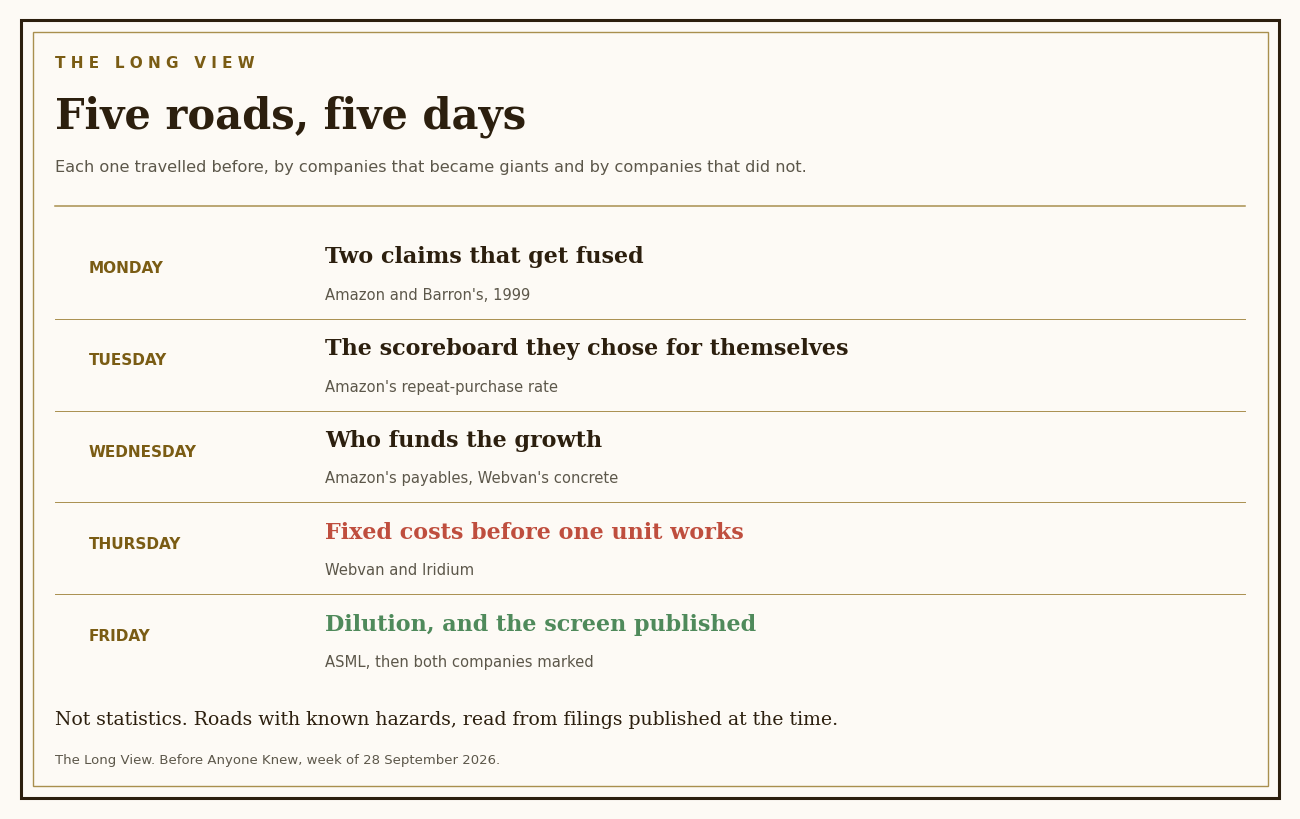
Five lessons, one a day, each one a road that has been travelled before.
Tuesday: grade a company on the scoreboard it chose for itself. Amazon published its repeat-purchase rate while everyone argued about the multiple. Rigetti has published a dated fidelity target for this year.
Wednesday: who funds the growth decides who survives a closed window. Amazon’s suppliers funded its inventory. Webvan’s investors funded its concrete. The test is what happens if no new money is available for eight quarters.
Thursday: committing fixed costs before one unit works is the road with the worst record in the filing archive. Webvan is one case. Iridium is the harder one, because its satellites still fly today and its shareholders got nothing.
Friday: dilution, the quiet road, and then the whole thing published as a screen with both companies marked against it.
Why this matters for the two quantum companies specifically
Rigetti and IonQ have no earnings, so there is no price to be called low against. That removes the tool I normally use and leaves the traits as the only instrument available.
It also makes the stakes concrete, and I own one of them, so the reasoning has to survive contact with my own position. Rigetti issued 7.74 million new shares to the U.S. government in September, about 2.3 percent of the company, for an award of up to $100 million, before the research was done. That is the fifth trait moving the wrong way, checkable every quarter on the cover page of the 10-Q. IonQ’s sales and marketing spending grew 242 percent year on year, which is the first counter-signal, and the next two filings answer whether it persists.
Neither fact predicts anything. Both are the kind of thing that was visible in 1999, on both sides of the Amazon and Webvan comparison, and mostly ignored.
The work this week is to build the rest of that list out of history rather than out of opinion, then run both companies through it on Friday and publish the result, including the parts that do not flatter a position I hold.
What this week cannot do
Three limits, said now rather than discovered on Friday.
It cannot tell you whether either company makes it. The traits improve the odds of asking the right question, nothing more.
Survivorship runs in both directions. Some companies failed every test and survived anyway, because a buyer appeared or a market turned in their favour. The screen narrows the field, it does not pick.
And quantum has no revenue history to pattern-match against. What transfers is the shape of the evidence, not the economics.
Tomorrow
In 2012, Intel, TSMC and Samsung bought shares in one of their own suppliers to pay for a technology that did not work yet. The supplier was ASML, the machine was extreme ultraviolet lithography, and the customers were funding the thing they intended to buy. It took years longer than planned, the schedule slipped repeatedly, and it ended in something close to a monopoly.
That is the closest historical parallel to the U.S. government taking shares in Rigetti this month, and it is where the week starts properly.
Not investment advice. The subscriber decides.
The 720 million loss with only 90.9 million of cash used, fair point.