

Four AI builders were on the test: Meta (Nasdaq: META), Alphabet (Nasdaq: GOOGL), Amazon (Nasdaq: AMZN) and Microsoft (Nasdaq: MSFT). On 26 October I published a test: three readings each, with the verdict rule fixed in advance. Meta had reported on 21 October, and its numbers were already in that piece. The other three reported after it. Two paid for the build partly by borrowing. One paid from savings. One paid from what it earned. Read on for who paid how, how the borrowing works, and where in a filing the rest of the bill sits, outside the debt figure.
Disclosure: the author holds none of the companies named here.
The scorecard, and the rule set on 26 October
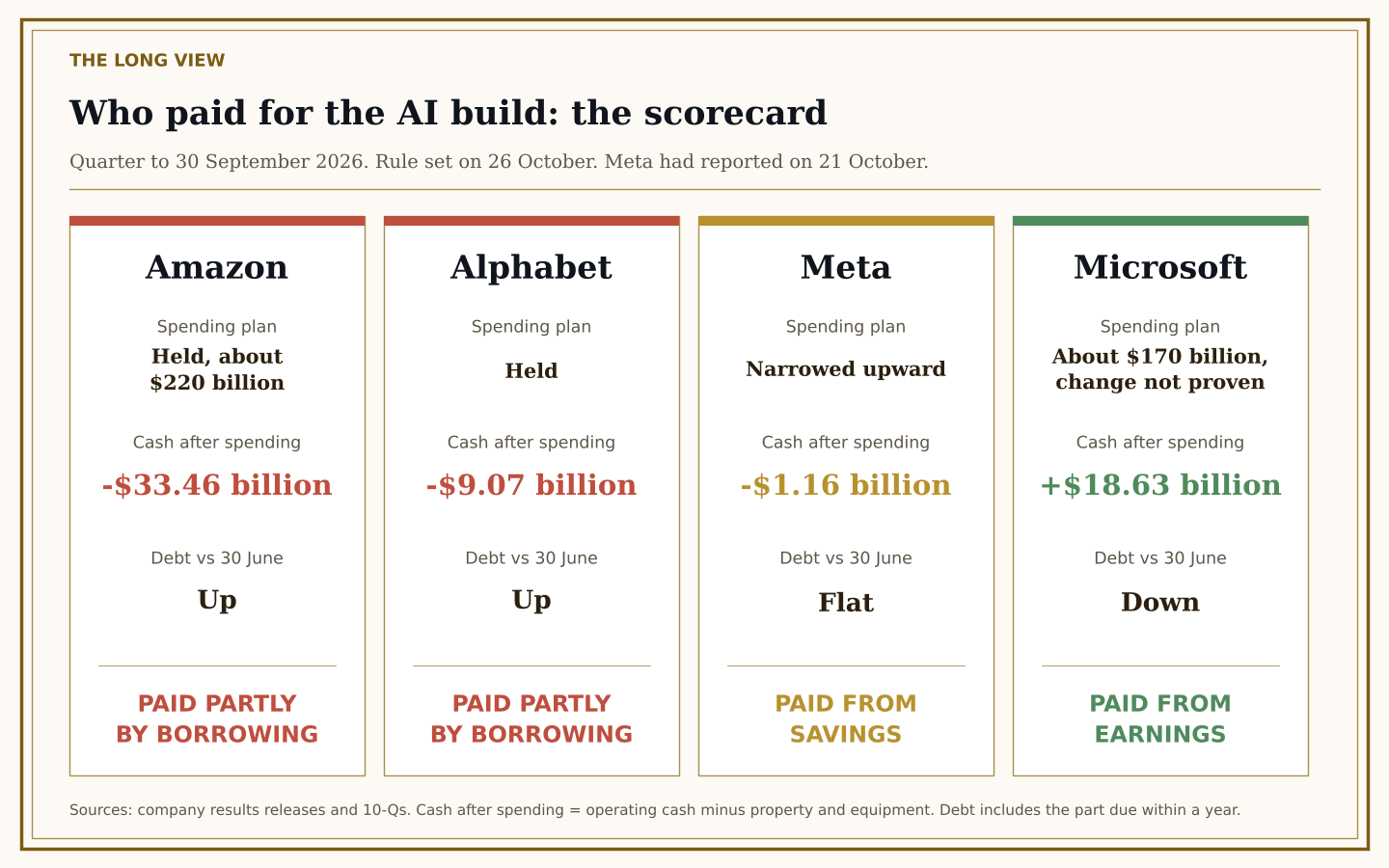
The test had three readings for each builder, each from its own results for the quarter to 30 September 2026.
The spending plan: raised, held or cut. Cash after spending: the cash its business brought in, minus what it spent on property and equipment. And total debt, counting the part due within a year, against 30 June.
The verdict rule was fixed too. Cash after spending positive means paid from earnings. Negative with debt up means paid partly by borrowing. Negative with debt flat or down means paid from savings.
Here is how the four came out.
Amazon: plan held, cash after spending negative $33.46 billion, debt up. Paid partly by borrowing.
Alphabet: plan held, cash after spending negative $9.07 billion, debt up. Paid partly by borrowing.
Meta: plan narrowed upward, cash after spending negative $1.16 billion, debt flat. Paid from savings.
Microsoft: plan about $170 billion, change not proven, cash after spending positive $18.63 billion, debt down. Paid from earnings.
Amazon: the biggest gap of the week
On 26 October I asked which builder would show the biggest gap between what it spends and what its business brings in. The answer is Amazon, by a wide margin.
In the three months to 30 September 2026, Amazon’s business brought in $42.42 billion of cash. It spent $75.88 billion on property and equipment, after small sales of equipment. That left a gap of $33.46 billion. In the quarter to 30 June, the gap was $7.69 billion.
The borrowing shows up in the same release. Amazon raised $48.10 billion from long-term debt in the quarter and repaid almost none of it. Long-term debt went from $128.89 billion on 30 June to $173.13 billion on 30 September.
The plan did not move. “We continue to expect 2026 cash capital expenditures to be approximately $220 billion,” the release says.
The business underneath is growing. Amazon Web Services, its cloud business, sold $45.98 billion in the quarter, up 39 percent. The question is whether that growth arrives fast enough to cover a bill that is growing faster.
Alphabet: borrowing kept pace with the build
Alphabet’s release shows $42.29 billion of cash from its business in the quarter and $51.36 billion spent on property and equipment. Alphabet calls the difference free cash flow. It was negative $9.07 billion, against negative $5.86 billion in the quarter to 30 June.
Its long-term debt rose from $98.17 billion on 30 June to $125.10 billion on 30 September. In the quarter it raised $29.00 billion of new debt and repaid $3.63 billion.
The spending plan held. Fortune’s Amanda Gerut reported on 28 October that Alphabet “confirmed its full-year capital spending forecast.” Its last stated range was $195 billion to $205 billion, Bloomberg News reported in July.
Reuters reported Google Cloud revenue of $30.71 billion, more than twice the year-earlier figure. The cash gap widened anyway.
Meta: paid from savings, with a footnote
Meta’s business brought in $32.79 billion of cash in the quarter to 30 September and it spent $33.94 billion. Cash after spending: negative $1.16 billion. Meta’s own measure, which also subtracts lease payments, was negative $2.12 billion.
The debt reading needs care, and it shows why the test counts the part due within a year. Meta’s long-term debt line fell from $83.66 billion on 30 June to $80.92 billion on 30 September. That looks like repayment. The 10-Q shows it is not. Meta moved $2.75 billion of notes due in 2027 into “long-term debt, current.” Add it back and total debt was $83.67 billion, flat.
So the gap came from savings. Meta’s cash and marketable securities fell from $90.26 billion on 30 June to $82.45 billion on 30 September. That fall of $7.81 billion is larger than the gap, because the same savings paid for other things too.
The footnote is the part the debt line does not show. Meta owns 20 percent of two data center ventures that it does not consolidate, so their borrowing is not in Meta’s debt line. Its 10-Q puts its maximum exposure to loss on them at $68.40 billion.
Microsoft: paid from earnings, and a smaller plan
Microsoft took in $58.00 billion from operations in the quarter to 30 September, against $39.37 billion of property and equipment. The difference was $18.63 billion. Its total debt fell from $40.29 billion on 30 June to $35.48 billion.
The plan reading is the one I cannot settle. On 28 October chief financial officer Amy Hood put calendar 2026 spending at about $170 billion, Fortune’s Sebastian Herrera reported. In July, Hood said her calendar 2026 expectations “remain unchanged” after an accounting change, and CFO Dive put that at about $175 billion. That $175 billion is the reporter’s figure, not Hood’s, so whether the plan moved is NOT PROVEN.
Fortune also reported first-quarter capital spending of $45.2 billion, less than analysts expected, and said Hood tied that figure to delays in capacity Microsoft expected from third parties.
One caution, carried from 26 October. The $39.37 billion counts equipment Microsoft bought. Equipment Microsoft rents on finance leases is not in it, though Hood counts those leases in her own spending figure, CFO Dive reported. On that wider count, the $45.2 billion, Microsoft’s business still covered its spending.
Microsoft doubled its spending from a year earlier and still paid for it from earnings. What separated the four was not the size of the build. It was how much cash their businesses produced while they built.
The suppliers: sales up 44 and 65 percent
The money the builders spend becomes their suppliers’ sales. The two suppliers on the test both grew fast.
Corning’s optical communications business, which makes fiber, cable and connectors, grew 44 percent from a year earlier, to $2.38 billion of sales in the September quarter. Amphenol sold $10.2 billion, up 65 percent, or 37 percent without acquisitions and currency moves. I found no share of sales from data center or AI buyers in either release, so that reading is NOT PROVEN for both.
A third supplier, Nvidia, shows one cost of selling into the build. Between its quarters ending 26 April and 26 July 2026, the money customers owed it rose from roughly 45 days of sales to roughly 60, by my arithmetic. Its July quarterly report allows some investment-grade customers longer terms, “ranging from 90 days up to one year,” on large data center builds. Two readers pushed me in the comments to check that number. They were right to.
How a company borrows by selling bonds
Two of the four builders borrowed heavily in the September quarter, so here is how it works.
A bond is a loan cut into pieces and sold to many lenders at once. Say a company wants to borrow $100. A buyer hands over $100. The company promises interest every year, say $5, and the full $100 back on a fixed date, called the maturity date. That is a 5 percent interest rate.
The banks named in these deals arrange the sale. The buyers are the lenders. In March 2026 Amazon sold $37 billion of bonds in the US in 11 parts, due in 2 to 50 years, and buyers offered about $126 billion, Bloomberg reported. The report did not name the buyers. Fortune’s Amanda Gerut reported on 7 March 2026 that the traditional buyers of the very longest bonds are corporate pension funds and life insurers.
You may own a slice without knowing it. Broad bond index funds follow indexes that include company bonds. Vanguard strategist Lucas Baynes wrote on 19 August 2026 that the tech sector’s share of the Bloomberg U.S. Corporate Bond Index “is now rising quickly,” and that “a broad ‘core’ bond fund is gradually becoming a larger claim on the AI buildout.”
How the debt gets repaid, and why the date matters
A bond is not paid back a little at a time. The company pays interest along the way and owes the whole amount on one day. On that day it pays from cash it has built up, or it sells new bonds to repay the old ones. That is called refinancing.
Refinancing is where the risk sits. The old bond carried the old rate. The new one carries whatever lenders demand on the day. If a 5 percent bond is replaced at 7 percent, the yearly interest on $100 rises from $5 to $7.
Meta’s 10-Q shows how slowly that risk arrives for a strong borrower. Its notes carry fixed rates from 3.50 to 6.45 percent. It owes $2.75 billion in 2027 and $1.50 billion in 2028. Of its $84.00 billion of notes, $73.75 billion is due after 2030. A rise in rates reaches Meta years from now, not in one bad day.
The risk in borrowing to build is not the interest on the first day. It is whether the revenue arrives before the bill comes due.
The hidden assumption, tested
On 26 October I named the hidden assumption behind the AI build: that the giants pay for it out of what they earn.
For one of the four, the filings say yes. Microsoft’s business covered its spending with $18.63 billion to spare. For Meta, the business came close, and savings covered the rest. For Alphabet and Amazon, the filings say no. Both spent more than their businesses produced, and both borrowed more.
That is not a forecast of trouble. Amazon and Alphabet both grew their cloud sales quickly in the same quarter, and both have large businesses behind the borrowing. What changed is who carries the risk. Part of the build now rests on bond buyers, a group that can include pension funds and the bond index funds held in retirement accounts.
Whether the build earns a return is NOT PROVEN, and no single quarter can prove it. The test measured how the build is paid for. It did not measure whether it pays off.
The lesson: the debt line is not the whole bill
Meta’s 10-Q shows it most clearly. Its debt line fell while its total debt held flat. Its $68.40 billion exposure to two ventures sits outside the debt line. Its 10-Q also shows about $355.73 billion of signed leases for data centers, power and network that had not started on 30 September. Nvidia, a supplier, is carrying more of its customers’ bills for longer. Corning recorded a $1.0 billion customer deposit to lock in supply through 2029.
The lesson is a procedure. When a company borrows to build, read three places: the debt note, the lease note and the commitments note. Then read the same three in its biggest supplier’s filing. The build is financed across all of them.
What comes next
Microsoft’s chief financial officer tied a lighter quarter of spending to delays in capacity it expected from third parties. That is the next question.
The money to build is there. Between the money and the profit sit permits, power, equipment, workers and, finally, customers who pay. From Monday 2 November, the week looks at each of those bars in the filings, and at what happens to the fixed bills if any of them slows the build.
Reply to this post with the bar you think is hardest to clear. I read every reply.
Not investment advice. The subscriber decides.