

Yesterday’s chain led to one thing underneath the whole AI trade: the national debt. A debt this size has only five ways out, and four of them are painful, ugly, or already closed. That leaves one painless road, growing out of it, which is why the government and the market are quietly betting everything on it. This piece walks all five, and then shows the catch: the one painless road runs straight through the paycheck-to-paycheck households who are two-thirds of the economy. It is all in the numbers, and it changes what a healthy consumer is worth to your portfolio.
A quick word on why this series exists, because it names the question everything here is chasing. This week I graded Nebius, a soaring AI name growing 454 percent a year, and I could not buy it, because the price terrified me. That left me with one question I could not put down, and it is the question this whole series is built to answer:
What would have to happen in the world for a company this good to ever come back to a price a value investor could pay, and what would that change cost the rest of us?
That question has two halves, and the series follows both. The first half, what could ever make these companies cheap, led into the macro machinery: the bond market, the debt, the roads a country can take out of it. The second half, what that change would cost, leads to the people underneath it all, which is where this piece goes. I do not answer the whole question today. Each piece takes one part of it, and I come back to answer it in full at the end of the series. Today is about the cost.
Where the chain left us
Yesterday I traced a chain: the AI buildout runs on borrowed money, the cost of that money is set in the bond market, the bond market is under pressure from a government borrowing more than the world wants to lend it, and that pressure runs all the way down to the price of every AI stock. Follow that chain to its source and you do not end up at a company or a chart. You end up at one thing underneath all of it: the national debt. That is the ground the whole AI trade is standing on, and it is the problem this piece and the ones after it are really about.
So let me state the problem plainly, because everything follows from it. The federal debt held by the public is around thirty-two trillion dollars, roughly the size of the entire economy. The deficit runs near one and nine-tenths trillion dollars a year, and we are running it at full employment, when the budget is supposed to be at its healthiest. The interest bill alone is about a trillion dollars a year now, more than the entire military budget, and it swallows roughly eighteen cents of every dollar the government collects.
Here is the consequence, and it is the part that makes this urgent rather than academic. High debt means a high interest bill. The interest bill widens the deficit. The wider deficit forces more borrowing, which adds to the debt, which raises the interest bill again. When interest compounds faster than the economy grows, the problem stops needing any help and begins feeding itself. We are not past that point. We are close enough to it that the only question worth asking is the practical one: how does a country really get out from under a debt like this?
The answer is not open-ended. History gives a country a bounded set of exits, and I want to walk all of them, because you cannot understand where the AI economy is heading until you see which road we are on and what it costs the person living through it.
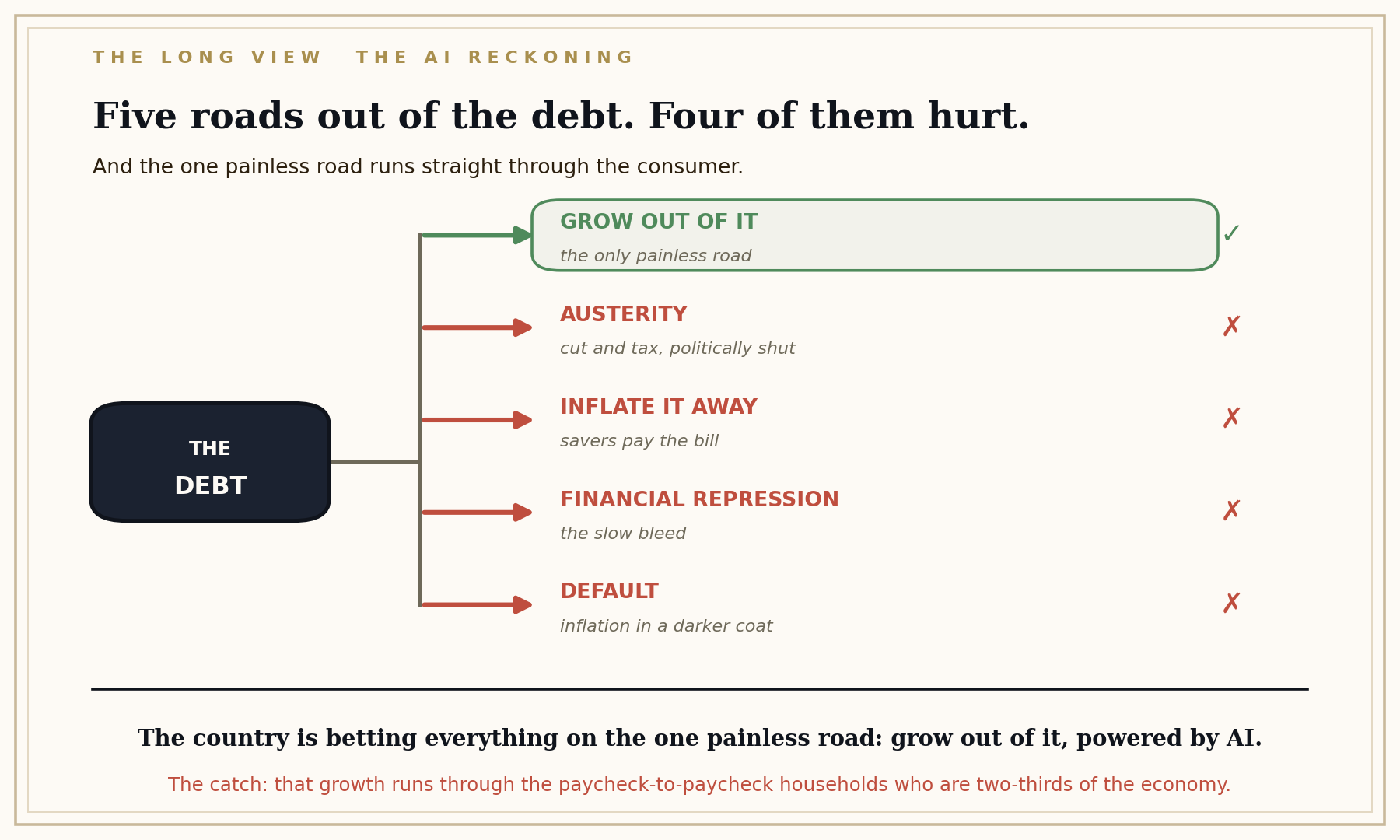
There are only five roads out, and four of them hurt
This is not a matter of opinion or cleverness. History offers a bounded set of exits from a sovereign debt this large, and every country that has faced one has taken some mix of them. There are five. It is worth walking each one plainly, because only when you see all five do you understand why the whole country is quietly betting on a single one.
The first road is to grow out of it. If the economy expands faster than the debt and its interest, the burden shrinks on its own, even if the dollar amount keeps rising. This is how the United States escaped its post-war debt, and it is the only road on this list that does not hurt. Nobody has to be taxed harder or paid less. You simply grow, and the debt fades against a bigger economy. Hold that thought, because it is the one everything else in this series turns on.
The second road is austerity: cut spending and raise taxes enough to run a surplus and pay the debt down. It has been done, most recently in the late nineteen-nineties. But the repercussion is brutal and political. Closing a deficit this size means cutting deeply into Social Security, Medicare, and defense, or raising taxes across the board, or both. Right now the country is moving the other way, the deficit is rising, not falling, so as a practical matter this road is closed. Nobody is walking it.
The third road is to inflate it away. Let inflation run hot and repay the debt in cheaper dollars, so the debt shrinks against rising prices even though the number does not change. The government did exactly this in the nineteen-forties. The repercussion is that savers and ordinary people pay the bill through the erosion of what their money is worth, and richly-valued assets, the expensive stocks most of all, tend to get repriced hard when inflation and higher rates arrive. It works, but it works by quietly taking from everyone who holds dollars.
The fourth road is financial repression, a gentler cousin of the third: hold interest rates below the rate of growth and inflation for years, quietly, so the debt slowly erodes without a dramatic crisis. Japan is the living example, carrying debt far larger than ours, held together by captive domestic buyers and near-zero rates for decades. It is survivable. The repercussion is a long, low-growth grind and a slow bleed of anyone trying to save, and a fragility that lasts as long as the arrangement does.
The fifth road is default, simply not paying. For a country that prints its own currency this one is almost never chosen outright, because it can always create the dollars it owes. The realistic version of default is not a missed payment. It is the soft default of the third road, inflating the value of the debt away, which is why it rarely appears on the menu as itself.
So look at the five together. Austerity is shut. Inflation and repression both work by taking from savers and repricing assets, and default is just inflation wearing a darker coat. Four of the five roads out are either closed or painful, and they land hardest on the people holding dollars and the stocks priced for perfection. Only the first road, growing out of it, hurts no one. That is why the government, the market, and most of us are quietly praying for it.
And the engine everyone is counting on to deliver that growth is AI.
You already watched them choose a road this week
Here is where it stops being theory. In yesterday’s piece I noted that the Treasury stepped in this week to buy back its own long-term debt, and that yields fell when it did. Look at that move through the five roads and you can see the government quietly making a choice in real time.
Buying back long-term debt to hold down the interest rate on it is not growth, and it is not austerity. It is a mild form of the fourth road, financial repression, leaning on the bond market to keep the cost of the debt lower than it would otherwise be. It is being presented as routine housekeeping, and taken alone it nearly is. But read alongside a rising deficit and foreign buyers stepping back, it looks like the first small reach for the lever a country pulls when the other roads are closed and it is buying time for growth to show up.
That is the honest way to read this week. The government is not on the painful roads yet. It is managing the edges, holding the long end of the bond market down a little, keeping the trap from tightening while it waits for the one painless road to deliver. Which brings the whole thing back to a single dependency. All of this, the buybacks, the patience, the hope, rests on growth arriving, and arriving broadly enough to matter. So it is worth asking, with clear eyes, what that growth really does to the people it is supposed to save.
I believe that road is real, and it may be the best hope the country has. But there is a cost buried inside it that never shows up on the government’s ledger, and it lands squarely on the person at that kitchen table. Once you see it, the hopeful story never sounds quite the same.
What productivity growth really means
Start with what “productivity growth” is, in plain terms, because the phrase hides the thing that matters. Productivity growth means producing more with less. More output per worker. And the way AI delivers it, the reason companies are spending hundreds of billions on it, is by letting a business do the same work, or more, with fewer people. That is not a side effect. That is the product. When a company says AI made it more productive, it very often means AI let it do what used to take more employees.
At the level of the whole economy, that can be wonderful. Every major wave of automation, farm machinery, the factory line, the computer, destroyed jobs and, over time, created even more of them, at higher wages. That is the optimistic case, and it has history behind it. But it has a condition attached that people skip past: the workers displaced have to be reabsorbed, into new work, fast enough, before the damage compounds. And that is where today’s numbers should stop you.
The consumer is already at the edge
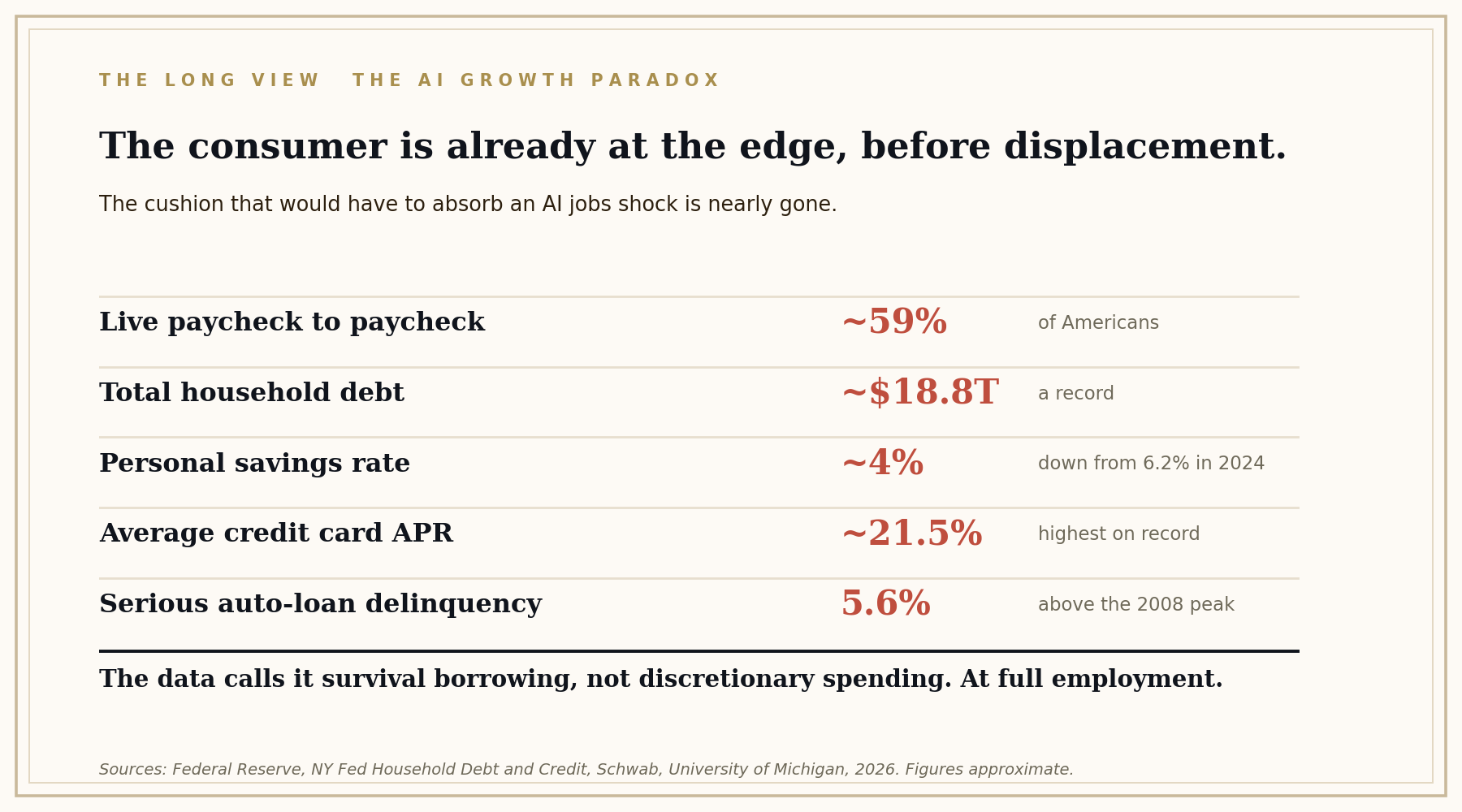
Here is the condition of the American household right now, before AI displacement has happened at any scale. Roughly fifty-nine percent of Americans live paycheck to paycheck. Total household debt sits at a record, near nineteen trillion dollars. The personal savings rate has fallen to about four percent, down from over six just two years ago. The average credit card interest rate is around twenty-one and a half percent, the highest on record, and serious auto-loan delinquencies have climbed above where they stood at the worst of the 2008 crisis. Consumer sentiment is sitting in recession territory even though unemployment is only about four percent.
Read those numbers together and one phrase from the data captures it: this is survival borrowing, not discretionary spending. A large share of households are not putting purchases on credit because they want a little extra. They are borrowing to cover the gap between what they earn and what they need, in a full-employment economy. That is the cushion, or the absence of one, that would have to absorb a wave of displacement. There is almost nothing there.
Why this is a circle, not a line
Now put the two halves together, and you get the contradiction. The workers most exposed to AI, routine white-collar work, administrative roles, customer service, scheduling, basic analysis, are disproportionately the same households described above: stretched, indebted, without savings. These are not people with a year of runway to retrain. Many are one missed paycheck from delinquency.
And here is why displacing them does not just hurt them, it hurts the very thing the growth was supposed to fix. Consumer spending is roughly two-thirds of the entire economy. A displaced worker stops being a taxpayer and starts being a cost: they pay less income and payroll tax, they draw on the safety net, they cut their spending to the bone, and they may default on their slice of that nineteen trillion dollars in household debt, which then lands on the banks. Every one of those is a negative on the government’s ledger. So the growth that was supposed to shrink the debt, if it arrives by hollowing out the workforce rather than lifting it, quietly widens the deficit through the back door and weakens the consumer economy that generates the growth in the first place.
That is the trap in one sentence. AI growth helps the government’s balance sheet by raising output, profits, and corporate tax, and it hurts the government’s balance sheet by displacing the consumers whose spending and taxes are most of the economy. The same force pulls both ways, and which way it nets out depends entirely on whether the gains are shared or concentrated.
What could get us out of displacement
The debt has a bounded set of roads out, and so does this. It is worth naming them plainly, because “AI will just create new jobs” is a hope, not a plan, and the other roads deserve to be on the table.
The first road is the historical one: new work is created faster than old work is destroyed, and displaced workers move into it. This has happened every time before. The honest question is whether AI is different, because unlike a tractor or a spreadsheet, it targets cognitive work directly, which is exactly where displaced workers have always fled to. If AI climbs the same ladder people are trying to climb, the reabsorption is harder than history suggests.
The second road is redistribution: if AI concentrates its gains in the companies that own it rather than the workers it replaces, the state taxes those gains and recycles them, through wage subsidies, transfers, or something like a universal basic income. Set aside the politics for a moment and notice the irony, this road only works if the AI profits are real and large enough to tax, which sends you right back to needing the boom to be genuine.
The third road is absorption: sharing the reduced work across more people through shorter hours, so productivity shows up as time rather than only as pulled-forward profit. The fourth is simply time, AI adoption proving slower and messier than the demonstrations suggest, so displacement unfolds over decades that natural retirement and gradual reskilling can absorb.
And the fifth road is the one to watch for, the unmanaged one, where displacement outruns creation and redistribution and reskilling all at once, leaving a large, indebted, un-reabsorbed population. On that road consumer demand falls, growth weakens, and the AI-growth escape from the debt stalls, because it undercut the consumer base that powered it. That is the road where both problems, the public debt and the private household, get worse together.
The two problems are one problem
Here is the insight that ties it together, and it is the whole point. The debt problem and the displacement problem are the same problem seen from two sides. The AI-growth road out of the debt only truly works if the growth is broad, if the productivity gains reach ordinary workers as income and not only shareholders as profit. When the gains are broad, workers keep earning, keep spending, keep paying tax, and the debt shrinks while demand holds. When the gains are narrow, workers are displaced and indebted, demand falls, the safety net swells, and the rescue eats itself.
So the answer to “what gets us out of the citizens’ displacement” turns out to be the same as the answer to “what makes the growth road out of the debt truly work.” In both cases it is this: the gains have to be shared. Concentrated AI wealth can make the government’s numbers look better on paper while making the citizen’s worse, and because the citizen is the economy, that is not a solution at all. It is the crisis being moved from the public balance sheet onto the private one, where it is harder to see and just as real.
What this means for a patient investor
I write about price and value, so let me bring it back to the ground where I live. The point of all this is not to predict the future of work. It is to correct a lazy assumption sitting underneath a lot of AI investing: that the growth story is a clean, one-directional good.
It is not. The same force that could rescue federal solvency could erode the mass consumer market that most companies, and the entire tax base, ultimately depend on. A great many businesses are valued today on the assumption of a healthy, spending consumer stretching out for years. If AI growth arrives in a way that thins that consumer out faster than it lifts them up, some of those valuations rest on a foundation that is quietly cracking, and it will show up in the data long before it shows up in the narrative.
So the discipline is simple to state. Watch the consumer as closely as you watch the AI capex. The savings rate, the delinquency rates, real wages, labor-force participation, these are not separate from the AI story. They are the other half of it. The AI buildout numbers tell you how much is being spent to create the productivity. The consumer numbers tell you whether the economy underneath can survive the way that productivity gets delivered. A patient investor who watches only the first half is reading one page of a two-page story.
Run any company through the Stock Story Firewall, free, at firewall.readthelongview.com. Subscribers get the Watch cards, the Evidence tool, and the full Research Tracker.
The growth might save the government. The question this piece leaves you with is the one the cheerful version never asks: at what cost, to whom, and whether the people who pay it are the same people whose spending the whole thing depends on. Watch the consumer. That is where you will see the answer first.
Which leaves one more question hanging, and it is the one I take up tomorrow. Everyone who tells the hopeful version leans on the same proof: we carried debt this big after the Second World War and simply grew out of it. We did. So tomorrow I go back and check whether that escape is still available to us, because the economy that pulled it off was a very different machine from the one we have now. What I found changes the odds on the whole hopeful story, and it points to a gap most people never see coming.
Not investment advice. The subscriber decides.