

It is also almost entirely absent from the prices of the companies most exposed to it. Here is how to see it, using two competitors as the window.
Disclosure: the author has held shares of Dynatrace since September 2022. This is an analysis of a risk, not a recommendation on either stock.
Here is a question worth more than most of the AI commentary you will read this year. When a company is called an AI winner, and its stock is priced as though the winning will continue for a decade, what exactly is that future built on. Not the technology, everyone talks about the technology. The money. Who is paying, with what, and for how long can they keep it up. Ask that question across the AI trade and you find the same answer in a lot of places: an enormous amount of assumed future revenue traces back to a small number of large buyers who are spending borrowed money on hardware that keeps getting more expensive, betting the revenue shows up before the loans come due. That is a real risk, and it is strangely absent from the prices. The clearest way to see it is through two companies that do the same thing and are priced as opposites.
The company one customer could move
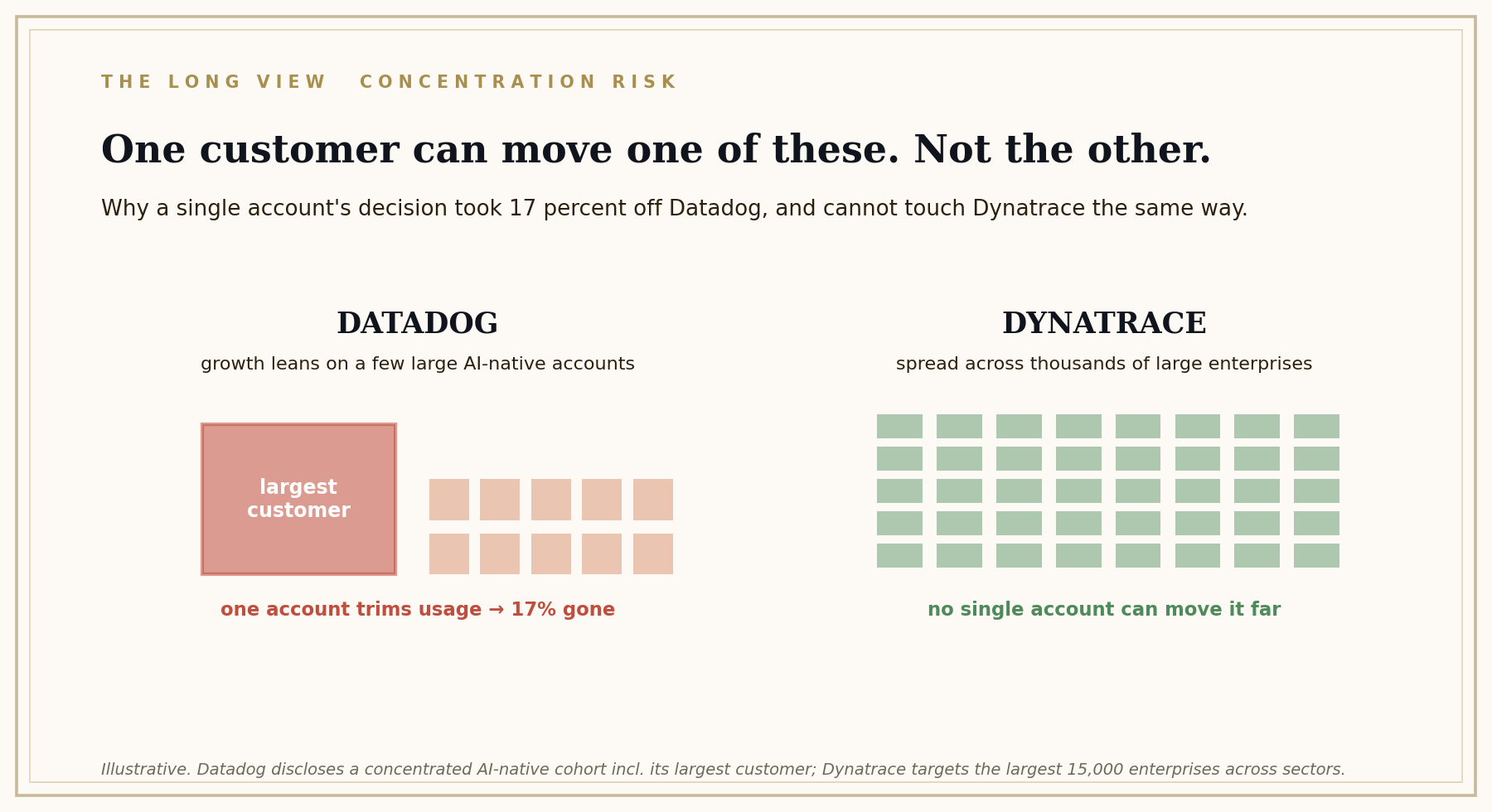
Start with the one that just proved the point. When Datadog reported, it disclosed that its single largest customer, which the company does not name but which analysts widely believe to be OpenAI, had reduced its usage. Not left. Not churned. It renewed a nine-figure contract in the same quarter. It simply used less. And that one customer optimizing its spend was enough, combined with slightly softer guidance, to take about 17 percent off a company worth roughly $90 billion, in a single trading session.
Sit with the proportion. One customer, still under contract, still paying, dialed back its consumption, and a sixth of the company’s market value evaporated in a day. That only happens when a meaningful slice of the growth depends on a small number of very large accounts. It is called customer concentration, the degree to which a company’s revenue leans on a handful of big buyers rather than being spread across many, and it is one of the oldest risks in business analysis. What is new is where it is hiding now.
Why Dynatrace cannot fall the same way
Now look at the competitor. Dynatrace sells the same kind of software to a different kind of base. Its customers are, in its own words, many of the world’s largest enterprises, and its sales effort targets the largest 15,000 companies on earth, across banking, government, retail, and industry. Its revenue is spread across thousands of large, diversified enterprise relationships, the kind that sign multi-year platform commitments and embed the software into how they run.
That structure has a specific consequence. No single Dynatrace customer is large enough to take 17 percent off the company by trimming usage, because the revenue is not concentrated that way. A diversified base grows slower, it is less exciting, it does not ride the vertical AI-spending wave the way a concentrated AI-native book does. But it also cannot be knocked over by one buyer’s decision. What Dynatrace gives up in explosive growth, it gets back in the one thing a value investor prizes most: durability.
The prices say the opposite of the risk
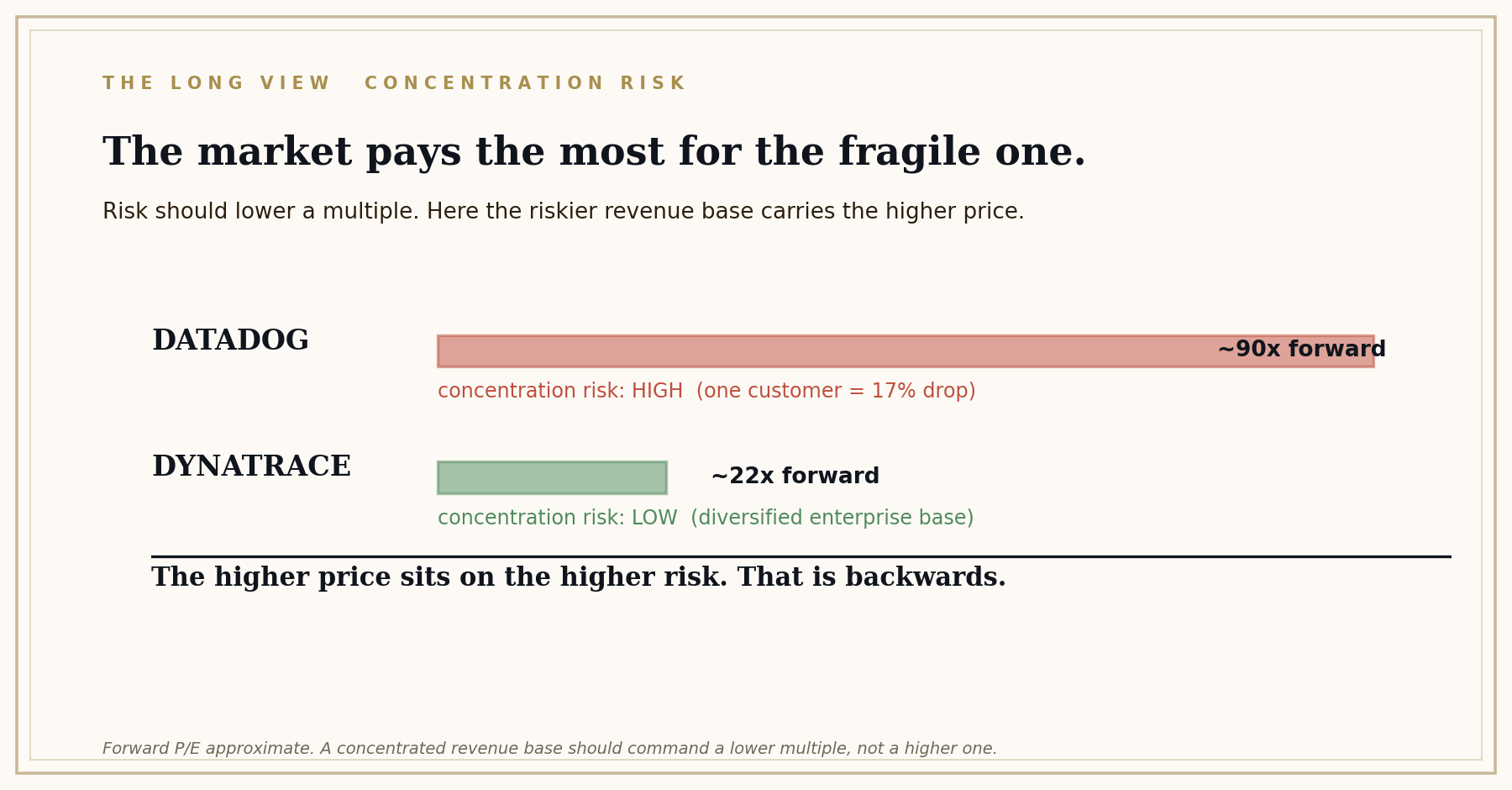
Here is where it gets interesting for anyone who thinks about price, which is the whole of what we do. Datadog, the company with the concentration risk, trades at roughly 90 times forward earnings. Dynatrace, the company without it, trades around 22 times. The market is paying a large premium for the business whose growth is more fragile, and a discount for the business whose growth is more durable.
That is backwards from how risk should be priced. A concentrated revenue base is riskier, and risk should command a lower multiple, not a higher one. Instead, the concentration comes bundled with faster growth, and the market has decided that growth is worth almost any price while treating the fragility underneath as though it were not there. Datadog is priced as if the concentration is not a risk at all. Dynatrace is priced as if nothing good will ever happen to it. The truth about the risk in each is the reverse of what the prices imply.
We are not saying Datadog is a bad business. It is a superb one, growing faster than Dynatrace, with higher margins. We own the point more narrowly: the price you pay should account for the risk you take, and in Datadog’s case it does not, which is why one customer’s ordinary decision could take 17 percent off it in a day. The business is excellent. The price is not accounting for how its growth is built.
The part that is bigger than either company
Now widen the lens, because this is the reason the week’s two grades belong in one piece. Datadog is not the only company whose value leans on a small number of AI-native buyers. It is just the most visible one, because it reports cleanly and the market reacted violently. The same shape runs through a large and growing slice of the AI trade.
Consider Nebius, whose story rests on a $27 billion contracted backlog, a huge share of it tied to a single counterparty, Meta. Or the wider constellation of AI-infrastructure names, the data-center builders, the GPU-cloud providers, the tooling layers. A striking amount of their assumed future revenue traces back to the spending plans of a small handful of AI-native companies, OpenAI foremost among them, whose consumption is modeled forward as if it will only ever rise, only ever stay, and only ever be spent with them specifically.
That is the hidden assumption underneath a big part of the AI trade: that a few enormous buyers keep consuming, keep growing, and keep buying from the same vendors, indefinitely. It is the same kind of single load-bearing belief our whole method exists to find. For one session, on the day of that report, the market remembered it was load-bearing, and then went back to forgetting.
The caveat that makes it sharper: the buyers are borrowing
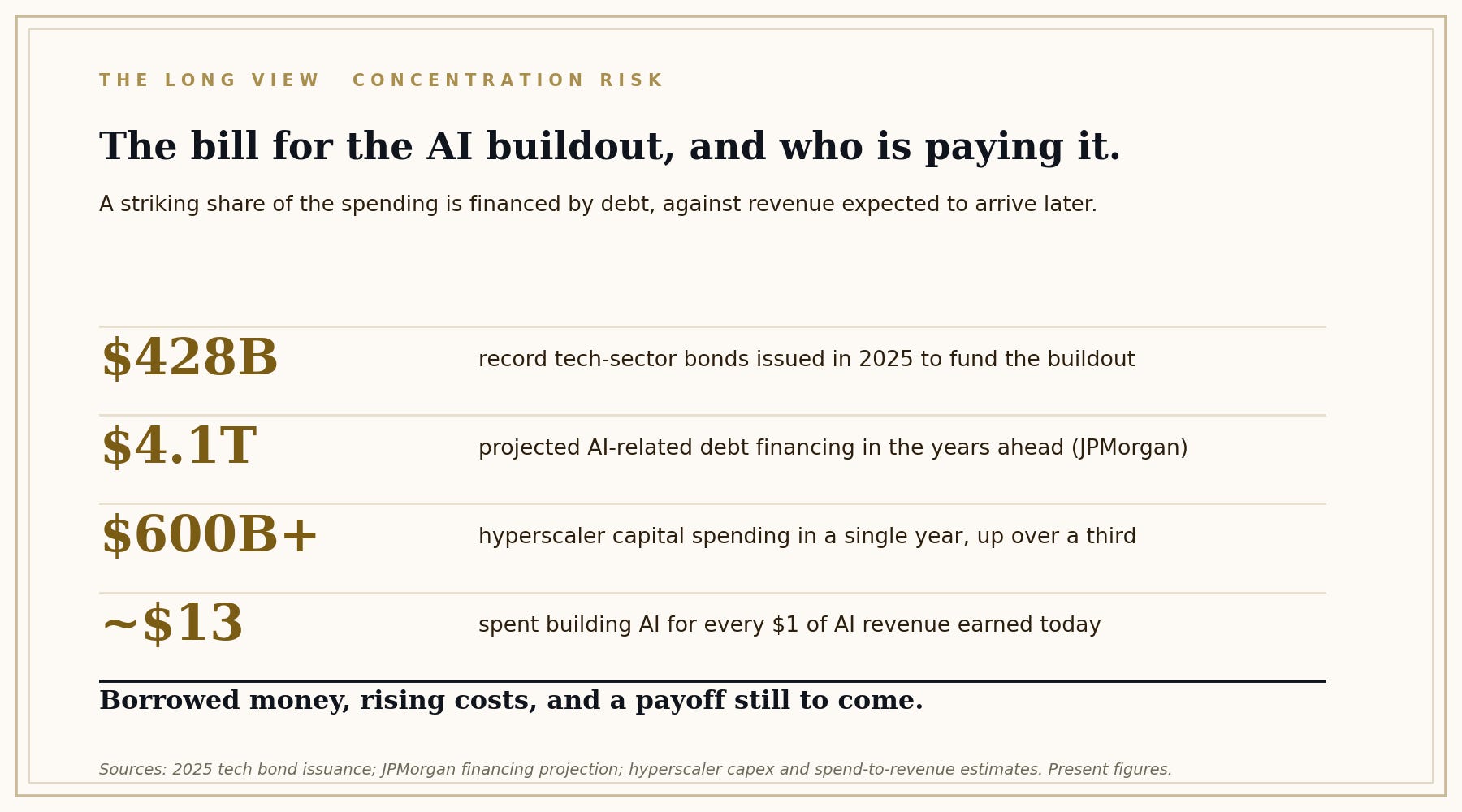
Here is what turns concentration from a structural fact into a live one, and it is the present environment, not a forecast. The AI-native companies underneath this trade are, in many cases, funding their own buildout with debt, at a moment when the hardware is getting more expensive, not less. The numbers are not small. Technology companies issued a record $428 billion in bonds in 2025, and JPMorgan projects AI-related debt financing could reach $4.1 trillion as loan-to-cost ratios rise, with some AI companies borrowing at double-digit coupons. At the same time, the key AI memory chips are sold out through 2026 and the cost of building data-center capacity is climbing. Four U.S. senators have publicly warned that Big Tech’s turn to complex, opaque debt markets could cause destabilizing losses. This is the environment as it exists today, and it is verifiable.
Now connect it to the vendors. A company like Datadog does not carry that debt. But its largest customers do, or their spending depends on those who do. The whole AI buildout is running on roughly thirteen dollars invested for every one dollar of current AI revenue, a bet that the revenue catches up to the spending, financed increasingly by borrowing. When the money is cheap and flowing, those customers spend freely, and their vendors grow beautifully. When capital tightens, or the return on all that spending is questioned, the first thing a cash-conscious AI company does is optimize its spend. Which is precisely what Datadog’s largest customer just did. The usage cut that took 17 percent off the stock was not a random event. It is what the beginning of spending discipline looks like, in an industry funding itself on debt, flowing downhill to the vendors who depend on it.
So the concentration risk and the debt environment are the same risk seen from two angles. Your revenue depends on a few large buyers, and those buyers are spending borrowed money on hardware that keeps getting pricier, betting on a payoff that has not arrived yet. A vendor does not need to carry a dollar of that debt to be exposed to it. It only needs its customers to.
And here is the turn, because this is not a doom story
Now the question a value investor should be asking, and it is the hopeful one. Datadog is a magnificent business. We do not own it because the price demands perfection. But what if this very environment, the debt pressure, the spending discipline, the concentration finally being noticed, is the thing that eventually brings Datadog to a price that accounts for its risk. If the AI-native cohort tightens, and Datadog’s growth cools from spectacular to merely strong, and its multiple compresses from ninety times toward something reasonable, then the magnificent business we admire but will not overpay for could finally become the value we have been waiting for. We are not rooting for anyone’s pain. We are saying the discipline that keeps us out of Datadog today is the same discipline that would let us in tomorrow, at a price that finally makes sense. The great company does not have to stay too expensive forever. Sometimes the environment does the repricing for you, and the patient buyer is there when it does.
What this does and does not mean
Let us be careful, because the truth protocol matters most here. This is not a prediction that the AI trade collapses, or that Datadog falls further, or that these customers cut spending. We do not know any of that, and anyone who claims to is selling something. The point is narrower, and it is the value investor’s point: a real concentration risk exists, it is spread across a large part of the AI-adjacent market, and the prices in many of these names are not accounting for it. When a price assumes a risk away, you do not need the risk to blow up to lose money. You only need the market to remember, briefly, that it is there, the way it did for one session on the day of that report. A stock priced for no concentration risk has only one direction to move when the concentration is noticed, and it is not up.
Where this leaves the two companies
Datadog stays what it was: a magnificent business at a price that assumes its growth is both durable and diversified, when its latest quarter showed it is neither as diversified nor as smooth as the multiple implies. Watch, on price, now with the concentration risk made visible rather than theoretical.
Dynatrace stays what it was too: profitable, growing slower, diversified, and priced as though the market cannot find a reason to care. For a value investor, the durable-and-ignored business is the more comfortable thing to own than the fragile-and-adored one, not because it will grow faster, but because no single customer’s Tuesday decision can take a sixth of it away. Disclosure, again: we hold Dynatrace, and we would rather own the concentration it does not have than the growth it cannot match.
What we watch, across all of it
Whether more large AI-native accounts optimize usage, at Datadog and across the AI-infrastructure names, because that pullback may be the first tremor or a one-off.
Whether any of these companies diversify their revenue away from the concentrated AI-native cohort, which would truly reduce the risk rather than merely postpone it.
And the prices, because the entire point is that risk should be paid for, not paid up for. The day one of these concentrated-growth stories is available at a price that accounts for its concentration, it becomes a value question worth asking. Until then, the market is buying the growth and ignoring the fragility, and we are watching, and naming what the prices are pretending is not there.
One customer, still under contract, used a little less software, and a $90 billion company lost a sixth of its value in a day. That is not a Datadog story. It is a window into how much of the AI economy’s value rests on how few buyers, and how little of that risk is in the prices. We do not know when it matters again. We know it is there, and that knowing is the whole job.
Run any company through the Stock Story Firewall, free, at firewall.readthelongview.com. Subscribers get the Watch Cards, the Evidence tool, and the full Research Tracker, including every company named here and where each one sits.
The best business is not always the safest one, and the safest one is rarely the most exciting. Price is supposed to tell you which risk you are taking. Right now, in two competitors and a whole industry behind them, the prices are telling you the opposite of the truth.
Not investment advice. The subscriber decides.