


Revenue up 454 percent, a real profit margin at the segment level, and a financing trick that quietly answers our biggest worry. The business is proving itself. The price is the problem, and this week has been a lesson in why those are different questions.
The Long View · Tuesday, 18 August 2026 · Nebius (NBIS), Q2 2026 grade
All week we have circled one idea, through IBM and now through a company at the opposite end of the spectrum: the difference between a good business and a good investment. IBM taught it from the value side, a company can be worth owning because the price is low enough to forgive being wrong. Nebius teaches it from the other side. Here is a business doing almost everything right, growing at a rate that stops conversations, and the open question is not whether the company is good. It plainly is. The question is whether any business, however good, is worth what this one costs.
What we said to watch, back in May
In May we ran Nebius through the Stock Story Firewall and classified it Needs Proof. Nebius builds AI cloud infrastructure, the GPU data centers that AI companies rent to train and run their models. A GPU is the specialized chip that does the heavy computation behind modern AI, and renting access to thousands of them is the picks-and-shovels layer of the AI boom.
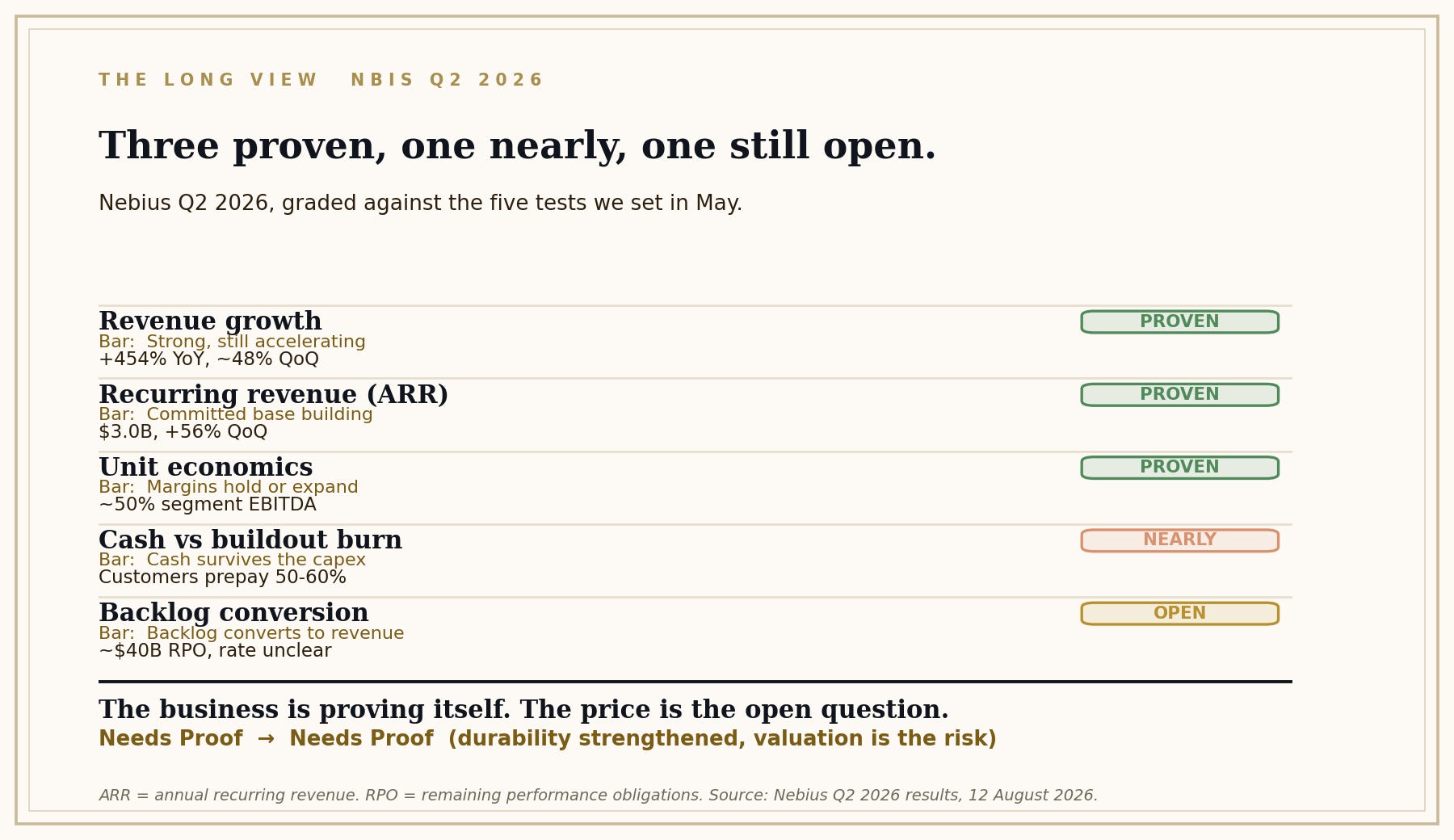
The hidden assumption we identified was specific: that Nebius’s revenue is scaling fast enough, and holding onto customers well enough, to justify a premium valuation before its cash is consumed by the enormous cost of the buildout. The framework we prescribed was Unit Economics Durability, which asks not whether demand exists, it clearly does, but whether Nebius can serve that demand at a profit that survives as the buildout scales. We set five tests. The company just reported, and it is time to grade them.
Test 1: Is the growth real and accelerating
Published bar: quarter-over-quarter revenue growth staying strong, with the trajectory holding rather than fading.
The number: second-quarter revenue was $582 million, up 454 percent from a year earlier, with the AI Cloud segment alone up 514 percent. Against the prior quarter, revenue grew roughly 48 percent. Proven, without an asterisk. This is not a company coasting on one good quarter. The growth is enormous and it is still accelerating, which is exactly what the bar asked for.
Test 2: Is the recurring revenue base building
Published bar: annual recurring revenue growing, signaling customers committing rather than dabbling.
Annual recurring revenue, or ARR, is the annualized value of a company’s subscription and contracted revenue, a way of turning current run-rate into a forward number. The figure: ARR reached $3.0 billion at the end of the quarter, up about 56 percent from the prior quarter’s $1.92 billion. Proven. Customers are not just showing up for one-time workloads. They are committing, and the committed base is compounding fast.
Test 3: Do the unit economics truly work
Published bar: margins expanding or holding as capacity scales, proving Nebius earns its revenue rather than buying it with underpriced compute.
The number: the AI Cloud segment posted an adjusted EBITDA margin of roughly 50 percent, up from about 45 percent the prior quarter. Adjusted EBITDA is earnings before interest, taxes, depreciation, and amortization, a rough proxy for the cash a business throws off before financing and accounting charges, and adjusted means certain one-time items are stripped out. Proven, and this is the one that matters most. A 50 percent segment margin, rising, says Nebius is not discounting its way to growth. The core service is soundly profitable at this scale. That is the single strongest piece of evidence that the unit economics are real.
Test 4: Will the cash last through the buildout
Published bar: cash reserves holding up against the capital burn, without an obvious near-term need to raise dilutive equity.
This was our biggest worry, and it is where the quarter delivered a genuine surprise. The raw numbers look alarming at first: Nebius spent $5.66 billion on capital expenditure, the money laid out to build data centers and buy chips, in a single quarter, and raised its full-year capex target to a staggering $20 to $25 billion. Against roughly $8 billion of cash, that pace of spending should light a fire.
Except it is being funded in a way we had not fully credited. Roughly 70 percent of the quarter’s deals included customer prepayments, money customers pay upfront, covering 50 to 60 percent of the associated capital cost. Nebius expects more than $9 billion in such prepayments this year. That is why the company ended the quarter with its cash pile intact and $2.3 billion in positive operating cash flow, despite the $5.66 billion of capex. The customers are pre-funding a large share of the buildout. We are moving this from inconclusive toward proven, with one reservation: the model works as long as customers keep prepaying, which ties the cash runway to continued demand. But the fear that Nebius would burn itself dry and be forced to raise equity at a bad moment looks materially weaker than it did in May. This is the most important thing we learned this quarter.
Test 5: Is the backlog converting to revenue
Published bar: the contracted backlog growing and converting, rather than sitting as a headline number that never arrives.
Remaining performance obligations, or RPO, is the contracted revenue a company has signed but not yet delivered, the backlog. The number: RPO stands in the neighborhood of $40 billion, and Nebius signed four landmark deals in the quarter averaging more than a billion dollars each. That is enormous for a company this size. But it stays inconclusive, because the specific rate at which that backlog converts into recognized revenue was not clearly disclosed, and a backlog is a promise, not a sale, until it arrives. The size is staggering and encouraging. The conversion is the thing we still cannot fully verify.
The tally, and the state that holds
Three of the five tests came in clearly proven: the growth, the recurring base, and the unit economics. The cash-runway question, our biggest worry in May, moved substantially toward proven on the strength of the customer-prepayment model. Only the backlog conversion stays truly open. On the evidence alone, this was close to a model quarter, and Nebius remains Needs Proof only because the highest-stakes question, whether all of this endures at scale, cannot be answered by two great quarters. The business is doing the proving. It is proving.
And here is the mirror to IBM
Now the part that ties the week together, and it is the whole point. We spent Monday and Tuesday on IBM, a company we own because in 2020 its price was so low it demanded almost nothing go right. Nebius is the exact opposite situation. The business is arguably far more impressive than IBM’s, growing more than four hundred percent a year at a real margin. And yet it may be the more dangerous stock, because of price.
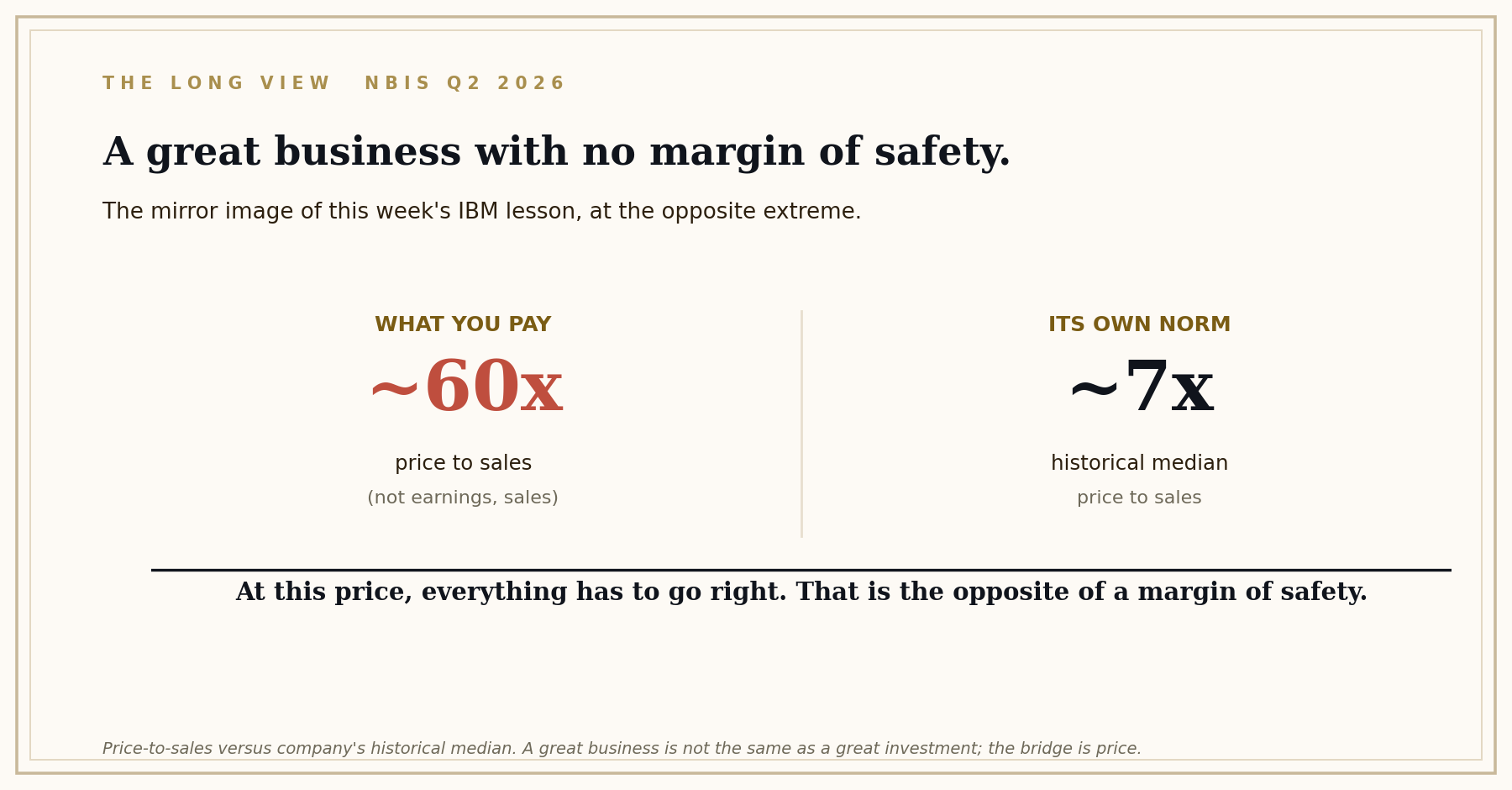
Nebius trades at roughly sixty times its sales. Not earnings, sales, and its historical median is closer to seven. At that price, essentially everything has to go right: the growth must continue, the margins must hold, the prepayments must keep flowing, the backlog must convert, and the demand must never soften. There is no margin of safety in a sixty-times-sales price. It is the mirror image of the IBM lesson. In 2020, IBM’s low price meant I could be wrong about a great deal and still win. At sixty times sales, a Nebius buyer has to be right about nearly everything, because the price has already priced in success, and then some. It is worth noting, quietly, that the people who know the company best have been net sellers of the stock in recent months. That is not damning on its own. It is one more data point in a picture where the price assumes perfection.
This is not a knock on Nebius the business. The business is extraordinary. It is an observation about Nebius the stock, and the difference between those two things is the most valuable idea we cover. A great company and a great investment are not the same, and the bridge between them is always the price.
What we watch next
The backlog conversion rate, quarter by quarter, because a $40 billion backlog only matters when it becomes revenue, and that is the one test still open.
The prepayment model, and who is behind it, because it is now central to the whole case, and this is where my real concern sits. The prepayments funding Nebius come from a very small number of very large customers, and those customers are themselves spending far more than they earn and borrowing heavily to do it. So the cash that makes Nebius look self-funding is riding on the continued willingness, and ability, of a couple of debt-stretched giants to keep pre-paying. As long as they do, the cash-runway fear stays contained. If even one of them pulls back, the enormous capex turns from a strength into a sharp risk, fast. That is the single thread I would watch above all others.
And the price, because at sixty times sales, the stock does not need bad news to fall. It only needs good news to arrive slightly slower than perfection.
The question this leaves open, and the piece coming tomorrow
So the price is the problem. But that raises the question every patient investor really cares about, the one this grade cannot answer on its own: if Nebius is this good and this expensive, and it may never stumble, then what could ever bring it down to a price worth paying?
Sit with that, because it is not a small question. A value investor could admire this company for years and never get a chance at it, if the only thing that would make it cheap is the company failing, and it never does. But there is another way a great company reaches a fair price, and it has nothing to do with the company at all.
Remember what I just told you about the concern. Nebius is funded by prepayments from two giants who are borrowing to pay it. Those giants borrow at rates set by the bond market. The bond market is moving, right now, for reasons that reach all the way from government deficits and foreign selling of U.S. debt to the price of every AI stock on your screen. There is a chain running from Washington’s borrowing to Nebius’s share price, and if it tightens, it could hand a patient investor this exact company at a price that finally works, without Nebius ever missing a beat.
That chain is the whole story, and it is too big to bury at the bottom of a grade. So it is tomorrow’s piece, in full: every link, what could set it in motion, and the specific conditions I would need to see before a company like this one becomes a buy. If the question of when a great AI company gets cheap has ever nagged at you, that is the one to read.
Run any company through the Stock Story Firewall, free, at firewall.readthelongview.com. Subscribers get the Watch cards, the Evidence tool, and the full Research Tracker, on the companies we own and the ones we do not.
Nebius proved almost everything we asked it to prove. The business is real, the growth is real, the margins are real, and the financing is cleverer than we gave it credit for. And it might still be a poor investment from here, because a magnificent company bought at sixty times sales is exactly the kind of thing this week was about. The company is not the question. The price is.
Not investment advice. The subscriber decides.