

Returns above 10 percent across all its divisions, not just the good ones. It cleared that bar with room to spare. Then, on results day, ten insiders including the chairman did something our pre-earnings read said they were not doing. This is a different kind of company from the software names we graded this week, and it asks a different question.
All week we have been in software, where the questions are growth rates and customer concentration. Barclays is a British universal bank, a different animal, and grading it means a different lens. A bank does not live on revenue growth. It lives on the spread between what it earns on its assets and pays for its funding, the quality of its loans, and the capital cushion regulators require. So the bar we set in July was built from a bank’s vocabulary, and to grade it fairly, we define that vocabulary as we go.
The one thing the story depended on
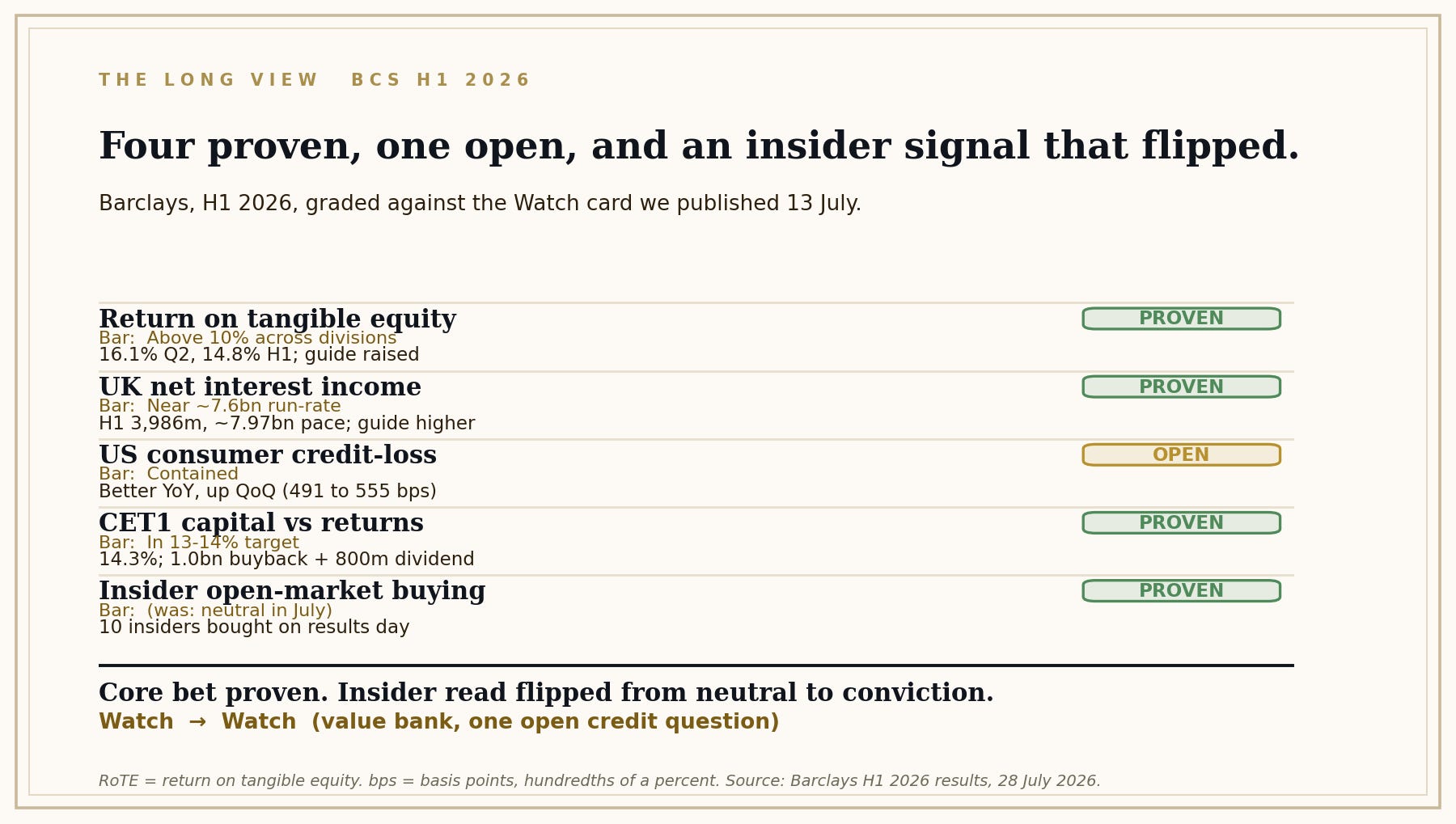
We published a Watch card on Barclays on the thirteenth of July, and named the hidden assumption its price rested on: that Barclays can sustain a return on tangible equity above 10 percent across all three of its major arms, its UK retail bank, its investment bank, and its US consumer business, while growing income toward its targets.
That phrase, return on tangible equity, is the single most important number for a bank, so let us define it plainly. Return on tangible equity, or RoTE, measures how much profit a bank generates for every dollar of hard shareholder equity it holds, stripping out intangible items like goodwill. It is the banking world’s version of asking how good a return the business earns on the real money invested in it. A RoTE of 10 percent is the rough line between a bank that is worth its equity and one that is quietly destroying value. Above it, the bank earns more than its cost of capital. Below it, ownership is a slow leak. Barclays’ whole story, and its price, rested on holding above that line everywhere, not just in the strong divisions.
We classified it Watch. Here is the grade.
Test 1: Did returns hold above the line
Published bar: return on tangible equity sustained above 10 percent across the divisions, with group income growing toward guidance.
The numbers: group RoTE came in at 16.1 percent for the second quarter, and 14.8 percent for the first half. Management raised its full-year income guidance to roughly £31.5 billion. Proven, decisively. This is not 10 percent scraped by in one favorable division. It is mid-teens returns at the group level, well clear of the line, with the income trajectory rising rather than fading. The core bet the price depended on came in strong.
Test 2: Is the UK engine running
Published bar: UK net interest income holding near its roughly £7.6 billion annual run-rate.
Net interest income, the next term to define, is the difference between the interest a bank earns on its loans and the interest it pays on deposits and other funding. For a retail bank it is the core profit engine, the spread that turns deposits into earnings. When it grows, the bank’s foundation is solid; when it shrinks, everything else has to work harder to compensate.
The number: Barclays’ UK net interest income was £3,986 million for the first half, an annualized pace near £7.97 billion, with full-year guidance of £8.1 to £8.3 billion. Proven. The engine is not just running, it is running slightly ahead of the run-rate we flagged, and guidance points higher still.
Test 3: The one that did not fully clear
Published bar: the US consumer bank’s credit-loss trend staying contained.
One more definition, because it is the crux of this test. A credit-loss rate, sometimes called an impairment or loss rate, is the share of a lender’s loans it expects not to be repaid, expressed against the loan balance, often in basis points, where one basis point is one hundredth of a percent. It is the single clearest read on whether a lending book is healthy or deteriorating. Rising loss rates mean borrowers are struggling; falling ones mean the book is improving.
The numbers, and why they are mixed: the US consumer bank’s impairment charge for the first half was £713 million, essentially flat against £711 million a year earlier. The loss rate ran at 555 basis points, an improvement from 562 a year ago, but up from 491 basis points in the prior quarter. Thirty-day arrears, the share of borrowers a month behind, sat at 2.9 percent, a touch above the prior year. Inconclusive. Better than a year ago, worse than last quarter. This is the one place the story is not yet settled, and it is the exact risk the Firewall flagged in July: a US consumer credit-card book is directly exposed to American household stress, and the quarter-on-quarter tick upward is the thing to watch. Not a break. Not a clean pass. An open question.
Test 4: The capital cushion and the cash it returns
Published bar: the core capital ratio holding within its target range while funding the promised shareholder returns.
The final term: CET1, or common equity tier one, is the ratio of a bank’s highest-quality capital to its risk-weighted assets. It is the cushion regulators require to absorb losses, and the number that determines whether a bank can afford to pay dividends and buy back stock. A bank returning cash it cannot spare is asking for trouble; one doing it from a position of strength is compounding for shareholders.
The numbers: Barclays’ CET1 ratio was 14.3 percent at the end of June, comfortably inside its 13 to 14 percent target, and 14.0 percent after accounting for a £1 billion buyback. It announced that £1 billion share buyback plus an £800 million interim dividend. Proven. The bank is returning substantial capital from a position of real strength, not stretching to do it.
The twist: what the insiders did
Here is where this grade gets its edge. When we published the Firewall on Barclays in July, our insider read came back neutral. The only transactions we could find were routine, compensation-related disposals, nothing that signaled conviction. So we flagged insider activity as neutral, and said so.
Then Barclays reported on the twenty-eighth of July, and on that very day, ten named senior insiders bought shares in the open market, at £4.974 each. Not granted. Not vested. Bought, with their own money, on results day. Among them was the group chairman, Nigel Higgins. When ten insiders including the chairman put personal capital into the stock on the day results land, that is the kind of signal our neutral July read did not have, and honesty requires us to update it. The insider picture is no longer neutral. It flipped, and it flipped toward conviction.
The tally, and the state that holds
Four of the five checks came in proven: returns well above the line, the UK engine running ahead of pace, capital strong and cash flowing to shareholders, and insiders buying with conviction. The fifth, US consumer credit, is truly inconclusive, better on the year, softer on the quarter. Barclays remains Watch, an honest one, because the core bet is proven and the one open risk is real rather than cosmetic.
The value question a bank like this poses
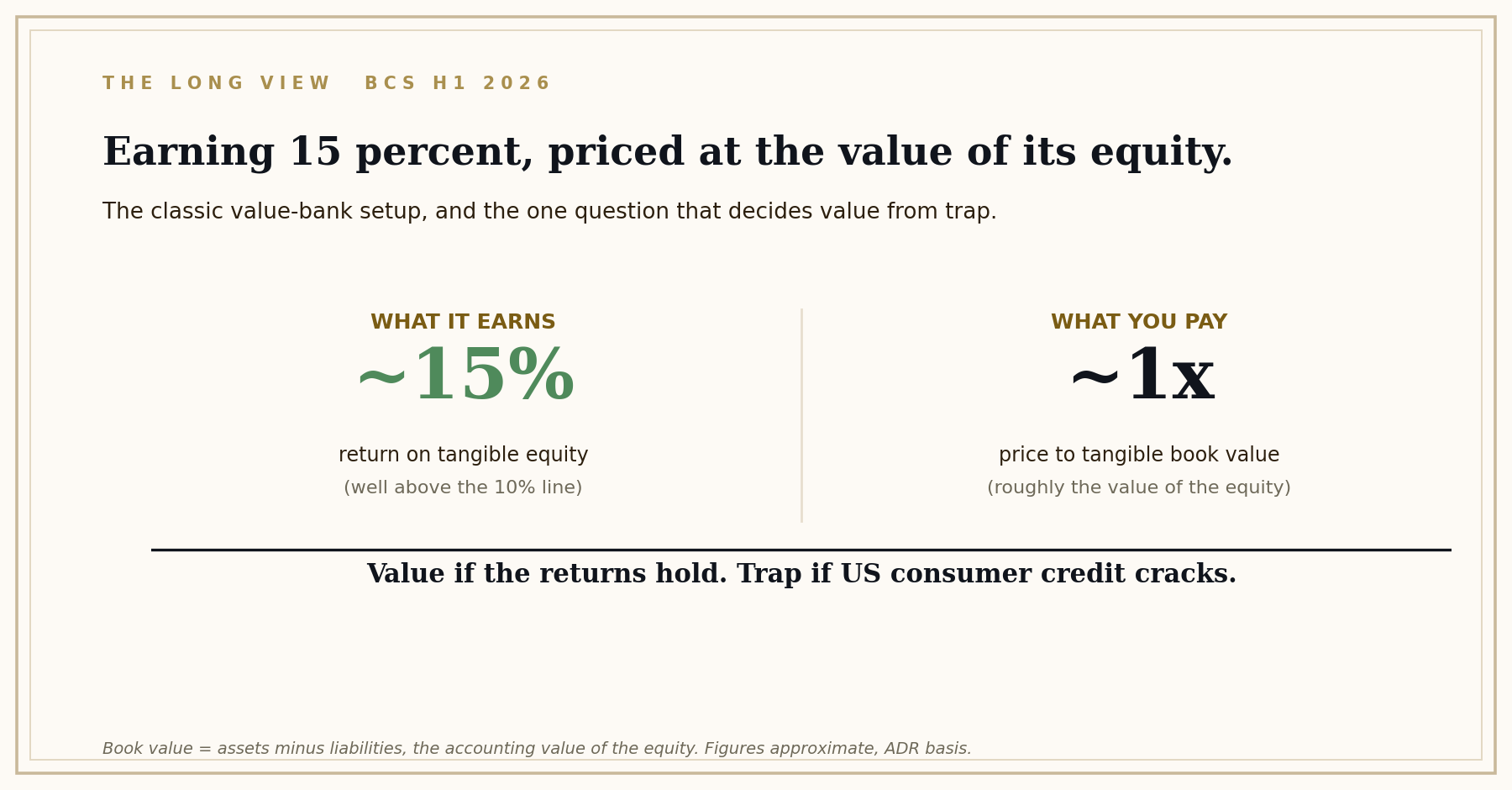
Now the part that makes Barclays interesting to a value investor, and it is a different question from anything we asked this week. Barclays trades at roughly the value of its own tangible equity, near one times tangible book value. Book value is what the company’s assets are worth on paper after subtracting what it owes; for a bank, trading at one times book means you are paying roughly the accounting value of the equity itself.
Put the two facts together. Here is a bank earning around 15 percent on its tangible equity, and you can buy that equity at approximately its book value. If those returns hold, you are buying a mid-teens return stream at the price of the underlying capital, which is the classic case for a value bank. That is a real draw, and it is why the stock has already risen more than 50 percent this year as the market began to notice.
But a value investor says the hard part out loud too. Banks trade cheap for reasons. Their earnings are cyclical, their loan books carry credit risk that surfaces exactly when times get hard, and a mid-teens return can compress quickly in a downturn. The US consumer credit trend we just flagged is precisely the kind of thing that turns a cheap bank into a value trap, a stock that looks inexpensive right up until the returns fall and the cheapness turns out to have been deserved. Barclays has the profile of value. Whether it is value or a trap depends on whether those returns hold, and the credit question is where that is decided.
What we watch next
The US consumer credit-loss rate, quarter by quarter, because it is the one number that would move Barclays from a proven Watch toward either a clearer value case or a warning. If it stabilizes, the value story strengthens. If it keeps climbing, the trap risk grows.
And the price against book value, because much of the easy re-rating has happened. The clearest value was available when the market was fearful and the stock traded well below book. Near book value, earning mid-teens returns, it is still reasonable, but it is no longer the obvious bargain it was, and the discipline is to know the difference.
We named the one thing in July: returns above the line, everywhere. Barclays proved it, added a capital return from strength, and saw its own insiders buy on results day, updating the neutral read we had reported plainly before the print. The one open question, US consumer credit, is the one that will decide whether a cheap bank stays a value or becomes a trap. That is the grade, against the bar we published, in a bank’s own language.
Run any company through the Stock Story Firewall, free, at firewall.readthelongview.com. Subscribers get the Watch cards, the Evidence tool, and the full Research Tracker, including every test we have published and how each one scored.
A bank earning 15 percent on its equity, priced near the value of that equity, is the kind of thing a value investor is built to notice. Whether it is a bargain or a trap is a question of whether the returns hold, and this quarter answered most of that question, and left one piece of it open.
Not investment advice. The subscriber decides.